








-
Ryan S. Clark
Close
Ryan S. Clark
ESPN NHL reporter
- Ryan S. Clark serves as an NHL reporter for ESPN.
-
Greg Wyshynski
Close
Greg Wyshynski
Senior NHL writer
- Greg Wyshynski is the senior NHL writer at ESPN.
-
Kristen Shilton
Close
Kristen Shilton
ESPN NHL reporter
- Kristen Shilton is a national NHL reporter for ESPN.
Multiple Authors
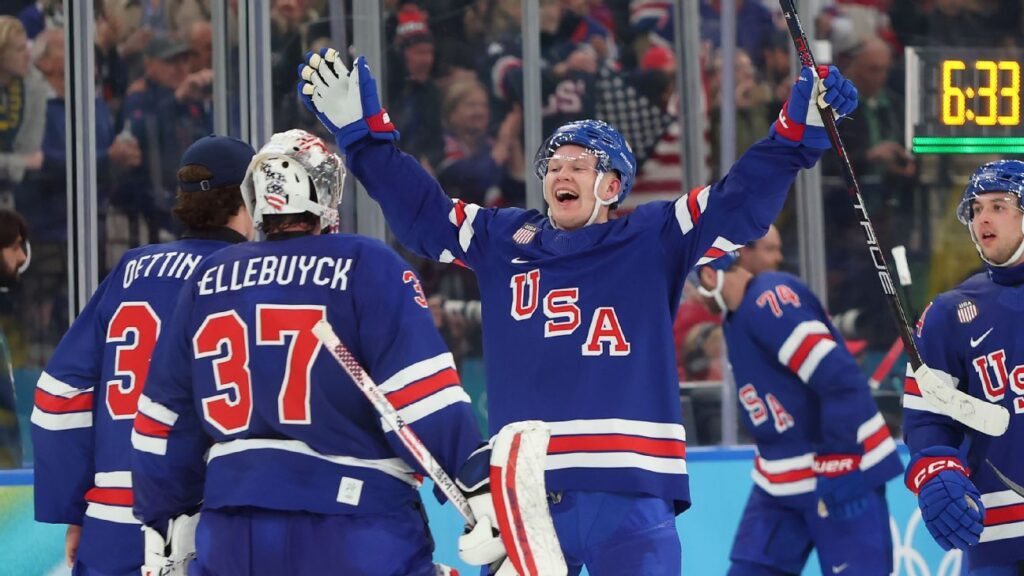
The 2026 Olympic men’s hockey tournament has reached its climax, culminating in a single decisive game.
The top-seeded Canadian team faces the No. 2 seed from the United States (8:10 a.m. ET) — with the winner securing Olympic bragging rights for the next four years.
Both teams feature a roster packed with NHL superstars, having won all their matches thus far—Canada narrowly defeated Finland 3-2 in the semifinal, while the U.S. decisively overcame Slovakia 6-2.
With the stakes high, we gathered ESPN hockey reporters and analysts Ryan S. Clark, Emily Kaplan, Arda Öcal, Kristen Shilton, and Greg Wyshynski to analyze the situation and share their final score predictions.
Key Player for Canada?
Ryan S. Clark, ESPN reporter: Jordan Binnington has faced considerable scrutiny over the past year, reflecting the issues surrounding Canadian goaltending. His steady performances are vital, particularly when Canada’s offense is slow to start. It’s now a matter of whether he can build upon his success thus far, along with what he showcased in the 4 Nations Face-Off against the U.S., in the gold medal match.
Emily Kaplan, ESPN reporter: Connor McDavid. He took the “C” when Sidney Crosby was unavailable for the semifinal against Finland. McDavid referred to it as merely “keeping the seat warm for Sid.” The Oilers superstar, now at his athletic peak, is the world’s best player, capable of unmatched speed and skill.
After consecutive Stanley Cup Final losses, McDavid’s determination is at an all-time high. He penned a heartfelt manifesto in the Players Tribune titled “Dear Canada,” revealing his intense desire to secure a gold medal for his nation. This moment is pivotal for his legacy.
Arda Öcal, ESPN broadcaster: Macklin Celebrini has made a remarkable impression in this tournament. Conversations about his selection over Connor Bedard are now a thing of the past. At just 19 years old, Celebrini is excelling (second in tournament scoring with 10 points, following McDavid). He’s poised to lead Team Canada in the future and could emerge as a captain when McDavid retires in the next decade. It’s hard to imagine a better start to his Olympic career as the youngest player in the tournament. A strong performance in the final will solidify his position as Canada’s next standout star.
Kristen Shilton, ESPN reporter: Jordan Binnington must excel in goal for Canada, especially if Connor Hellebuyck is at his best on the opposing team. Binnington has proven himself reliable repeatedly in this tournament, despite allowing a few questionable goals. His reputation for performing under pressure is well-established, making him a crucial asset for Canada against a U.S. team that showcased its offensive dominance against Slovakia.
Greg Wyshynski, ESPN reporter: Nathan MacKinnon may not boast the impressive point totals of McDavid or Celebrini, but these high-pressure moments are when he shines brightest. Recall his pivotal plays during the Avs’ 2022 Stanley Cup-winning game. Last year, he scored the first goal in the 4 Nations Face-Off championship match.
Without MacKinnon’s game-changing contributions, Canada may not have even reached this final, as he drew a crucial penalty against Finland that led to a power play goal. An explosive skater with a knack for finding the net, few players in hockey are as formidable as MacKinnon when focused on victory.
Key Player for the United States?
Clark: Quinn Hughes. He has accrued the most minutes among U.S. players. His skill in controlling the puck and facilitating plays in the offense is equally important as his defensive prowess during extensive shifts. This versatility is essential when facing the tournament’s most prolific offensive team.
Kaplan: Connor Hellebuyck was last season’s top goaltender in the NHL, capturing both the Vezina and Hart Trophy. yet, his playoff performance was less impressive, leading to a rocky start in those games. The U.S. management chose to start him based on his exceptional track record, and Hellebuyck has validated that decision thus far. His confidence shows; he is clearly back in peak form after recovering from his recent knee procedure. He stated, “Is there a number greater than 100%?” when asked about his current condition.
With just five goals allowed in 90 shots faced, Hellebuyck boasts the best save percentage (.945) in the tournament. Now is his chance to shine on the biggest stage.
Öcal: Taking a different viewpoint, The Tkachuk brothers are the heart of this squad. On the ice, Matthew has tallied six assists while Brady has netted three goals and accumulated five points. Beyond their scoring, they are vocal leaders who fervently represent the U.S. and are determined to secure their first gold medal since 1980.
During that legendary tournament, Herb Brooks delivered a famous speech; Mike Eruzione noted that the Kurt Russell film was largely an amalgamation of Brooks’ addresses throughout the competition. One could imagine that the 2026 version of this motivational speech would be delivered by Brady and Matthew, which would undoubtedly be immortalized in a future documentary.
Shilton: It’s time for U.S. captain Auston Matthews to make a significant impact. While the Americans have demonstrated scoring depth, the recent standout performances from Jack Hughes and Brady Tkachuk bring attention to Matthews’ lack of tangible contributions. It’s not for lack of effort—he’s been involved and has hit a few posts—but this crucial game needs to reflect Matthews’ presence.
Having faced criticism for his past playoff performances with the Maple Leafs, Matthews also hasn’t faced intense scrutiny regarding his captaincy during these Games. If he wants to prove he’s the right captain—mirroring former teammate Mitch Marner’s tournament-defining goal—this is his only chance to create magic.
Wyshynski: Auston Matthews must seize this golden opportunity. The Americans are entering the gold medal game with two high-scoring lines, housing the Tkachuks with Jack Eichel and Jack Hughes alongside Dylan Larkin and Tage Thompson. To match Canada’s overwhelming offensive depth, Matthews’ line must deliver. He contributed a secondary assist against Sweden but had no points in the dominant win against Slovakia.
Critics have deemed Matthews unworthy of the Team USA captaincy due to his performance in high-pressure situations; despite setting up two goals in the 4 Nations final, all that remains in memory are his missed scoring opportunities and defensive blunders. Now is the time for Matthews to silence his detractors by making a significant play in pursuit of a gold medal.
1:15
Brady Tkachuk on facing Canada: ‘There’s hatred there’
Emily Kaplan joins “SportsCenter” to discuss the significance of Sunday’s gold medal match against Canada for the U.S. men’s hockey team.
Biggest X Factor?
Clark: Control and the ability to capitalize on decisive sequences will be vital. Canada has exhibited control to engineer comebacks effectively, while the U.S. has employed control to exhaust opponents. yet, neither has encountered a team capable of wielding control against them until this matchup.
Kaplan: The United States’ penalty kill is crucial. It has been short-handed for 26:57 minutes during these Olympics, successfully killing off all 15 penalties faced. The U.S. prioritized selecting players suited for every situation rather than opting for the top stars—this strategy is particularly evident on the PK.
yet, facing Canada’s assembly of elite talent is an entirely new challenge. Previously, the most formidable team the U.S. faced was Germany, which included top-tier players such as Leon Draisaitl and Tim Stutzle. Canada, on the other hand, fields an unrelenting group of superstars, with a power play that has succeeded 7 out of 16 times in this tournament.
“Their power play is remarkably effective,” noted Vincent Trocheck, a crucial member of the U.S. penalty kill. “We’ll review the footage and aim to replicate our current approach.”
Öcal: Early game momentum is key. Team Canada has only held the lead for just over six minutes during elimination rounds, a risky strategy facing Team USA, who has won three matches by margins of four or more goals. If the U.S. scores early, it could lead to a situation where “they scored first and never looked back.” The start of the first period will be critical. The phrase “set the tone” resonates strongly in hockey, and it applies here.
Shilton: Can the Canadians actually maintain a lead? although their impressive roster, Canada seems to have been fighting from behind for too much of this tournament. While their comeback efforts are commendable, what will Canada do differently to sustain a lead for more than 35.2 seconds?
The U.S. has proven it can capitalize against strong teams, while Canada hasn’t replicated that consistency. Their roster is undoubtedly skilled, dynamic, and talented, but they need to prove they can convert advantages into sustained leads. Will they move from the “Cardiac Canadians” to becoming the team that gets hunted?
Wyshynski: Has Team USA learned from previous errors? This is not a repeat of 1980 against the Russians or 2010 and 2014 against Canada. This 2026 Olympics is the culmination of USA Hockey’s long-term development strategy, marking a time when their talent pool genuinely matches Canada’s.
America heads into this game on equal footing with Canada. for that reason, it’s crucial they play like equals. Utilize the depth of their scoring game. Let the strongest group of defensemen in the tournament dominate all three zones.
The U.S. attempted to play conservatively while leading against Sweden in the quarterfinals, a strategy that backfired just as it did for Finland in their semifinal against Canada. It’s time to play confidently. The U.S. must stop viewing Canada as the dominant force in hockey. To quote a classic phrase from a memorable Olympic gold victory: “This is your moment. Their time is over. Now get out there and seize it.”
0:49
Brady Tkachuk: Gold medal shot ‘everything we’ve dreamed of’
Emily Kaplan speaks with Brady Tkachuk and Vincent Trocheck in anticipation of the U.S. men’s hockey gold medal game against Canada.
Predictions: Who Wins?
Clark: Canada takes it 3-2 in overtime.
Kaplan: U.S. wins 3-2 in overtime with Jack Eichel scoring the golden goal.
Öcal: My instinct says 4-2 Canada, headlined by a Brad Marchand empty-netter. yet, if this were a scripted movie trilogy, we are in the “Empire Strikes Back” chapter. A U.S. victory would generate immense interest in hockey in North America similar to the excitement that followed the 1980 Miracle team.
Interest in Canada would remain high—they’d be even more resentful over their loss and would have to wait to stew until the next Olympics, while the World Cup of Hockey in 2028 could serve as consolation. Imagine the massive hype surrounding a Canada vs. Team USA gold medal match in 2030 if the U.S. triumphs on Sunday? It would be epic.
That said, I still predict a 4-2 Canada win with a Brad Marchand empty-netter.
Shilton: Canada wins 4-3 in overtime, with Macklin Celebrini scoring the game-winner—a definitive changing of the guard.
Wyshynski: U.S. emerges victorious 4-2, with Jack Hughes sealing the tournament’s fate with the game-winning goal, assisted by his brother Quinn. No more Tkachuks to contend with!