








The Chinese company is adapting to the demise of Moore’s Law, which guides chip production. It could complicate US chip dominance.
Source: www.wired.com

The Chinese company is adapting to the demise of Moore’s Law, which guides chip production. It could complicate US chip dominance.
Source: www.wired.com

The irony of writing a piece for Variety’s Don’t Forget About series about an actor playing President James Garfield is not lost on me. Often relegated to a footnote in U.S. history, Garfield was president barely six months before he died after being shot by Charles Guiteau in 1881.
In the Netflix limited series “Death by Lightning,” Michael Shannon rips the oft-overlooked president from the history books and brings him to life in fine fashion. Shannon, who has delivered unforgettable performances in films like “Nocturnal Animals,” “The Shape of Water,” “Take Shelter” and “Revolutionary Road,” plays Garfield with quiet dignity and strength. At a time when many are clamoring for more civility in politics, Shannon sees Garfield as “wish fulfillment in the form of television.”
“That’s what everybody wants, isn’t it? A decent man?” says Shannon. “I hear all this bellyaching about these criminals and insane people that are running everything. Everybody’s fantasizing about having a decent person to call the shots, so here you go.”
Shannon says that he is grateful that Garfield’s story is being told, as the post-Civil War, pre-World War I period of American history is often overlooked. He also wants to see Garfield recognized for his accomplishments, like working to establish what would become the Dept. of Education.
“He got the ball rolling on that,” Shannon says. “He believed that to have a free and equal society, everyone had to have an education. It’s a beautiful thing. Now, unfortunately, we’re seeing it be dismantled.”
While he admits that “Death by Lightning” is a not a completely unbiased portrayal of Garfield, the actor believes that there is much to learn from the late president’s story, including the ideals of service and self-sacrifice.
“He started at the bottom. It’s not BS. It’s not some story somebody made up. It’s what happened,” he says. “When he met Crete, his wife, she was a student at a school where he was the janitor. A guy like that, I think he understands what’s important.”
“Death by Lightning” largely focuses on the struggles Garfield faced during his presidency in trying to overcome the influence of Senator Roscoe Conkling. It was a period marked by corruption, influence peddling and partisan infighting.
The similarities to today’s political environment are clear to Shannon.
“One of my favorite songs has a line in it that goes ‘Our president’s crazy. Did you hear what he said?’ The song was recorded in the early ’80s and it’s basically been true since before the song was recorded, when the song was recorded and now many years after the song was recorded,” he says. “This idea that the president is crazy — there are people who thought Garfield was crazy. It’s easy to forget that.”
Shannon is surrounded by a murderer’s row of talent in “Death by Lightning,” including Betty Gilpin, Nick Offerman and Shea Whigham.
But it’s the parallelism the show establishes between Garfield and Guiteau (played expertly by Matthew Macfadyen) that drives the narrative forward. While Garfield’s story — Civil War veteran, farmer, reluctant president — is the stuff of the American Dream, Guiteau’s penchant for delusion and self-aggrandizement is clearly an American Nightmare.
“That’s a fork in the road that a lot of people find themselves at,” Shannon says. “That’s where the self-sacrifice, dedication, the idea of service — I think people wind up heading toward the nightmare because they think too much about themselves and their own gratification. That can’t help but lead to a nightmare.”
Source: variety.com

CrowdStrike, working with Google and Shadowserver, a nonprofit organization that scans and monitors the internet for cyberattacks, took down a botnet that cybercriminals used to push malware and steal passwords from open-source software developers.
The takedown operation had the goal of disrupting the activities of the cybercriminals behind the so-called Glassworm botnet, who have been targeting the broader open source software supply chain for two years, according to CrowdStrike.
In recent months, several hacking groups have targeted developers and open source projects to push malicious software to companies and organizations who in turn use that software. These attacks can be effective because they exploit the trust that companies put into code that’s hosted on platforms like GitHub, and the workers behind that code.
“Adversaries are no longer just targeting products, they’re targeting the developers who build them,” CrowdStrike wrote in its report about the takedown operation. “Developers represent uniquely high-value targets: compromising a single developer’s workstation can cascade into a supply-chain compromise that impacts thousands of downstream organizations and users.”
The Glassworm hackers used several strategies to push out their malicious code. This included publishing malicious extensions on a marketplace used by developers; by malvertising — where hackers pay for sponsored search results that trick victims into downloading malware; and using credentials stolen in previous hacks, which allowed the hijacking of developer accounts and the planting of malware in their code.
In the end, the hackers were able to poison — as CrowdStrike put it — more than 300 GitHub code repositories.
Do you have more information about the Glassworm hacking group? Or about other supply chain attacks? From a non-work device, you can contact Lorenzo Franceschi-Bicchierai securely on Signal at +1 917 257 1382, or via Telegram, Keybase and Wire @lorenzofb, or by email.
CrowdStrike said it was able to takedown four command-and-control channels used by the Glassworm hackers, which cut the hackers’ access to infected computers and stopped them from delivering more malware.
The command-and-control servers relied on the Solana blockchain, the BitTorrent peer-to-peer network, Google Calendar, and virtual private servers, according to CrowdStrike.
It’s not clear on what legal or technical authority CrowdStrike and others operated under to takedown the operation. A spokesperson for CrowdStrike did not immediately comment.
Last week, hackers compromised several open source projects that pushed out malicious updates in a different hacking campaign that was called “Mini Shai-Hulud.” An OpenAI developer was compromised by this group of hackers. In another supply chain attack in March, a suspected North Korean hacker hijacked the popular open source software development tool Axios, which is used by millions of developers.
When you purchase through links in our articles, we may earn a small commission. This doesn’t affect our editorial independence.
Source: techcrunch.com
There are tons of computer speakers on the market, and many of the ones I tested are perfectly fine, but don’t deserve a spot above for one reason or another.
Photograph: Simon Hill
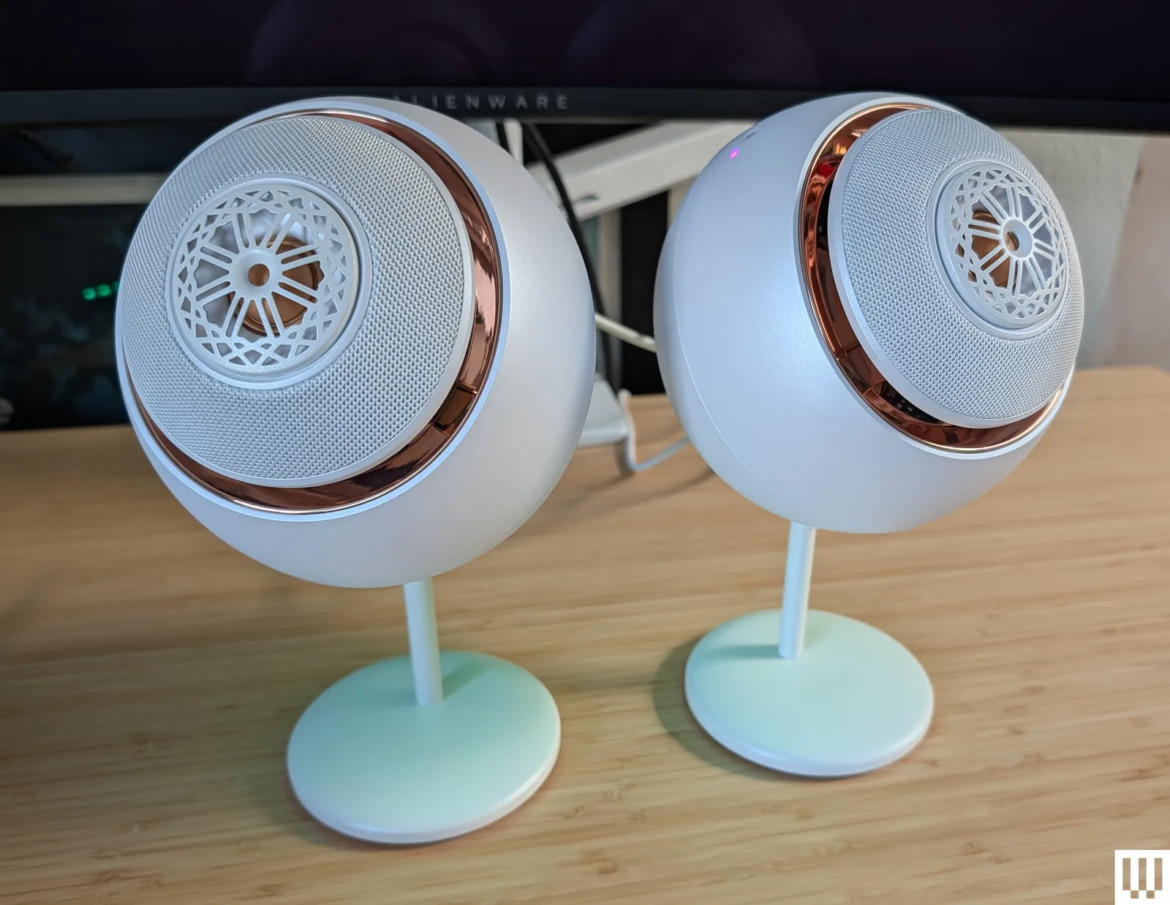
Creative Pebble Nova for $240: These eye-catching orb-shaped speakers with RGB rings around the base are a statement piece for your desk. They are big, angled at 45 degrees, and you have the choice of a flat base or elevated stands. They light up, produce a pleasant sound that’s rich across the board and with real depth, and can, frankly, get far too loud for your desktop. I was also impressed by the virtual surround sound for gaming. Don’t make the mistake of thinking the Creative App is superfluous, because it’s packed with options, from an equalizer to dialogue enhancement to RGB lighting controls. While I love the stand, it made them too tall for my desk because of my dual monitors. I also found the touch controls a bit finicky, and I advise switching off the power saving mode.
Photograph: Simon Hill
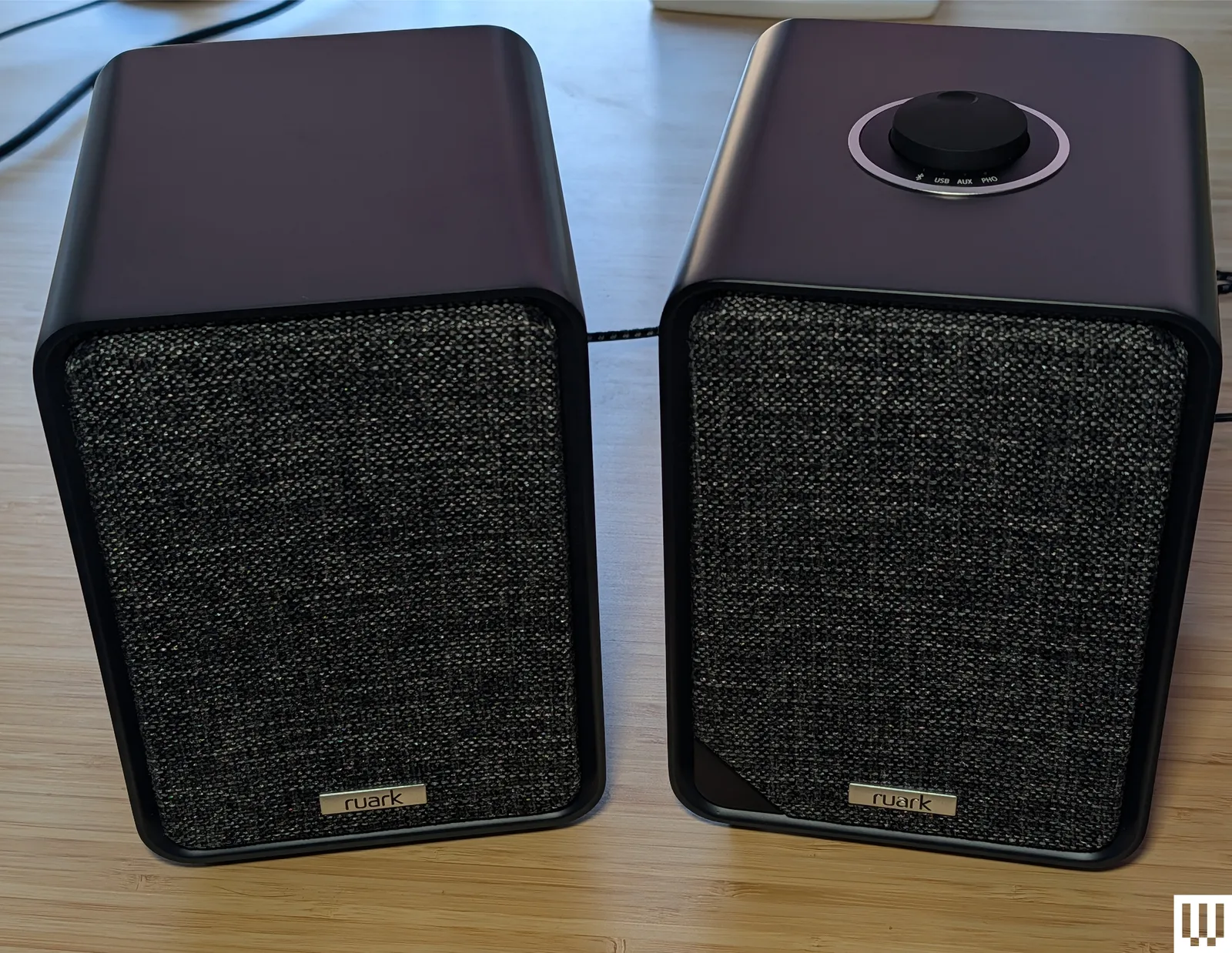
Ruark MR1 MK3 for $599: Perfect for a retro vibe, the styling includes a fabric front, and black finish with a dial on top. With a fluid and expansive soundstage, music sounds great on these speakers, and even without a subwoofer, there’s a decent rumble of bass. I found Ruark’s speakers equally pleasing for watching movies and video calls, as voice clarity is excellent, though I experienced some slight distortion with deep voices during meetings. They are also quite large, maybe too large for some desks.
Photograph: Simon Hill
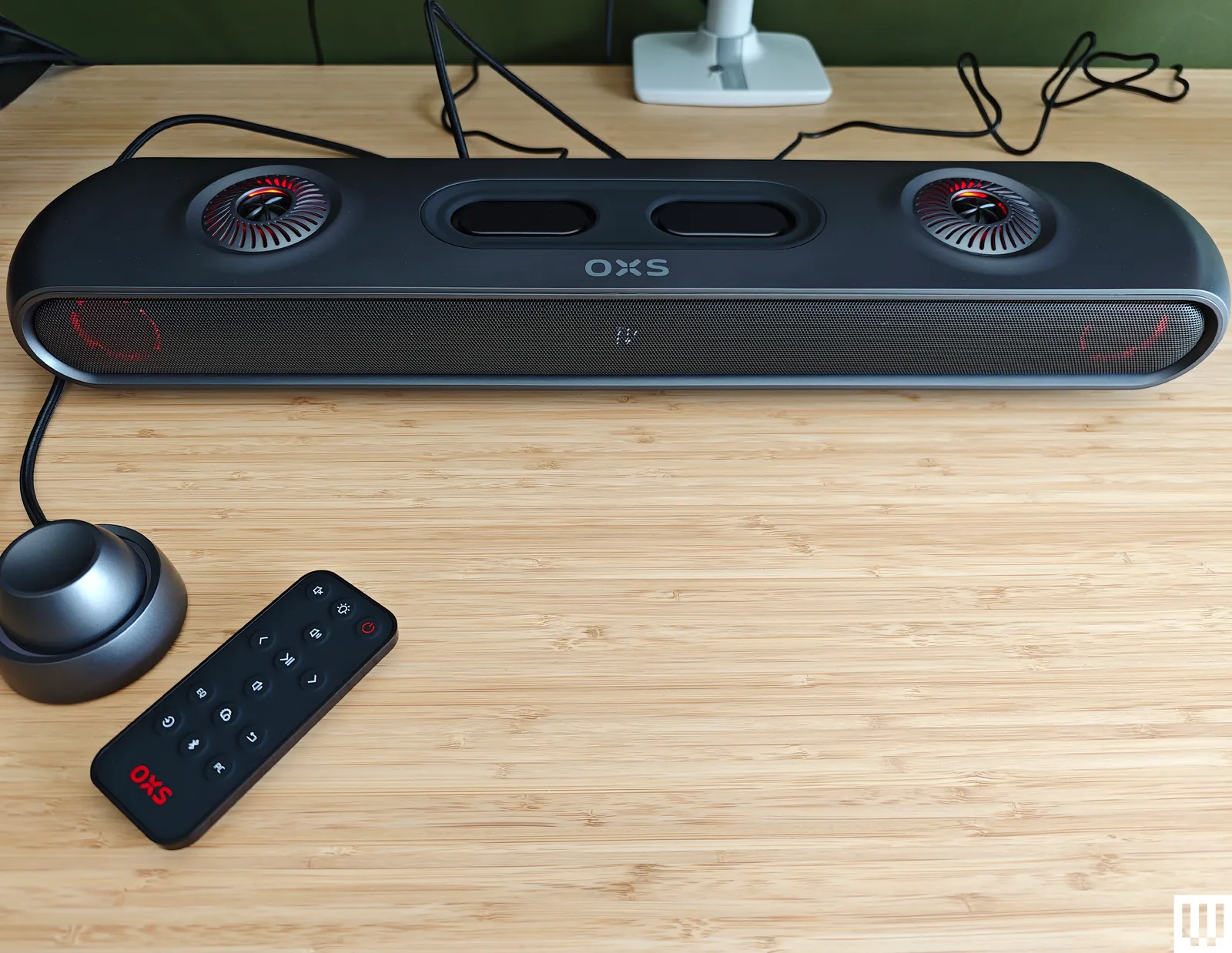
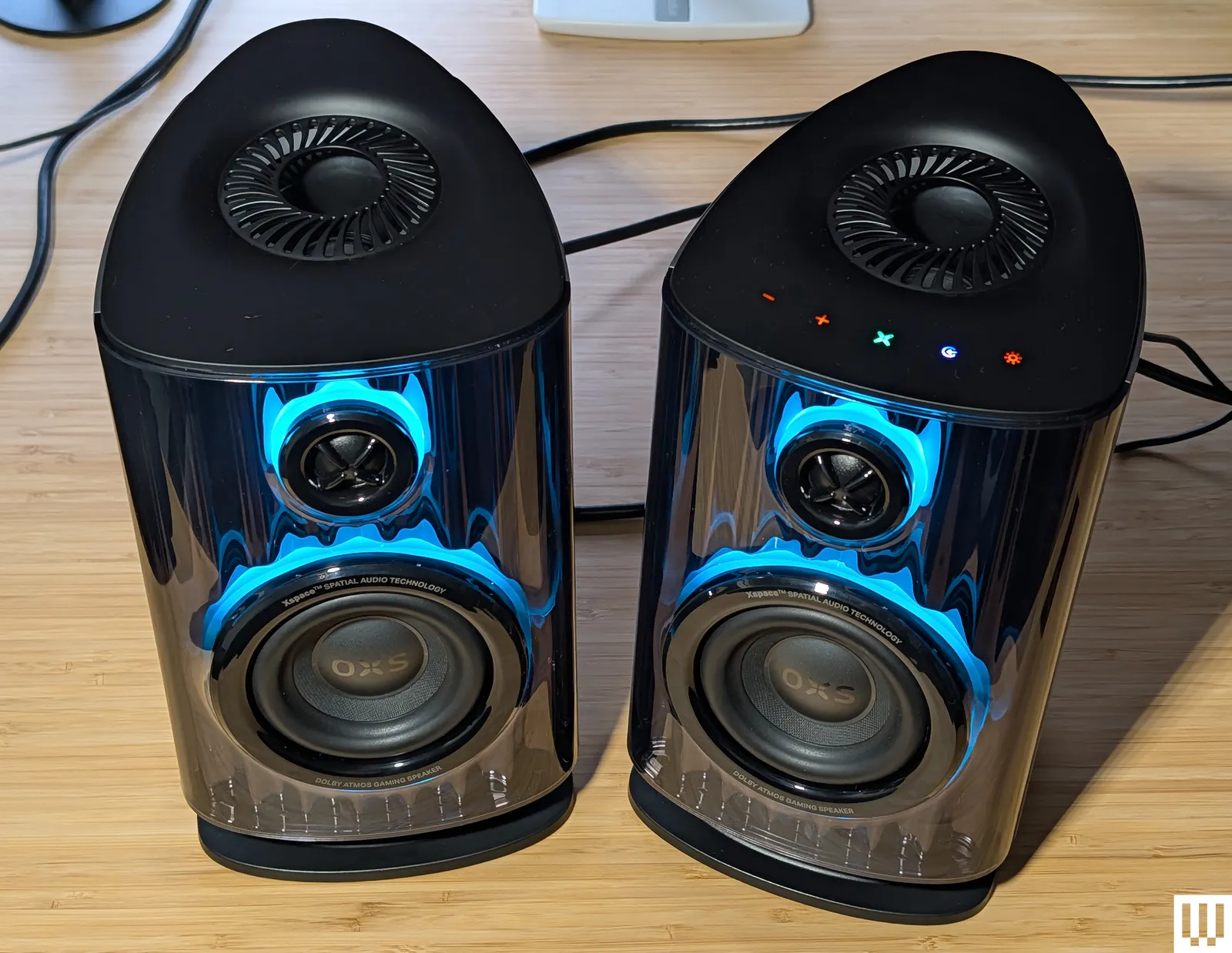
OXS Thunder Pro for $600: With a compact design, sci-fi styling that includes RGB lighting, and no separate subwoofer, I was unsure what to expect from this soundbar. The Thunder Pro is 24 inches long and just 3 inches tall, so slotted into place perfectly under my monitor. It comes with a wired control dial, a remote control, and extra feet in the box to angle it. I was immediately impressed when the bass of Dead Prez’s “Hip-Hop” kicked in, bouncing the passive radiators up and down. The sound is expansive, the bass is far better than it has any right to be without a large subwoofer, and the highs are surprisingly crisp. This soundbar is Dolby Atmos-certified and has three distinct gaming modes. The first-person shooter mode offered excellent spatial sound, allowing me to hear the footsteps and grunts of a cloaked Elite in Halo Infinite just in time to avoid being impaled. Connectivity is comprehensive with USB-A and USB-C, 3.5-mm aux, Bluetooth 5.0, two HDMI ports (one eARC), a mic-in port, and a headphone jack. All that’s missing is the option to hook up a subwoofer. The wired control unit lights up, acts as a volume dial and power button, and has EQ and mode buttons on the back. While the OXS Thunder Pro impressed, you will get better sound, especially for music, if you buy separate speakers and a subwoofer.
Razer Nommo V2 Pro for $450: Stick to one brand for all your gaming gear, and it’s easier to achieve harmony. Plus, you only need one app to configure everything. If Razer is your jam, the Nommo V2 Pro is a 2.1 system with tempting bells and whistles. These stylish cylindrical speakers fire light out the back and tilt up towards your ears. The chunky subwoofer is wireless, which could be handy if you prefer to keep the space under your desk free. The wireless control puck acts as a volume dial, and you can press it to mute, play, or skip. You can expect booming bass and rich mids, but there’s a little crispness lacking in the highs, particularly when you crank the volume up. The sound profile is well-suited to action movies and games, with a deep bass rumble that you feel in the pit of your stomach. Connectivity is limited to USB or Bluetooth 5.3. I had some setup issues with the wireless control puck, but after a few attempts, the new firmware was installed successfully. I still found it a bit flaky and didn’t like having to hold it down to turn the speakers on. (They switch off automatically unless you deactivate the power-saving setting.) While Razer Chroma RGB now supports more than 300 games, offers various effects, and an ambient awareness mode that reacts to your screen, there are only two lighting zones (one for each speaker). Unfortunately, the Razer Synapse software is the only way to get at some settings, and it feels bloated and sometimes hogs system resources.
Logitech G560 Lightsync for $250: everyone who prefer Logitech gear should consider the G560 Lightsync. This 2.1 system comprises a huge subwoofer and two speakers with an attractive curved loop design. The speakers project RGB lighting onto the wall behind them. Sound-wise, the bass is dominant and the soundstage lacks definition, but you can play around with the equalizer or use the presets Logitech provides. For movies and gaming, the G560 does better, with DTS:X Ultra virtual surround sound to emulate larger systems. There’s a good thump of bass for explosions, and they provide a decent positional sense in games. These speakers connect via USB, but there’s also a 3.5-mm aux port and support for Bluetooth 4.1. Sadly, for lighting fans, you only get four zones of LEDs here, but there are lots of presets and colors to choose from, and you can have them react to the onscreen action. While these speakers don’t grab me, with the bass bossing the show, they are decent value, particularly as the price has dropped significantly since they were first released.
SteelSeries Arena 7 for $299: The SteelSeries Arena 7 boasts great sound and real versatility. This 2.1 system is the sweet spot in the SteelSeries Arena lineup, as it adds a chunky subwoofer and RGB lighting over the Arena 3, but is still relatively affordable. Simply plug in the USB and attach the pear-shaped speakers to the subwoofer. The adjustable speakers look interesting, with RGB lighting around the base and back, and a mode button and volume dial on the right speaker (headphone port behind it). This system produces a soundstage with clarity and precision, but can sound too bassy and flat, though you can tweak it in the SteelSeries GG software. The spatial sound for games is immersive and accurate enough to help you pinpoint footsteps or the whomp of an approaching helicopter. With USB, Bluetooth 4.2, optical in and out, and 3.5-mm aux, your connectivity bases are covered. You can also sync the Prism RGB lighting with the rest of your setup, have it react to music, or just pick a color. On the downside, the speakers are quite tall, and the subwoofer is bulky and sometimes overpowers the sound.
Photograph: Simon Hill
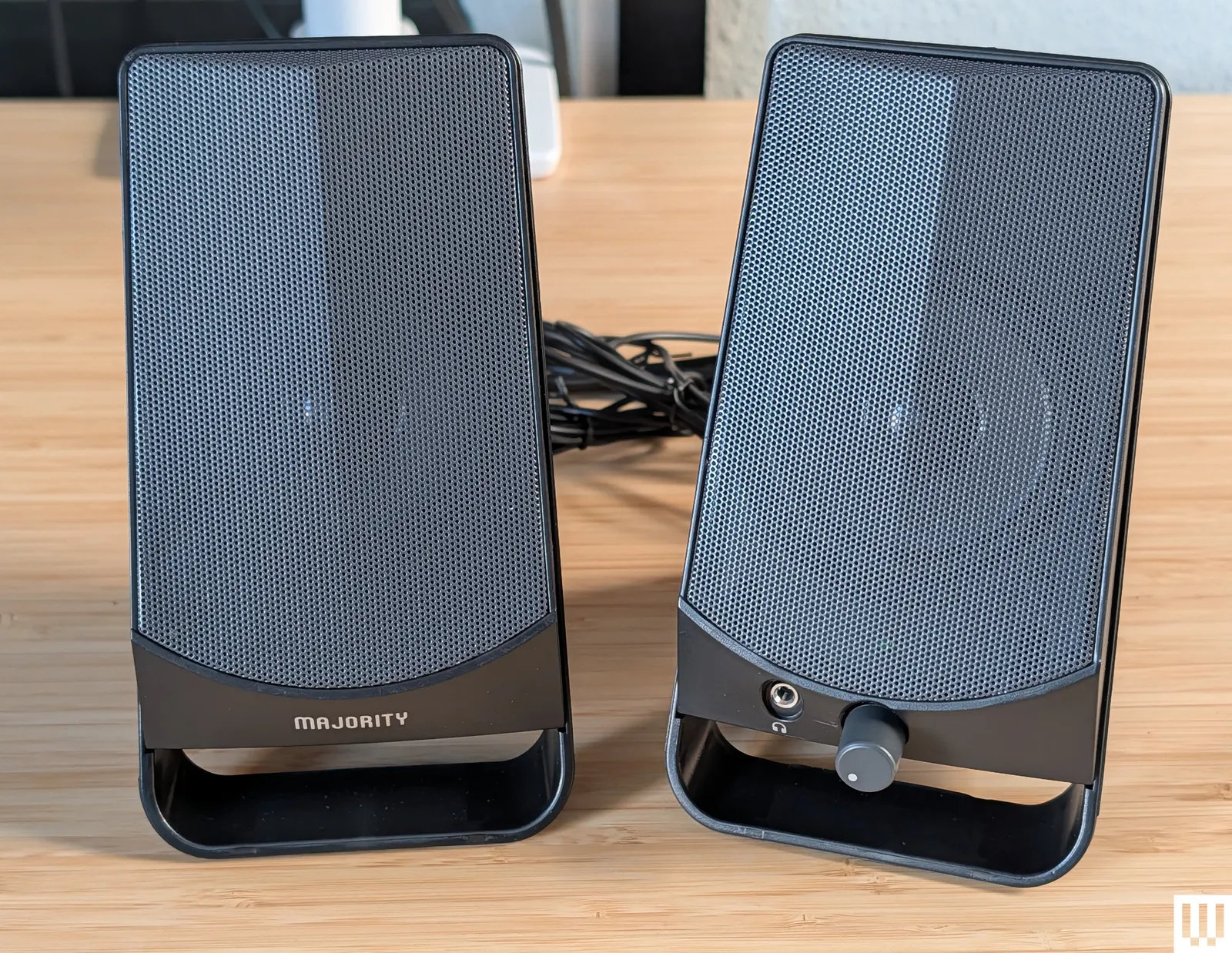
Majority DX10 Desktop Speakers for £13: They lack bass and general clarity, but these USB-powered speakers are the cheapest I’ve tried. These 10-watt, 2.5-inch, full-range speakers are angled up toward your ears and have a simple power and volume dial. There’s also a 3.5 mm headphone port. Only available in the UK, they could be enough if your budget is very tight.
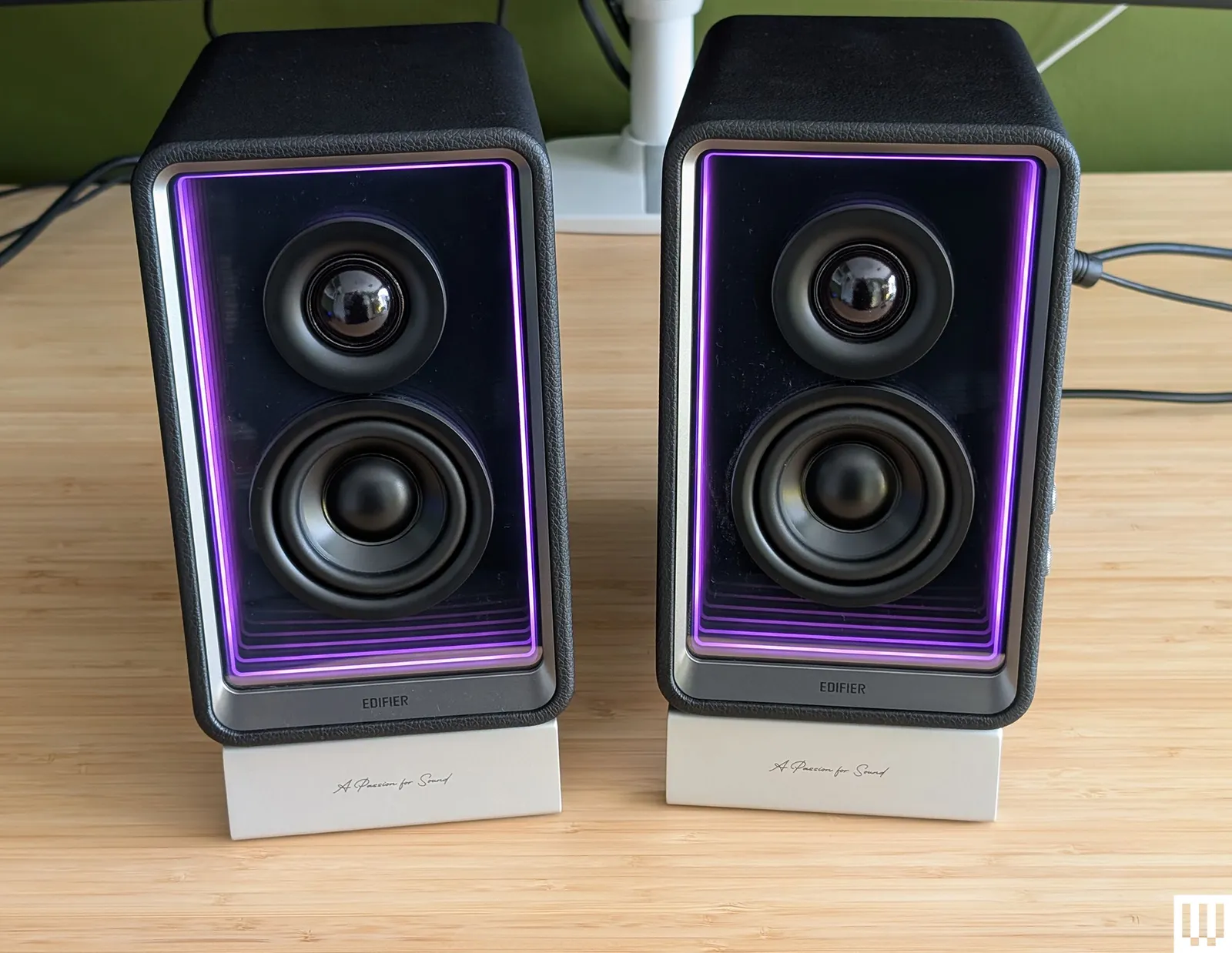
Edifier G2000 Pro for $250: A spruced-up version of the G2000 above, the Pro is an upgrade to 64-watt power, 3-inch full-range drivers, and virtual 7.1 surround sound. Edifier also made these speakers translucent and added garish RGB lighting effects courtesy of LED strips in each speaker. They do sound a bit better, though still lacking in bass, and some folks will love the sci-fi light show, but there isn’t enough extra to justify the significant jump in price.
Photograph: Simon Hill
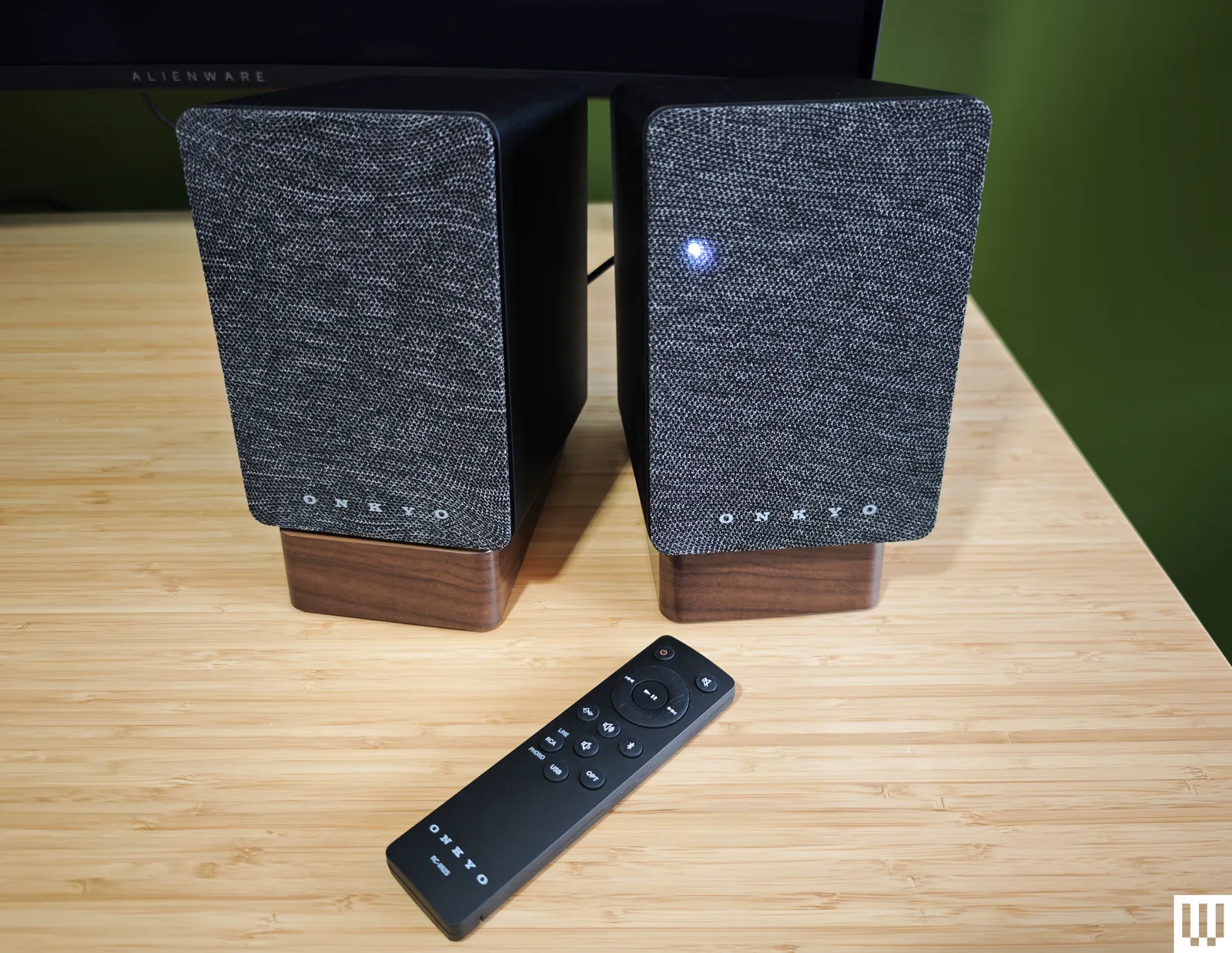
Onkyo Creator GX-10DB for $160: Capable of producing a warm and rich sound, Onkyo’s speakers are the perfect size for your desktop and come with angled stands (though they are plastic). The connectivity options are solid, with USB-C, optical, and stereo RCA inputs, and support for Bluetooth 5.3. These speakers get a little louder than our top pick, though you’ll need to pair a subwoofer if you’re into bass (there is a subwoofer-out port). Sadly, the volume knob on the back of the right speaker is tricky to reach, the slim remote control has a weird layout, and the source LED on the front is always on. But what I struggled with most was the automatic power-off (Onkyo says this “feature” is an eco-regulation in Europe) that turns off the speakers if they aren’t used for 15 minutes. If you have more space and crave more power, I also tested the Onkyo Creator Series GX-30ARC ($350), which goes far louder and adds a decent thump of bass.
Creative Pebble X Plus for $116: If our budget pick isn’t quite doing it for you, Creative’s Pebble X Plus adds a cube-shaped subwoofer under your desk. The larger speakers, with RGB lighting, are also more powerful, and the sub provides punchy bass. They sound reasonably good for the money. Connectivity is also beefed up compared to the V3 above, with headphone and microphone ports and Bluetooth 5.3, but all of this invariably comes at a higher cost.
Photograph: Simon Hill
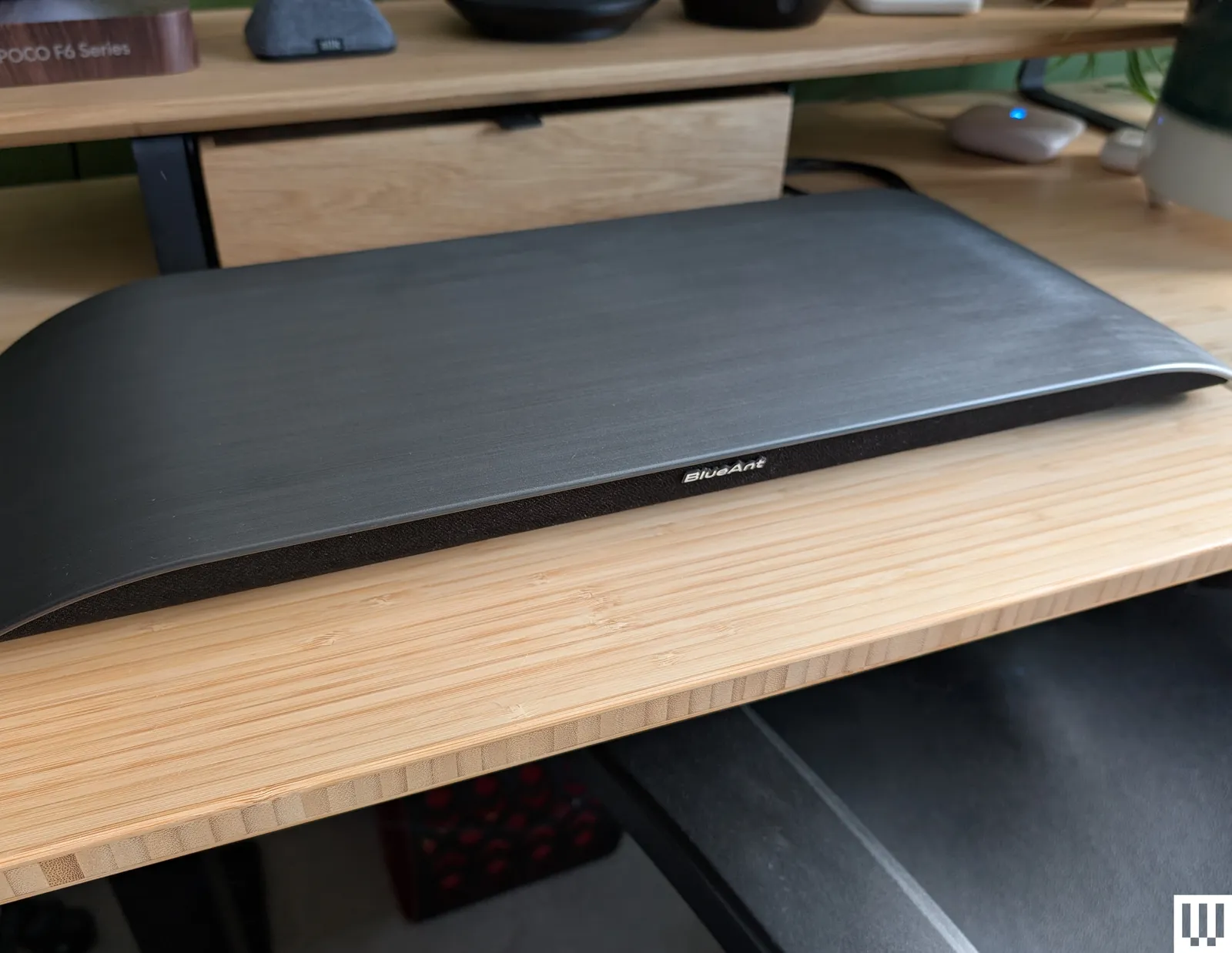
Soundblade by BlueAnt for $100: If there were an award for the most stylish soundbar, the curved Soundblade by BlueAnt would win. The Soundblade also delivers a surprisingly nuanced sound and a real punch of bass, courtesy of the built-in subwoofer. It is supposed to sit under your monitor but not serve as a stand or riser (BlueAnt told me not to put anything on top of it). Connectivity is good with USB-C, 3.5-mm aux, or Bluetooth 5.3, but the voice prompts are annoying. It sounded good for movies and games, but slightly muddy mids and restrained highs hampered the music. It comes with a handy wee remote.
Creative Sound Blaster GS5 for $95: While it doesn’t quite have the power of the OXS Thunder Lite above, this soundbar is cheaper and matches it on connectivity, even adding cool RGB lighting to the underside. It also has a remote and decent software for making EQ and lighting adjustments. The sound lacks clarity, and the bass is limited, but this is a solid, small soundbar for the money and works well as a desktop device.
Logitech Z407 for $114: A complete 2.1 system at this price is no mean feat. These speakers connect via USB, 3.5-mm aux, or Bluetooth, and there’s a wireless remote volume dial. Construction is cheap, and the sound lacks definition, but there’s a good thump of bass from the subwoofer, and mids and highs are reasonably crisp, provided you don’t turn the volume up too high. WIRED senior reviews editor Julian Chokkattu says he used a variation of the Logitech Z-series for nearly a decade and only recently donated them to someone else.
Razer Nommo V2 X for $150: The sound quality of Razer’s entry-level speakers is solid for music and good for movies and games (there’s THX Spatial support), though lacking in bass. These no-frills speakers look great but lack a subwoofer, RGB lighting, and a remote. They offer USB and Bluetooth connectivity and can be customized in Razer’s Synapse software.
These are the computer speakers that had deal-breaking flaws for me.
Photograph: Simon Hill
OXS Thunder Duo X for $550: These powerful speakers get plenty loud and come with a wireless neck speaker for surround sound, but they are very large (way too big for my desk) and, frankly, kinda garish when they light up. The sound quality is decent and I liked the surround sound for gaming, but the neck speaker is not comfortable, especially for long gaming sessions (much will depend on your office chair). You can also get these speakers with a subwoofer.
OXS Thunder Lite for $150: This compact soundbar lacks the bells and whistles of its bigger sibling above, but is far more affordable. It can get plenty loud, supports virtual surround sound, and comes with a small remote. Unfortunately, separation was poor, so it was tough to tell where sounds were coming from in games, and it is severely lacking in bass for a soundbar with thunder in its name. Connectivity includes USB-C, 3.5-mm aux, optical, or HDMI, and it supports Bluetooth 5.0.
Photograph: Simon Hill
Edifier QR65 for $370: Delivering classy looks with supercool lighting effects and a seriously big, powerful sound, these speakers are excellent for music, movies, or games. They also come with two angled stands to point them at your ears. They have USB, RCA, and Bluetooth 5.3 connectivity and USB ports for charging your gadgets. Controls are decent, with a physical button on the right speaker for power and cycling through modes. The problem is that they are huge and won’t fit on most desktops, including mine.
Creative Stage V2 for $150: This affordable soundbar offers excellent connectivity with HDMI ARC, optical, USB, 3.5-mm aux, and Bluetooth 5.0. But it’s not especially powerful, can sound muddy and flat, and has a short cable (no good for sit-stand desks). The subwoofer lends some decent bass, there’s a remote control, and I like the Clear Dialog option to sharpen voices, but you can do better.
Photograph: Simon Hill
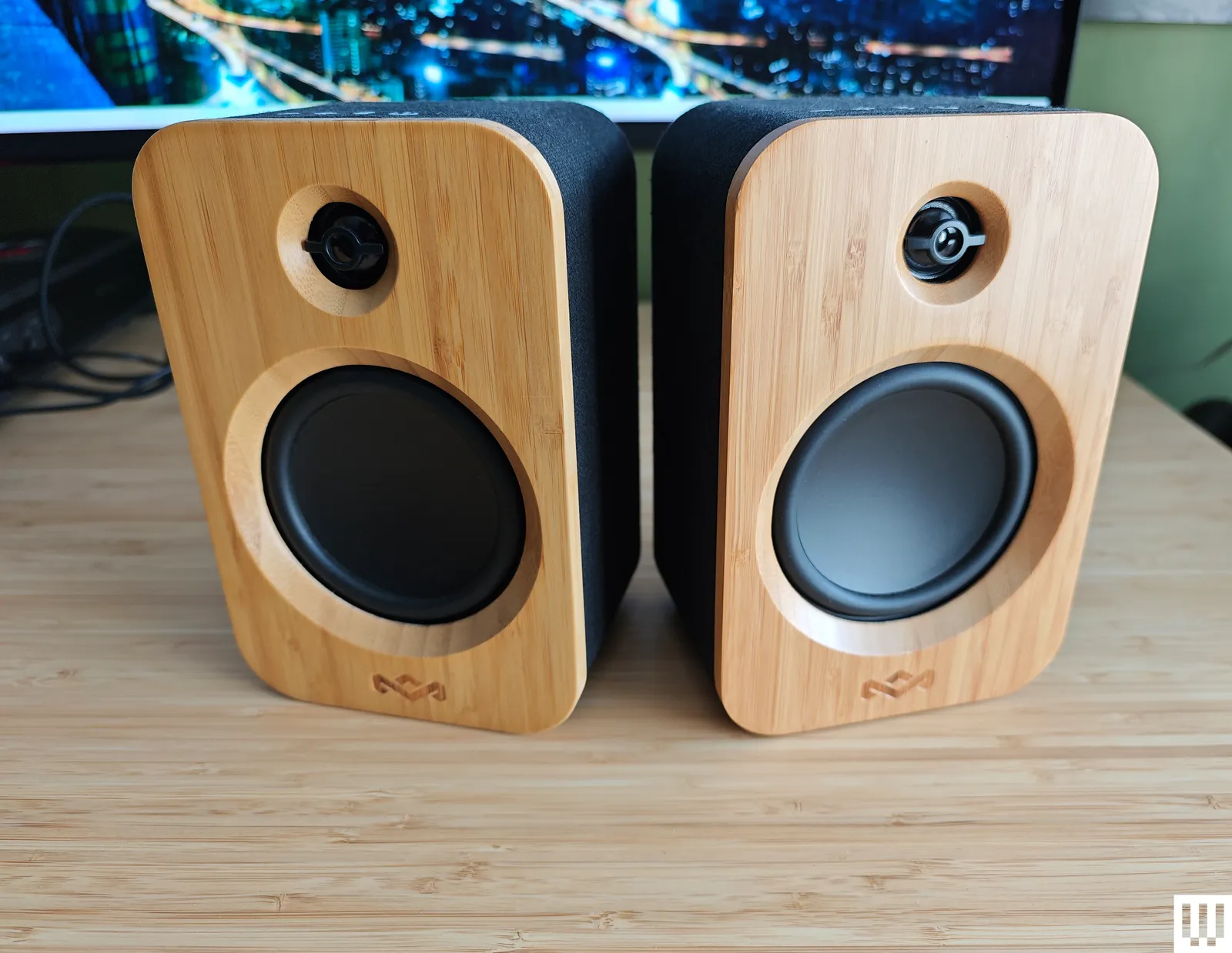
House of Marley Get Together Duo for $170: Sporting an attractive and eco-friendly blend of bamboo and fabric, the Get Together Duo from House of Marley is affordable. They connect via Bluetooth 5.0, RCA, or 3.5-mm aux. There’s no subwoofer, the midrange is dominant, and they are lacking something at the high end. The battery-powered right speaker can also double as a portable speaker, and you can use these as bookshelf speakers or pair them with House of Marley’s Stir It Up turntable ($160) (8/10, WIRED Review), but as computer speakers, they are just OK.
SteelSeries Arena 3 for $129: Sporting a nice pear-shaped design with tiltable speakers and subtle branding, the entry-level Arena 3 from SteelSeries can get loud. But they lack bass, lose detail in the highs, and sound a bit fuzzy for music. Even for SteelSeries fans, there isn’t much reason to choose these over some of our picks above. They don’t have lighting, USB, or any other extras.
Logitech Z906 5.1 Surround Sound Speaker System for $445: This 5.1 system is THX-certified and comes with a huge subwoofer, five speakers, and a central control unit. The design feels dated, maybe even a bit ugly, and you need to run cables around your room. The surround sound effect is solid, and you can even convert stereo with the 3D mode, but overall, it’s a bass-heavy system.
Are Computer Speakers Worth It?
Budget is a deciding factor for most folks, but even cheap desktop speakers offer far better sound than your monitor. Headphones are a great alternative, but not everyone wants to wear headphones all the time. You can spend as much as you like on audio gear, but I have focused on reasonably affordable desktop systems here, starting from as low as $35 and not exceeding $700.
What Should I Look for in Computer Speakers?
It depends. There’s plenty to weigh when shopping for a set of computer speakers, so it’s vital to start by deciding what’s most important to you. For example, I work and play on the same desktop PC, so I need speakers that perform well for video calls, long gaming sessions, listening to music, and watching movies. I also have a standing desk, and my monitor setup doesn’t leave much room, so I prefer compact all-rounders with long cables.
Sound quality: The top consideration for most folks, you want the best sound quality you can afford. A good set of speakers will offer a balance of clear vocals, rich treble, and rumbling bass. If you crave bass you feel in the pit of your stomach, a subwoofer is essential, though it might not be a good idea for folks who have downstairs neighbors. For accurate positional sound, you might want to look at a surround sound system with multiple speakers.
Design: Consider the finish. Your speakers will be on show, so you’ll want to pick something that fits your decor.
Brand: Gamers with devices from an existing brand might lean toward the same brand of speakers because they can be configured in the same software. This is particularly important with speakers that have built-in lights, so you can sync up your entire setup.
Extras: Some people will consider these superfluous, but if you want a remote control for kicking back or RGB lighting to bring a splash of color to your desk, these are extra perks on higher-end speakers. Snag speakers with a decent range of connectivity, and you can always repurpose them later. Most speakers come with all the cables you need, but it’s worth checking before you buy. I have listed what you will find in the box with all the computer speakers I recommend.
Where Should I Position My Desktop Speakers?
You ideally want the speakers to be angled slightly up (around 15 degrees) and pointed at your ears. Since you know the exact spot you’ll be in when listening, you can tweak the position of your speakers for the best results. Don’t just chuck them on the desk and leave it at that. Try moving and angling them until you find that sweet spot.
Do I Need Speaker Stands?
Speaker stands can maximize sound quality by helping to reduce vibrations from your desktop that can muddy the sound. Angled speaker stands are also a good way to direct the sound toward your ears. Some manufacturers, such as Edifier and Onkyo, include stands; IK Multimedia and Razer include adjustable bases or fold-out feet; Audioengine sells stands separately. You will also find a wide choice of third-party stands online.
What Size Speakers Should I Get?
If space is limited, a compact set of speakers will work best. The trade-off is power and volume, as small speakers generally don’t produce as big or high-quality a sound as large speakers. If you opt for a subwoofer, you will want a suitable space under your desk. For surround sound systems, you must run cables and find suitable spots for speakers behind you. If you have a wide monitor on a mount, a compact soundbar beneath it could be the best fit. Check the dimensions carefully and measure the space on your desk before you buy.
What’s the Best Way to Connect My Speakers to My Computer?
Speakers can come with a multitude of ports and connectivity options. USB connections usually sound best because they output the digital signal for the digital-to-analog converter (DAC) in the speakers, which is likely to be better unless you have a good sound card. But the best way to be sure is to try both and see which sounds better. If you want to be able to connect a phone or laptop wirelessly, then Bluetooth is paramount. Most speakers have a 3.5-mm aux input, and some have an output for headphones. Just make sure your preferred speakers support the connectivity you want. You should also make sure that you have the necessary free ports on your PC or laptop, though you can always add more with a USB hub.
How I Test Computer Speakers
Every set of speakers in this guide was tested for at least a week, sometimes longer. I don’t use headphones, so they were all used for video calls throughout my work day, listening to music and podcasts, and for movies and games in the evening. While I played several games, watched many movies or shows, and listened to lots of music and podcasts, I ran through a specific list of test content with every speaker system to make it easier to compare them.
My test content included the game Halo Infinite, the movie Dune, and a music playlist including “Hip-Hop” (Dead Prez), “The National Anthem” (Radiohead), “All Along the Watchtower” (Jimi Hendrix), “Hey” (Pixies), “Sabotage” (Beastie Boys), “A Day in the Life” (the Beatles), “Nothing Compares 2 U” (Sinéad O’Connor), and “Only God Knows” (Young Fathers).
Power up with unlimited access to WIRED. Get best-in-class reporting and exclusive subscriber content that’s too important to ignore. Subscribe Today.
Source: www.wired.com

The Chicks will celebrate the 20th anniversary of their multiply Grammy-winning “Taking the Long Way” album with a 10-city, 16-date run through U.S. theaters this fall.
It marks the trio’s first trip out on the road in America since they did an arena tour in 2023.
The tour has a subtitle: “Still Not Ready to Make Nice,” a nod to the anthem that fired up fans and defenders in 2006, three years after the group — then the Dixie Chicks — was embroiled in an explosive controversy that had conservatives attacking the women for their comments on President Bush and the Iraq War.
“Not Ready to Make Nice” won the Grammy for both record of the year and song of the year, while “Taking the Long Way” picked up album of the year — a rare trifecta in the Grammys’ top three categories.
The anniversary tour begins with a single show in Detroit at the Fox Theatre Sept. 30, and wraps up just over a month later with two shows at Hollywood’s Dolby Theatre. (The latter venue is where they filmed their “An Evening with the Dixie Chicks” DVD in 2002, promoting their “Home” album, in the calm before the storm to come.)
Other stops include two-night stands in New York (at the Beacon), Chicago, San Francisco, Seattle and San Antonio. The group will be doing one-nighters in Washington, D.C., Nashville and Austin.
Ticket sales will kick off with an artist presale beginning June 3 at 10 a.m. local time, followed by a general on-sale starting June 4, also at 10 local time. Information can be found at Thechicks.com/tour.
Participation in the artist presale involves signing up at https://signup.livenation.com/thechicks by the end of day this Sunday.
The Chicks do have a handful of shows already lined up for this summer, ahead of the “Taking the Long Way” tour starting at the end of September. They are opening four stadium gigs for Tim McGraw in July and August. The group is also doing isolated dates in Atlantic City, Highland, Calif., Lincoln, Calif., Missoula, MT and Springfield, Ill. during the summer. Earlier this year, they did their first show in some time as headliners at Brandi Carlile’s Girls Just Wanna Weekend festival in Mexico.
The Chicks’ Taking the Long Way 20th anniversary tour dates:
Wednesday, September 30, 2026 Detroit, MI Fox Theatre
Saturday, October 3, 2026 Chicago, IL The Auditorium
Sunday, October 4, 2026 Chicago, IL The Auditorium
Tuesday, October 6, 2026 Washington, DC The Anthem
Monday, October 12, 2026 New York, NY Beacon Theatre
Tuesday, October 13, 2026 New York, NY Beacon Theatre
Thursday, October 15, 2026 Nashville, TN The Truth
Saturday, October 17, 2026 San Antonio, TX Majestic Theatre
Sunday, October 18, 2026 San Antonio, TX Majestic Theatre
Tuesday, October 20, 2026 Austin, TX Bass Concert Hall
Sunday, October 25, 2026 Seattle, WA Benaroya Hall
Monday, October 26,2026 Seattle, WA Benaroya Hall
Thursday, October 29, 2026 San Francisco, CA The Masonic
Friday, October 30, 2026 San Francisco, CA The Masonic
Sunday, November 1, 2026 Hollywood, CA Dolby Theatre
Monday, November 2, 2026 Hollywood, CA Dolby Theatre
Source: variety.com
People walk past a Lululemon store on April 03, 2025 in Miami Beach, Florida.
Joe Raedle | Getty Images
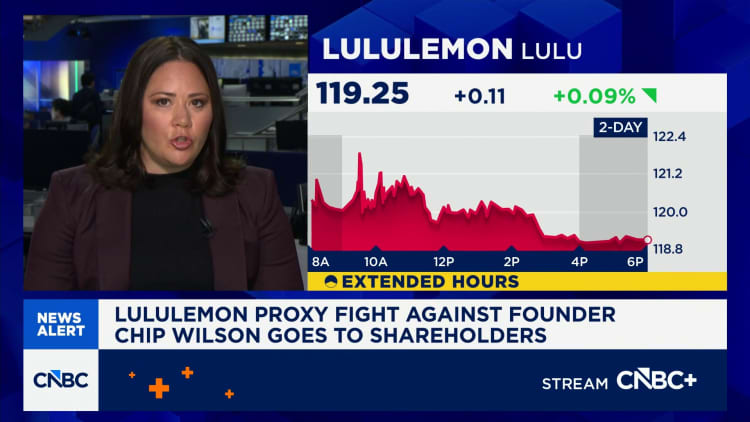
Lululemon is ending its feud with founder Chip Wilson.
The athletic apparel company entered into an agreement with Wilson on Wednesday that ended a messy proxy contest the founder started late last year as its largest individual shareholder.
Under the terms of the deal, Luluelmon has agreed to appoint two of Wilson’s nominees – former On co-CEO Marc Maurer and former ESPN Chief Marketing Officer Laura Gentile – and an additional director with “product and brand expertise in apparel” by October.
In exchange, Wilson agreed not to bad-mouth the company for about a year and a half, among other provisions.
Lululemon’s shares were up more than 3% in afternoon trading.
Wilson previously asked the company to reimburse expenses associated with his proxy contest, but ultimately agreed instead to a donation that Lululemon will make to Kitsilano Beach in Vancouver, British Columbia, where Lululemon was founded, to support athletics, art and landscaping.
“We are pleased to reach this agreement with Chip Wilson, which allows lululemon to focus on continuing to strengthen its performance,” said Marti Morfitt, Lululemon’s executive chair, in a press release.
“We look forward to welcoming Laura and Marc, who will bring additional perspective to our existing group of qualified directors. Lululemon now has a clear path forward for our incoming CEO, Heidi O’Neill, and our leadership team, as we continue to advance our strategies to foster strong brand health, reaccelerate growth, and deliver enhanced value for our shareholders.”
Wilson said the appointees, alongside strategic changes already made, “reflect meaningful progress toward restoring the company’s product-first vision and unlocking tremendous value for shareholders.”
The founder, who has been publicly sparring with the company since late last year, was nearing a deal with Lululemon two weeks ago, but settlement talks fell apart when he upped his demands.
Lululemon then took the proxy contest public, issuing a scathing letter to shareholders where it said Wilson had “outdated perspectives” and “troubling conflicts of interest” that will derail its turnaround plan.
“Wilson, who stopped serving on the Board over a decade ago for well-documented reasons, has been attacking the company and the Board for many years, damaging the brand and hurting shareholders. He has now put forward three opposing nominees in an attempt to regain increased influence over the company that he has coveted since he left,” the letter stated.
At the time, the company said its board “firmly believes that replacing any of lululemon’s directors with Mr. Wilson’s less qualified nominees would endorse his misguided perspectives, deprive the company of critical skills and expertise, and risk derailing our progress in an especially pivotal time for our business and organization.”
Soon after Lululemon issued its letter to shareholders, Wilson released his own press release saying he was under the impression he and the retailer were in agreement and there is “no reason” why they can’t “reach a resolution to this fight quickly.”
Just over a week later, the sides announced a deal.
Wilson has long been critical of Lululemon since he stepped down as chairman in 2013, but ramped up his attacks in recent months as the retailer’s performance faltered and its share price plummeted.
Following several years of rapid growth, Lululemon’s business in the Americas, its largest market, has slowed as it navigates tariff costs, an unsteady U.S. consumer and a product assortment that’s failed to win over shoppers in the same way it once did.
It also faced steep competition from upstarts like Vuori and Alo Yoga as the global athleisure market started to cool.
When it reported fiscal fourth-quarter earnings in March, Lululemon issued weak fiscal 2026 guidance and warned higher tariffs and its proxy battle with Wilson would weigh on its bottom line. As of Tuesday’s close, the company’s shares are down almost 39% year to date.
Source: www.cnbc.com