








-

Ryan S. Clark
Multiple Authors
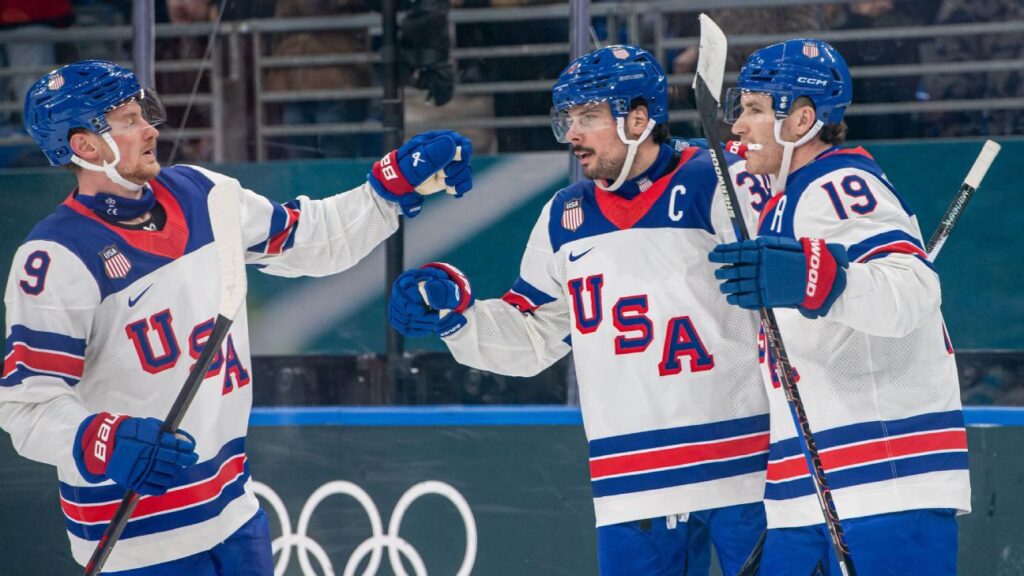
Team USA kicked off the 2026 Olympic men’s ice hockey tournament with a commanding 5-1 victory against Latvia.
The game wasn’t without its tension, as Latvia successfully challenged two U.S. goals in the first period.
After that, however, the Americans surged ahead, with contributions from Tage Thompson, Auston Matthews, and two goals from Brock Nelson making the difference.
Here’s what we gleaned from the opener, along with an overall team grade and key questions to consider before Team USA faces Denmark on Saturday.
Takeaway 1: Who stood out more, the Hugheses or the Tkachuks?
There are essential players on every winning team, and Team USA’s reliance on the Hughes and Tkachuk brothers is significant.
The Hughes brothers lead the pack. Quinn is arguably the most pivotal player on the team, serving as a top-pairing defenseman who excels in all scenarios. His performance against Latvia was a testament to that, logging a team-high 21:29 of ice time and contributing two assists. Jack started on the fourth line but also added two assists.
As for the Tkachuks, physical play was evident in this matchup, and the Tkachuks play a key role in that aspect. but, their contributions extend beyond just being gritty power forwards. They formed a top line with Jack Eichel, combining size, speed, and skill that troubled Latvia throughout the game. Brady scored the opening goal, while Matthew added two assists.
Takeaway 2: Will Coach Mike Sullivan tweak his lines?
Brock Nelson’s impressive showing deserves mentioning here, as he was pivotal for the fourth line. He centered the line featuring Jack Hughes and J.T. Miller, netting two goals (and potentially more).
Jack Hughes notched two assists, while Miller’s role is slightly more complex; he assisted Quinn Hughes on a disallowed goal and was involved in another called back due to goalie interference. Miller logged the highest ice time among the trio, just over 12 minutes, while his linemates each played just over 11 minutes.
Will changes be made for the matches against Denmark and Germany, or will Sullivan maintain the successful formula?
Everything coming up BROCK. NELSON. #WinterOlympics pic.twitter.com/yy7xGkXiR0
— NBC Olympics & Paralympics (@NBCOlympics) February 12, 2026
Takeaway 3: Consider the fatigue factor
A theme from the 4 Nations Face-Off was the pace, particularly in the final matchup between Canada and the U.S.
This tempo was evident early in the contest, as the U.S. methodically wore down Latvia in many respects. Merging speed with physicality and puck control made it difficult for Latvia to keep pace after tying the game at 1-1. The U.S. forced penalties and capitalized on them, scoring four unanswered goals in the process.
Can the U.S. replicate this against other teams? They may find challenge in nations consisting of a mix of NHL and non-NHL players, but the Canadians’ performance suggests they can maintain that level of play.

Player of the game: Brock Nelson, center
He scored two goals and came close to a few more: one hit the post, and another was ruled out for goalie interference.
Undoubtedly, Nelson delivered the most noteworthy and arguably the strongest performance among Team USA players.
While much of the conversation around Nelson will focus on his goal contributions, it’s also important to note how he consistently positioned himself and utilized his 6-foot-4 frame to create opportunities in what was a physical contest.
Can the U.S. increase their goal tally against Denmark?
As two gold medal favorites, attention will be on both Team USA and Canada during this preliminary round.
Canada opened with an impressive 5-0 win over Czechia, leading to heightened interest in the U.S. game later on Thursday, which ended in a 5-1 victory.
The next challenge is for Team USA to see if they can maintain this momentum into their game against Denmark on Saturday. The Danes, who played concurrently with the U.S., fell 3-1 to Germany, despite tallying 38 shots.
Overall team grade: A-
The sole minor setback for Team USA in their opening game was the one goal conceded due to a scramble in front of the net. Beyond that, they dominated every facet of the contest.
Those disallowed goals, paired with Latvia’s equalizer, created an initial tension. but, the four unanswered goals showcased how the U.S. flexed their skills and strength, making it increasingly difficult for Latvia to find an opportunity.