









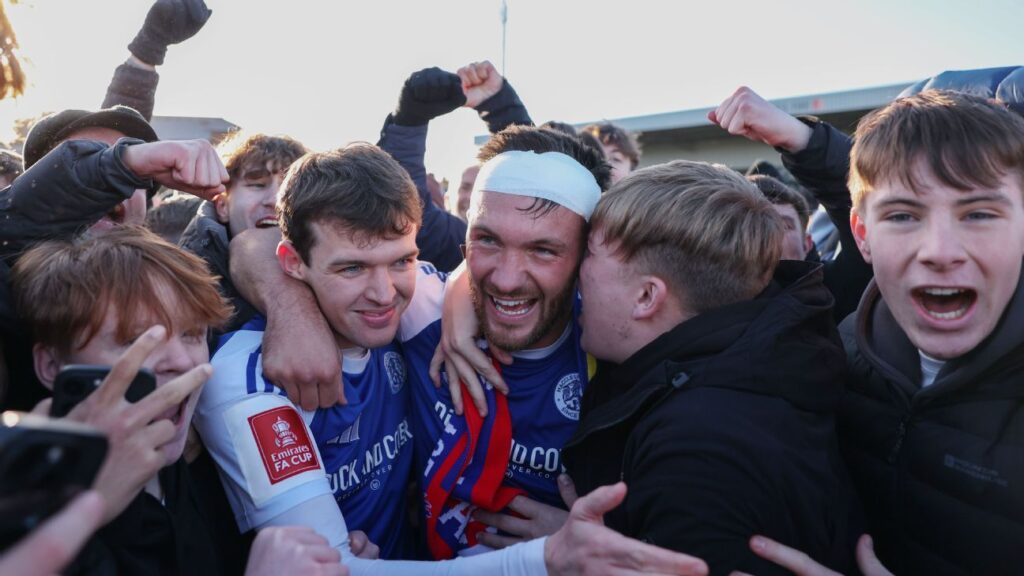
MACCLESFIELD, England — On a chilly January morning, Sam Heathcote is busy on the training ground, distributing bibs to players. At 28, he’s well-acquainted with this role, having spent his adult life as a footballer in England’s lower leagues. Recently, he experienced a standout achievement when he assisted Macclesfield, a sixth-tier semiprofessional club, in a stunning upset over Premier League team Crystal Palace in the FA Cup.
This was one of those magical football moments — a true Cinderella story — and it’s hard to overstate the significance of this victory. When Macclesfield faced Palace on Jan. 10, there was a staggering gap of 117 places between the two in the English football hierarchy, with Palace being the reigning FA Cup champions. In the 154-year history of the FA Cup — a tournament known for its “David vs. Goliath” upsets, akin to the NCAA’s March Madness — such a result had never occurred. Fans surged onto the pitch at the final whistle, and players found themselves hoisted onto shoulders. It’s a moment that will forever replay in the minds of everyone associated with Macclesfield.
For Heathcote, those memories are still fresh as he oversees a rather unusual training session. Set on a concrete pitch at a grade school just outside Manchester, the participants are just 10 years old. Many members of Macclesfield’s squad have secondary careers: a property developer, a lawyer, a podcaster, and a gym owner. Their captain, Paul Dawson, boosts his income by packing boxes for a friend’s candle business.
– Ogden: From Wrexham to Macclesfield, FA Cup is why we love soccer
– Olley: The job was too big for Frank, but Spurs’ problems go much deeper
– Connelly: Premier League’s 50 worst transfers of all time
Heathcote, a no-nonsense center-back standing 6 feet 2 inches tall, doubles as a gym teacher, and this morning, his teaching responsibilities are in full swing.
“Aubrey, everyone else has gone for red. You chose orange,” Heathcote remarks to one child.
“I like orange!” Aubrey, seemingly oblivious to soccer’s strict color regulations, replies.
“Alright then,” Heathcote concedes as Aubrey remains steadfastly in orange. Such is life for a semiprofessional footballer.
Macclesfield’s moment in the spotlight isn’t over yet. Their victory secured them a place in the FA Cup fourth round, where they will face Premier League side Brentford on Monday (Watch live on ESPN+). The big question is whether they can replicate their previous triumph.
Brentford can glean valuable lessons from Palace, whose manager, Oliver Glasner, lamented that his team “never showed up.” But what insights can they, and other teams, derive from Macclesfield?
LESSON 1: Find a purpose
If anyone in the small town of Macclesfield could teach a course on resilience, it would be the football club’s 48-year-old owner, Robert Smethurst. He acquired the club six years ago just as it was on the verge of collapse. The structure of English football can be unforgiving, and Macclesfield had faced considerable adversity, cascading down the football ladder as debts of £190,000 ($258,554 USD) and unpaid tax bills mounted, forcing players to strike.
Growing up just eight miles from Moss Rose, Smethurst had never been a supporter of the team, nor had he attended any matches. He didn’t fully comprehend the magnitude of the issues: debt collectors had stripped the club of anything valuable; the kitchen lacked equipment, copper pipes were missing, and air-conditioning units were gone. The squad had disbanded. Why did he decide to step in?
Interestingly, Smethurst doesn’t entirely recall purchasing the club. Both Macclesfield and himself were in dire straits. After selling his online car business for over £10 million ($13.6 million), he felt a void in his life.
“What do you do when you’re bored at noon? I opened a bottle of wine,” Smethurst confides to ESPN. “From there, it spiraled into addiction. I began drinking excessively and lost touch with who I was.”
A friend of Smethurst’s spotted Macclesfield, recently defunct, on a real estate website called Rightmove. In a moment of distraction, and under the influence of his alcohol use, he instructed his lawyer to submit a £500,000 ($680,267) offer.
“Honestly, I barely remember it because I thought it would be amusing,” Smethurst reflects. Days later, he received a call indicating the sale was finalized. That’s when the reality set in.
“I was flabbergasted, wondering, ‘What have I done?’” he admits. “When I finally woke up and inspected the place — having never seen it before — I realized it was in ruins. The whole setup was terrible.”
If the stadium’s condition was alarming, the club’s situation was even graver. Once a team goes out of business, it must be rebuilt from the absolute lowest tier of English football. Forget the sixth tier where they currently play; Macclesfield Town began in the North West Counties Football League — the ninth and final tier — where attendance often hovers around the hundreds.
Smethurst’s drinking didn’t cease until a year later. “I entered recovery,” he details. He followed the steps, learned about his addiction, and recognized a purpose he had been neglecting. Around the same time, he received an ADHD diagnosis.
“Recovering transformed my mindset,” he states. “I was fighting for my life but also eager to create something meaningful… Everything I’ve done for the club centers around: ‘How can I create something special post-recovery? How can I positively impact lives?’”
“I embarked on that mission, investing about £4 million ($5.4 million) of my own finances to improve facilities, build new pitches, a community gym, and more.”
In just four seasons, Macclesfield achieved three promotions, securing three league titles in the process. The trophies are displayed proudly in the club bar. They achieved success largely by outspending their competitors in each division. Locals frequently credit the facilities and Smethurst’s funding as crucial to their rise from the ninth tier to defeating Crystal Palace.
Smethurst readily acknowledges that financial support aided their climb through the first three divisions. Now, at their established sixth-tier level, it’s the community’s solidarity and external investment that can propel them further.
“I am approachable; fans can come talk to me, meet me in my office,” he says. “I’ve even had coffee with fans before. We’re in this together. I’m easily reachable. They can call me if they have concerns.”
LESSON 2: You always have each other
In the hour leading up to the FA Cup showdown against Palace, John Rooney should have been focused on tactics. Instead, he found himself preoccupied with a different concern.
Gathered in the home dressing room, one player’s locker remained unoccupied: that of 21-year-old striker Ethan McLeod, who tragically died in a road traffic accident on Dec. 16 — just a week after Macclesfield was drawn against Palace and less than a month before game day.
Rooney spoke with McLeod’s parents the night before the Palace match. McLeod’s father expressed good wishes and confirmed they would be attending. As kickoff approached, Rooney hesitated, debating whether or not to relay that message, fearing it could generate undue pressure.
“I wrestled with the decision: do we inform them or not?” Rooney tells ESPN.
finally, he chose not to share the news. The grief was still raw. He understood the desire of the team to win for Ethan, whose image oversees the pitch at Moss Rose and whose number the club has retired. That conversation could wait until after the game.
The incident occurred on a Tuesday evening after a last-minute 2-1 victory against Bedford Town FC. McLeod had just started to establish himself in the lineup but was an unused substitute that day.
“A memory that will remain with me is the selflessness he showed,” shares striker Danny Elliott, Macclesfield’s leading scorer. “He was a striker like me. For most of the season, he had been in a secondary role. That night against Bedford, although he didn’t get to play, I scored the winning goal in the final minute. As a young striker, I would have probably felt disappointed; instead, he was the first to celebrate with me.”
Normally, McLeod would travel back with the other players, but that night he opted to drive home to Wolverhampton. He got into his car while the team bus followed shortly after, but they soon became stuck in heavy traffic. By the time they passed the site of the accident, they realized it was a serious collision. It wasn’t until Rooney, who returned home at 6 a.m. due to the traffic, received the call informing him it was McLeod’s car involved in the accident.
Having been awake for nearly a full day, Rooney felt it was his responsibility to inform the team. He called each player individually.
“The players were distraught on the phone, and I continued through the list, one call after another,” Rooney recounts.
“I can’t express how difficult that must have been for him,” Elliott reflected about his manager. “That was also his birthday, which adds another layer.”
The following evening, the team convened at their Moss Rose stadium in the club bar, spending hours together. “We sat there and grieved collectively for hours,” Elliott explains. “But the beauty of football is that it goes on.”
Macclesfield decided to cancel their game the following weekend to “mourn as a team,” as Elliott phrased it. They went on to lose two of their next three matches. The FA Cup third-round clash would be their fourth.
LESSON 3: Ignore the odds
For Crystal Palace’s players, a warning message was visibly displayed right before they headed onto the field for their FA Cup matchup. The sign read, in bold letters: “DREAM. BELIEVE. ACHIEVE. AGAINST ALL ODDS.”
Perhaps the Palace players didn’t take notice. The pitch had just thawed after a recent snowstorm. Macclesfield’s captain Dawson, juggling responsibilities as a candle company employee and youth coach, helped staff clear the pitch for a league game earlier that week — much to the displeasure of his manager, Rooney.
“I was shoveling snow until the boss called me,” Dawson admits. “He wasn’t pleased. I told him I’d been on the tractor all day, which wasn’t true. I fibbed.”
Dawson’s effort yielded results, but the conditions remained well below the standards expected by Premier League teams. Before the game, Dawson approached the opposing captain, England international Marc Guéhi (who would soon sign with Manchester City). Dawson later recounted: “Franny [assistant coach Francis Jeffers] remarked to Marc, ‘Is the pitch alright for you?’ He replied, ‘Not at all.’ In that moment, I sensed an opportunity for us.”
It was Dawson, too, who netted the match’s opening goal. Early in the game, following a collision with Palace defender Jaydee Canvot, he sustained a head injury and wore a bandage for the remainder of the match. When Macclesfield earned a free kick 30 yards from Palace’s goal, Heathcote helped him adjust the dressing before the ball was delivered into the box, where Dawson successfully headed it in.
“To be honest, I’ve replayed that moment numerous times; I can’t recollect it happening,” Dawson reflects. “Major events like that tend to fade from memory. I can’t remember much else of the game until I watched it again.”
Scenes in the dressing room 🍾
Macclesfield FC players and staff sing Adele’s Someone Like You after their FA Cup victory over Crystal Palace 🎶 pic.twitter.com/by44M82ZFx
— Football on TNT Sports (@footballontnt) January 10, 2026
What transpired next only intensified the fairy tale narrative. Macclesfield headed into halftime with a shocking 1-0 lead, and manager Rooney instructed them to maintain their composure: if they could avoid conceding in the second half, they might just claim the upset. Imagine the astonishment when forward Isaac Buckley-Ricketts doubled the lead in the 61st minute, nudging the ball past the Palace goalkeeper.
Palace still had a chance to overturn the situation. They narrowed Macclesfield’s lead with a free kick taken by winger Yéremy Pino, whose £26 million ($35 million) transfer fee was 26 times that of Macclesfield’s entire player expenditure. but, it was not enough, and a customary fan pitch invasion followed. Soon, Dawson found himself on a pair of fans’ shoulders.
“One moment, I was airborne. My calf began cramping!” he recalls. “I was trying to stretch it, but everyone kept cheering and patting me.”
Reuniting with teammates in the dressing room, McLeod’s spot remained unfilled. They held hands, singing Adele’s “Someone Like You.” McLeod’s parents joined in the festivities, and Rooney shared the message he had previously wrestled with delivering before the game.
“I’ll forever cherish that they were a part of this day with us,” Rooney reflects. “Having Ethan’s family share that experience meant a lot.”
Opta, the leading data analytics provider in world soccer, maintains a live global ranking of 13,000 teams. Prior to the FA Cup match, Palace ranked 19th; Macclesfield was placed 6,879th — roughly equivalent to Mons Calpe, who sit third in the Gibraltar Premier League, and similar to Ghanaian team WaleWale Catholic Stars FC.
Next on their FA Cup adventure is Brentford, another Premier League club currently sitting 13th in Opta’s rankings. Macclesfield is the first team to defeat an opponent five tiers above them. Lightning would need to strike twice for this miracle to repeat.
But who would bet against it?
“As a lifelong football fan, I’ve always watched the Premier League,” Rooney shares. “We know a fair bit about them… We won’t be naïve. We’ll treat them like any other match, just as we did with Crystal Palace.”
“Like we do with teams in our own league, we respect every opponent, and I’m confident they’ll respect us in turn.”