









-

Kristen Shilton
Multiple Authors
As the 2026 Winter Olympics men’s ice hockey tournament progresses, Canada has little to be concerned about.
Following a dominant 10-2 victory against an overwhelmed France team on Sunday, Canada remains undefeated at 3-0-0-0, likely securing a top seed for the knockout round with a remarkable plus-17 goal differential.
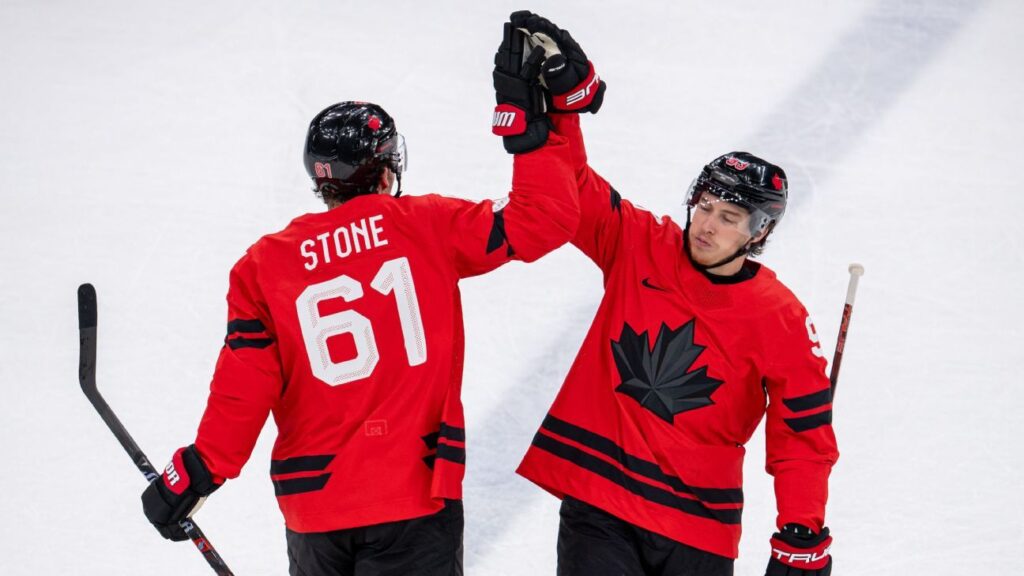
In this match, Canada boasted nine goal scorers: Tom Wilson, Devon Toews, Mark Stone, Cale Makar, Sidney Crosby, Connor McDavid, Bo Horvat, Brandon Hagel, and two for the remarkable 19-year-old Macklin Celebrini, who continues to impress.
Here’s what we gleaned from Canada’s final preliminary-round game, including key insights, an overall team assessment, the standout player of the match, and a pressing question leading into the next round.
Takeaway 1: Connor McDavid is a force
The premier center for the Canadians showcased his prowess against France, recording two assists early on to bring his tournament total to a staggering eight points. This tally ties Jonathan Toews’ record for the most points in a single Olympics—accomplished in just three games.
McDavid isn’t just meeting expectations; he’s exceeding them. While we anticipated his role in leading Canada’s offense, his spectacular play has surpassed all notions. He constantly crafted odd-man rushes against the French defense, putting pressure on goaltender Julian Junca.
though he could have scored numerous times, it was in the early third period when McDavid finally lit the lamp, bringing his points to nine across nine periods (two goals, seven assists, and 13 shots on goal), thereby overtaking Toews for the Olympic record.
Few words can encapsulate his talent; he approaches each match as if it were Game 7 of the Stanley Cup Final, intent on winning at all costs.
Takeaway 2: Jordan Binnington’s performance fluctuated
Canada’s goaltender earned praise for a stellar shutout against Czechia at the tournament’s outset, but his showing against France was notably less impressive.
He conceded his first goal of the Olympics mere seconds after Canada gained the lead in the first period, an unfortunate rebound back into the slot that allowed Florian Duray to respond to Tom Wilson’s opening goal.
Canada and France combine for THREE goals in one minute in a wild start at Milano Santagiulia Arena. 👀 pic.twitter.com/zwerijrLSj
— NBC Olympics & Paralympics (@NBCOlympics) February 15, 2026
Though Canada’s dominance made it difficult for Binnington to find his rhythm, he lacked confidence when called upon.
Immediately following McDavid’s goal that pushed Canada’s lead to 7-1, Binnington allowed another quick goal, this time from Sacha Treille, which slipped under his arm, meaning the French had netted two goals on just eight shots—a tough spot for Binnington, particularly with Canada’s robust performance in front of him.
Which version of Binnington will we see next? Perhaps he alone has the answer.
Takeaway 3: Canada is well-rounded
At first glance, it’s easy to dismiss Canada’s impressive win on Sunday against a weaker opponent. but, it’s not merely the score—it’s how they achieved it.
Canada received contributions from both forwards and defensemen, excelling at even-strength, short-handed, and even during a penalty shot taken by Celebrini in his Olympic debut.
Wilson’s engagement in a fight following a high hit on Nathan MacKinnon by France’s Pierre Crinon highlighted the diverse skill set Canada possesses.
still, there’s always room for growth. MacKinnon—who previously played alongside McDavid and Celebrini against Switzerland—might need to adjust since he hasn’t gelled as well with Nick Suzuki. This could motivate coach Jon Cooper to shift Suzuki down and pair Brad Marchand with MacKinnon. though Canada has excelled in scoring throughout this tournament, fine-tuning will be crucial as they prepare for the quarterfinals.

Player of the game: Mark Stone, LW
We don’t give enough credit to Stone. While he may not be the fastest skater, his contributions throughout Canada’s Olympic campaign have been invaluable, especially in the victory over France.
It’s not just that Stone can create momentum-shifting moments, like his short-handed goal at the end of the first period giving Canada a 3-1 lead. It’s his overall play that stands out. His puck sense, ability to position himself effectively, and sharp instincts (evident in the setup for Crosby’s goal late in the second) are unmatched.
Stone adapts seamlessly to any role required by Canada, making it appear effortless. He embodies the ultimate team player and deserves recognition alongside Canada’s star athletes.
Big question for the next round: Who will be Canada’s starting goaltender?
Binnington initially seemed the clear choice as Canada’s top goaltender after his stellar shutout against Czechia.
Yet Logan Thompson also excelled against a challenging Swiss team, complicating Cooper’s decision following Binnington’s less-than-stellar outing on Sunday.
Cooper has staunchly supported Binnington despite his struggles this season in St. Louis, particularly since he guided Canada to gold in February’s 4 Nations Face-Off.
but, Cooper must remain pragmatic; the challenges ahead are greater, and with Canada’s next opponent still unknown, there’s no rush to reveal his choice. still, the decision has grown more complex since Sunday, as Thompson may indeed be the better choice.
Overall team grade: A
although Binnington’s allowed goals, this was a resounding victory for Canada, securing them prime seeding for the knockout round with a plus-17 goal differential.
They have demonstrated, through these three games, that they are exactly what they were expected to be: a fast, flashy scoring machine with exceptional defensive skills and unmatched depth of talent.
There’s almost an overload of strategies for how Canada can exploit opponents. Tougher battles await beyond this one, but the Canadians can execute a high-quality team game against any challenge they face.