








-

Laurence Edmondson
Multiple Authors
Formula 1’s new era has naturally prompted numerous questions, and the first week of serious racing has created even more. Preseason testing in Bahrain revealed glimpses of performance and abundant data, yet it has not provided clear answers on how the sport’s new environment is truly evolving.
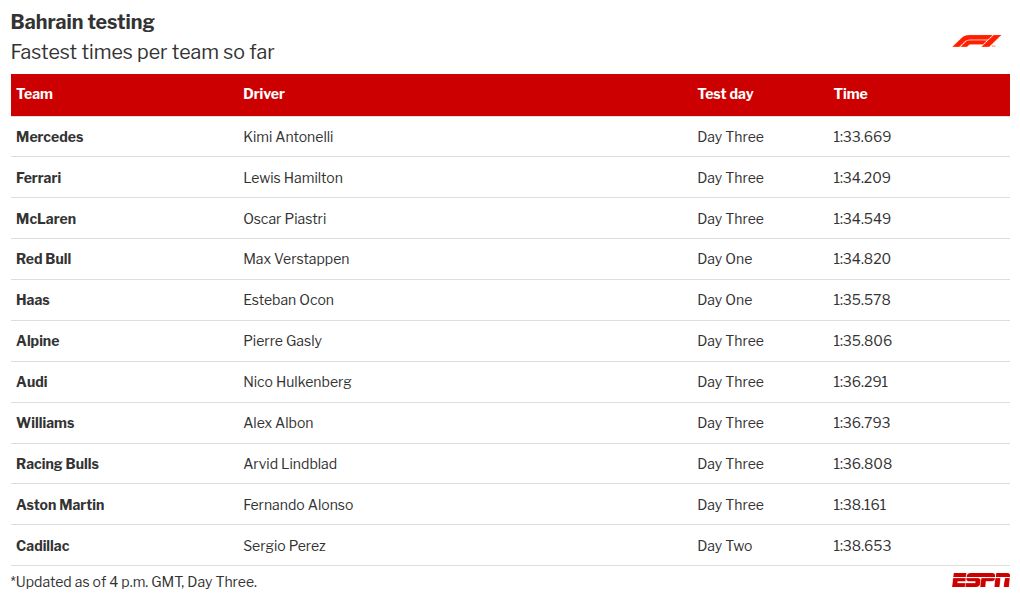
On the track, lap times have told a fluctuating story, with various teams showing speed at different intervals, and no definitive standard emerging amidst a game of deception.
– F1 testing: Who’s posted the fastest times and most laps
Off the track, this uncertainty has been echoed by dissatisfied drivers and rising tensions behind the scenes. Concerns around technical interpretations, competitive distrust, and safety issues have arisen as teams navigate the new regulations. With one more test yet to come, ESPN analyzes an engaging three days in Sakhir.
Who’s fastest?
Preseason testing’s headline lap times can often be deceptive, and this year’s competitive landscape is further clouded by new power unit regulations and a hint of political maneuvering.
When asked about the fastest package, Mercedes points to Red Bull, while Red Bull claims they trail Ferrari, Mercedes, and McLaren.
Ferrari acknowledges that Red Bull and Mercedes are ahead, while reigning champions McLaren believe all three competitors have the advantage.
On paper, F1’s latest power units are impressive, producing three times the electrical power of previous models and harvesting double the energy over a lap. yet, this means they often operate energy-starved, making it impossible to simply push to the limit for the fastest lap, as battery depletion comes quickly.
“It’s ridiculously complex,” remarked seven-time champion Lewis Hamilton. “I was in a meeting where they explained it; you need a degree to fully grasp it.”
In the paddock, one individual uniquely qualified to understand the challenges is Williams team principal James Vowles, who succinctly summarized the complexity.
“Consider it this way,” he explained, “in one braking zone, you can nearly fill the battery, yet in half a straight, you can deplete it entirely.”
so, “energy management” has emerged as the primary topic in Bahrain this week. mainly, the more effectively energy can be harvested under braking and through corners, the more can be utilized on the straights, resulting in faster lap times.
This often means drivers refrain from pushing to their limits in corners, as sacrificing a bit of speed there can yield greater gains on the straights. Teams have found this balance particularly challenging to master during flying laps this week, contributing to a rapidly shifting understanding of who is leading.
Mercedes maintains that Red Bull, using its own power unit for the first time, has discovered a way to deploy more energy on specific straights than other teams, with both team boss Toto Wolff and driver George Russell suggesting their rivals have found a deployment advantage worth up to a second per lap.
“They’re not just a small step ahead,” Russell said. “It’s around half a second to a second in deployment throughout a lap, so it’s quite concerning to see that gap.”
McLaren’s Lando Norris, driving a Mercedes-powered car, added, “When someone has a deployment advantage, that’s an extra bit of lap time you can easily gain. Without effort, you just go faster.”
yet, when Red Bull’s technical director Pierre Wache was asked about his team’s status as the benchmark, he pointed back at their competitors.
“We are not the benchmark, for certain,” he clarified. “Our analysis shows Ferrari, Mercedes, and McLaren are ahead, and we are currently behind.”
“It’s challenging to judge the others due to varying fuel and power levels, but that’s our analysis, and it could be incorrect.”
Outside of the top four teams, Alpine managing director Steve Nielsen noted that data he gathered indicated that different power unit suppliers appeared strongest on different days.
“Honestly, if you had asked me that in Barcelona [during the first test], I would have said Mercedes was clearly ahead. If you asked me on Wednesday [in Bahrain], I probably would have said Red Bull is the benchmark. Yesterday [Thursday], I would have said ‘wow, you need to see Ferrari’s long run.’
Nielsen also emphasized that all teams would be learning from one another this week by analyzing various energy deployment strategies and would likely converge on optimal solutions.
“We’re all shameless plagiarists,” he said. “We observe anything anyone else does on and off the track, and if we like it, we adopt it—from their speeds, cornering abilities, to energy deployment. We’re all at it.”
Considering these various energy strategies in conjunction with typical testing variables such as fuel loads and fluctuating track conditions, deriving meaningful conclusions from lap times is quite tricky. Some long-run data from Friday suggested Mercedes and Ferrari held an advantage over McLaren, but this is merely a glimpse of a much broader dynamic that will likely shift once testing resumes in Bahrain next week.
Is it still F1?
If the new rules are perplexing for spectators, feelings among drivers are more straightforward. Four-time champion Max Verstappen has never hesitated to express his thoughts and was forthright when addressing the media this Thursday.
“As a pure driver, I love going flat out,” he said. “Right now, you can’t drive like that. There’s so much happening.”
“A lot of your actions as a driver significantly impact energy management. For me, that’s just not Formula 1.”
“Perhaps it would be more enjoyable to drive in Formula E, where the focus is on energy efficiency and management, which is their core principle.”
“From a driving perspective, it’s not as fun.”
compared to, Norris, possibly responding to Verstappen’s comments, framed the challenges posed by the new regulations positively.
“It’s a challenge, but an enjoyable one for both engineers and drivers,” Norris noted. “It’s different—we have to drive in a new manner and adapt our understanding and management.”
“yet, we still get to drive cars, travel the world, and have loads of fun. There’s nothing to complain about.”
although varying opinions, all drivers seemed to agree the 2026 regulations are undeniably “different.” Just by observing from trackside, there are notable changes in driving style that can be seen and heard. Some drivers (notably those without Ferrari engines) are now opting for first gear in Bahrain’s slowest corners—Turns 1, 8, and 10.
Using first gear allows the engine to rev higher than it would in second or third, which helps charge the battery while keeping the turbo spinning at elevated speeds, optimizing boost pressure on corner exits while avoiding turbo-lag.
“One challenge we’re facing is using low gears in corners. For instance, in Bahrain, the first corner typically operates in third gear,” Russell explained. “With the previous generation, using the first gear feels unnatural, as the car and engine are designed to handle corners in third gear, yet we need high revs to keep the turbo going, leading to a need for first gear. It’s not intuitive.”
Another visible change is the reduced speeds through fast corners. At times, deploying battery power in high-speed corners yields little advantage, prompting drivers to ease off.
Fernando Alonso, a veteran of Bahrain since its debut in 2004, noted how his approach to Turn 12 has shifted.
“Historically, Turn 12 was challenging,” he reflected. “You would adjust your downforce to navigate it flat out, minimizing downforce until easily handling it with new tires.”
“Now, we’re going around Turn 12 about 50 kph slower because we wish not to waste energy there, preferring to conserve it for the straights. We’re at 200 kph instead of 260 kph— even our chef [in Aston Martin’s hospitality] can manage that speed there. Yet, you want to preserve energy for straight-line speed.”
“I can relate to Max’s comments, as a driver would typically love to be faster through corners. yet, now we’re restricted by the energy our engine will supply for the subsequent straight.”
Telemetry data revealed Alonso was indeed taking more speed into Turn 12 compared to rivals, needing to lift while others stayed flat. Still, the issue of slower speeds in high-speed corners remains valid.
Power politics
The complexities of the new regulations have spurred significant anxiety among teams regarding what their competitors are up to. As this week’s test approached, Mercedes’s interpretation of engine compression ratio regulations became a major topic, and progress wasn’t made at the end of the three days.
The controversy revolves around the compression ratio being reduced from 18:1 in 2025 to 16:1 this year to level the playing field for new power unit manufacturers.
It’s stated in the regulations that the compression ratio will be assessed at ambient temperatures, and it appears Mercedes has managed to comply with regulations while achieving a higher compression ratio—and thus more power—when the engine runs hot.
The FIA has stated its intent to resolve this issue before the season-opening race to prevent it from escalating to the stewards or legal courts. One potential solution is modifying the rules so that the 16:1 compression ratio limit applies when the engine is hot, but the change would require support from the FIA, FOM, and all of Mercedes’ power unit competitors.
There’s a sentiment among competitors that Mercedes may have concealed its true testing performance to avoid scrutiny from the FIA and FOM.
“Mercedes has displayed some impressive developments, but I suspect they’re concealing even more,” Charles Leclerc commented on Friday. “I would anticipate them to be slightly ahead of us.”
Verstappen took a more straightforward approach to Wolff’s claim that Red Bull has the benchmark power unit.
“To me, it’s more of a diversion tactic,” Verstappen stated. “But that’s alright. We focus on our team’s progression because there’s so much for us to learn. This new ruleset is incredibly complex, and we just want to put in our laps and move forward.”
Wolff claims any advantage merely equates to “a few” horsepower and insists that the FIA was kept informed throughout the engine’s evolution. A rule change must occur ahead of the impending engine homologation deadline on March 1, leaving uncertainty about its implications for Mercedes and its customer teams: McLaren, Alpine, and Williams.
Another contentious topic ahead of the Australia season opener involves race starts. Following numerous practice starts in Bahrain, it became evident how challenging it would be to achieve smooth getaways with the new power units.
The current regulations stipulate that the power unit cannot deploy any electrical boost until the car reaches 50km/h, meaning that initial departures rely solely on the V6 turbo engine. Previously, under the former regulations, the MGU-H hybrid system assisted in spooling the turbo for optimal start boost, but that component has been eliminated this year.
because of this, the V6 engine must be revved in advance to build up boost pressure and minimize turbo-lag, a common issue in turbocharged engines. During practice starts in Bahrain, cars had to rev for over ten seconds to generate sufficient turbo boost before beginning their launch.
Concerns have emerged regarding whether the current starting procedure—consisting of five red lights illuminating in one-second intervals, followed by their simultaneous extinguishing—will allow drivers at the back of the grid enough time to prepare their turbos for a successful start.
Concerns about discrepancies in starting abilities across the grid could lead to collisions.
“We must ensure that the race start procedure allows all cars to prepare their power units because the grid isn’t the place for slow starts,” stated McLaren boss Andrea Stella.
“These considerations are more crucial than any competitive interests. Teams and the FIA should prioritize responsibility when deciding on race start procedures, including the timing of the lights and intervals before they turn off.”
This issue is compounded by Ferrari’s belief that it opted for a smaller turbocharger to tackle turbo-lag.
A report from The Race indicates that the Italian team initially raised concerns but was not heeded by competitors and subsequently opposed a later attempt to amend the start procedures.
Stella reiterated his worries regarding overtaking and potential collisions resulting from drivers coasting along straights to accumulate energy. He believes that necessary regulatory changes to address these issues are “straightforward,” though they would likely center on the rules surrounding energy harvesting and deployment, which some teams are handling better than others. All three concerns raised by Stella are anticipated for discussion at next week’s F1 Commission meeting on Wednesday.
finally, much more is at stake during the final preseason test than simply identifying which car is the fastest.