









-

Ryan S. Clark
Multiple Authors
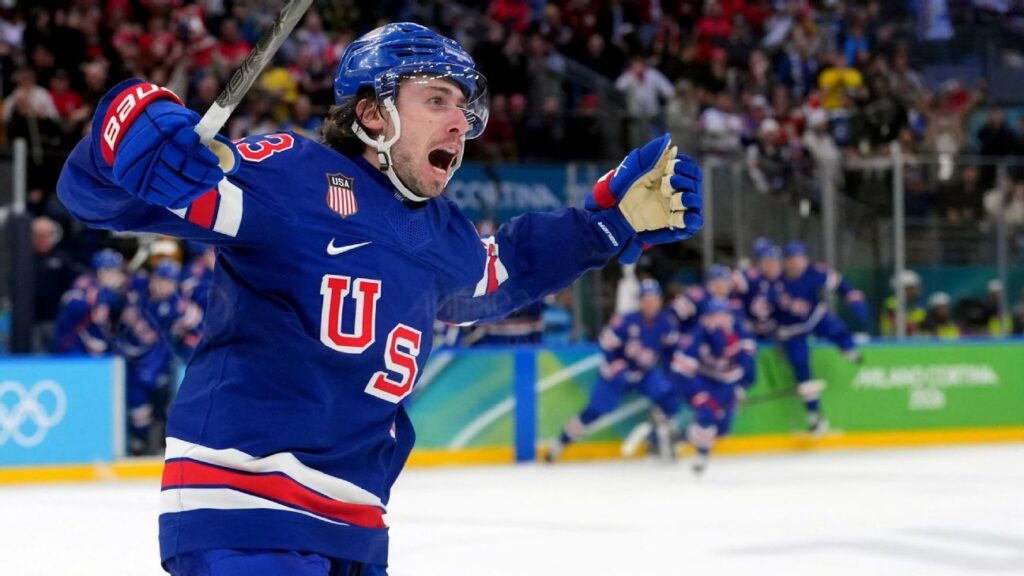
With two of the initial three quarterfinal matchups in the 2026 Olympic men’s hockey event requiring overtime, it is no shock that the clash between the United States and Sweden followed suit.
This tournament marks the first time active NHL players have participated since the 2014 Sochi Games, with Team USA entering as the second favorite for the gold medal, trailing only Canada.
In third place were the Swedes, who proved to be formidable adversaries, equalizing with 1:31 left in the third period before Quinn Hughes netted the game-winner in overtime.
What insights can we glean about Team USA from this intense matchup? Which players shone the brightest, and what major questions linger as the team gears up to face Slovakia in the semifinals?
Takeaway 1: Quinn Hughes may be Team USA’s most vital skater
While scoring the game-winning goal in 3-on-3 overtime grabs attention, Hughes’ overall performance against Sweden underscores his significance to Team USA.
Hughes entered the match as the only American skater averaging over 20 minutes per game, consistently facing the opponents’ top lines. His ability to dictate the game’s tempo helped open more scoring opportunities for the U.S.
Against Sweden, he logged over 27 minutes of ice time and averaged 56 seconds per shift, the highest among Americans, surpassing Sweden’s Erik Karlsson by three seconds.
This made his overtime goal especially impactful. Hughes was on the ice for the final 75 seconds and executed moves that forced Sweden’s Joel Eriksson Ek to focus intently as he approached the net. in the end, Hughes found the opening and fired the shot that propelled the U.S. into the semifinals.
QUINN HUGHES! USA WINS! 🦅 pic.twitter.com/WxbCRKxPiO
— NBC Olympics & Paralympics (@NBCOlympics) February 18, 2026
Takeaway 2: Did Team USA play too conservatively in the third period?
We will address Team USA’s overall defensive performance shortly. yet, why were they more conservative in the third period compared to the second, where chances were abundant?
keep in mind that the U.S. began Wednesday with a plus-7 scoring margin in the second period. Dylan Larkin’s goal pushed that to plus-8 during a period where the team exhibited remarkable consistency. Larkin’s redirected shot contributed to a push that allowed the U.S. to generate opportunities at the net against Sweden, fostering the belief they could continue this trend into the third period.
DYLAN LARKIN FLIES IN AND OPENS UP THE SCORING. 🇺🇸#WinterOlympics pic.twitter.com/Lmu8uuDeij
— NBC Olympics & Paralympics (@NBCOlympics) February 18, 2026
yet, Team USA transitioned from tallying 20 shots in the second period to just four in the third. Initially, it seemed the Americans would achieve the round’s first shutout until Mika Zibanejad scored with 91 seconds remaining, sending the game to overtime.
Interestingly, in overtime, the U.S. registered five shots in under 90 seconds, surpassing their third-period total.
Takeaway 3: Was this Team USA’s strongest defensive performance of the tournament?
The momentum swung when Charlie McAvoy leveled Gabriel Landeskog with a hit. The U.S. went on to deny Sweden a shot on goal for the initial six minutes. When the Swedes did get a shot, it came from a distance and was easily handled by Connor Hellebuyck.
Hughes and McAvoy’s defensive efforts were complemented by Brock Faber, Jake Sanderson, Jaccob Slavin, and Zach Werenski, with Noah Hanifin stepping in when necessary. U.S. forward J.T. Miller consistently sacrificed his body to block shots, while the penalty kill remained perfect in the tournament, with no power-play goals allowed in 10 attempts.
Of course, having Hellebuyck in goal, making 27 saves, significantly contributed to their success.
This kind of defensive consistency stands out, especially when contrasted with Germany’s six-goal concession, Canada’s overtime win over Czechia amid defensive missteps, and Switzerland’s overtime loss after blowing a two-goal lead against Finland. The Americans’ strong defensive showing is a key reason they’re advancing to the next round.

We’ve highlighted the critical role Quinn Hughes plays for Team USA overall.
yet, in the context of his performance against Sweden? His contributions exemplify why Hughes is considered one of the best defensemen and players globally.
He was integral to their defensive strategy, assisting on the first goal, upping his ice time above all skaters, and ultimately scoring the game-winning goal in overtime.
Key question for the semifinals
What strategies can Team USA implement against Slovakia? They showcased their best defensive performance of the tournament but now face a potent offense.
Slovakia lit up the scoreboard with six goals against Germany, showcasing their prowess throughout the Olympics. The defending bronze medalists rank fourth in goals per game, having netted four against Finland and three in a loss to Sweden.
For Team USA, replicating much of their successful formula from the match against Sweden could be crucial in determining whether they vie for gold or bronze.
Overall team grade: B+
The mere four shots recorded in the third period are the sole barrier keeping the U.S. from earning a higher grade. though the Americans only scored once in the second period, that frame seemed to open up further opportunities for goals before Sweden’s late equalizer sent the game to overtime.
even so, Team USA’s defensive performance lays down a blueprint for them to build upon as they aim for a gold medal.