








MILAN — Alysa Liu never aimed to become an Olympic gold medalist.
Upon returning to figure skating after a two-year break, her goal was to express her creativity, her artistry, and to showcase her true self.
Anything beyond that would simply be a perk.
Yet, unexpectedly, Liu will leave Italy with not just one, but two gold medals.
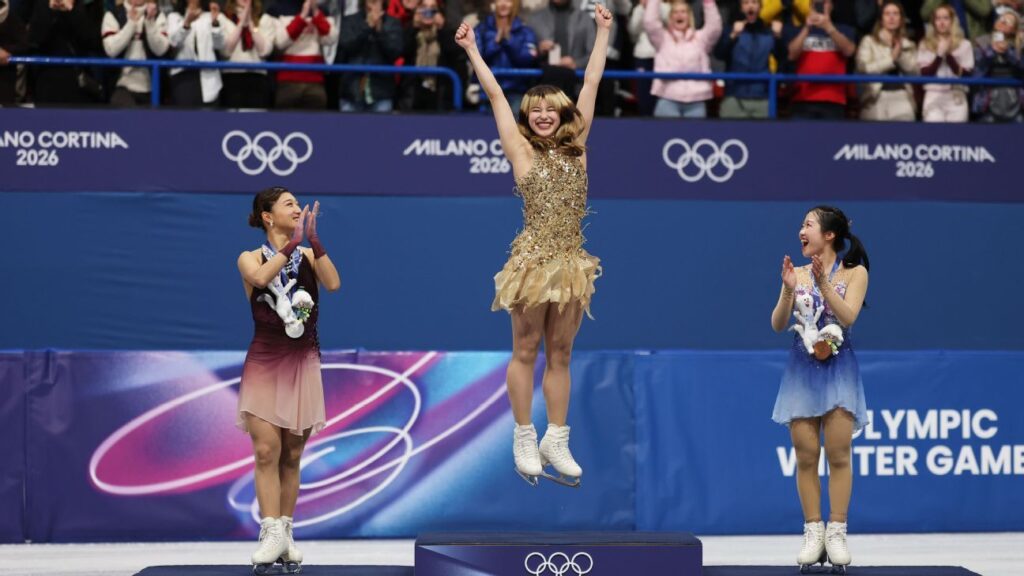
On Thursday, nearly two weeks after contributing to the United States’ triumph in the team event, Liu — the cheerful California comeback star with her distinctive bleached hair — surprised many by claiming gold in women’s figure skating with an impeccable free skate performance, ascending to the top of the leaderboard.
As she skated off the rink, she joyfully shouted to the camera: “That’s what I’m f—ing talking about!”
The 20-year-old Liu had to watch two more competitors skate, but it didn’t affect her. In her heart, she had already achieved what mattered most.
“I don’t need this [medal],” Liu stated later. “What I truly needed was the platform to express myself, and I got that, so I was content. Regardless of the outcome.”
And when it concluded, Liu was not only adorned with the gold but also made history as the first American woman to win this coveted title since 2002 — more than three years before her birth. In a whirlwind Olympic Games for the American skaters, it might be the most fitting and perfect finale.
“I’m honored to be part of this [gold medal] club,” Liu expressed. “I suppose it’s a club of sorts, but I genuinely feel privileged, and these athletes are extraordinary… With the newfound visibility, I hope people don’t simply see a headline like, ‘Oh, she won a gold.’ I wish for people to delve into my story, even if it’s not fully revealed yet. One day, it will be, and on that day, I aspire to inspire even more individuals.”
After a remarkable start to her career, including becoming the youngest national champion at 13 and reaching the Olympics at 16, Liu announced her retirement from the sport after finishing third at the world championships in 2022.
“Heyyyyy, I’m here to announce my retirement from skating,” Liu wrote in a now-deleted Instagram post. “I began skating at 5, so that’s around 11 years on the ice, and it’s been an incredible journey filled with highs and lows, but that’s just life.”
Having never enjoyed a typical childhood or teenage experience, Liu embraced everything life outside skating had to offer.
She socialized with friends, enrolled at UCLA, and even hiked to Mount Everest base camp in 2023, a cherished memory. She explored other passions, such as dancing and music, discovering who Alysa Liu the individual was, beyond just being a skater.
A family skiing trip reignited her love for athleticism and pushing her limits. She stepped back onto the rink. It began casually, but she was pleasantly surprised to find many of her skills still intact. Before long, she had rekindled her affection for the sport. She enlisted former coaches Phillip DiGuglielmo and Massimo Scali for guidance once more. This time, however, they agreed that everything would be in her control, with her having the final say.
With that understanding, they refrained from setting targets like winning Olympic gold medals. Liu sought a venue to express her creativity — she showed just as much, if not more, excitement regarding the costume she wore in her free skate while speaking to the media than about the final outcome — and they never fixated on winning. DiGuglielmo recognized during her first competitive season back in 2024-2025 that her short and free skate programs had what it took to outperform the world’s finest, but they never discussed it.
Upon reaching the world championships last March, they centered their efforts on allowing Liu to showcase her programs, rather than fixating on potential outcomes.
“At the worlds, she won the short program, and we exclaimed, ‘Done, goals achieved. She’s shown this phenomenal short program,'” DiGuglielmo recounted on Thursday. “The crowd witnessed the best short program in the world. That was a win. Next, it was, ‘Alright, let’s perform in the free skate and see how it unfolds.’
Executing the same free skate that earned her Olympic gold, Liu clinched the 2025 world title. Yet even after that victory, no one on Liu’s team discussed specific aspirations for Milan. Instead, Liu simply concentrated on qualifying for the Olympic team to have an authentic Olympic experience after participating in the pandemic-affected Games in Beijing.
DiGuglielmo noted that one of his and Scali’s goals was just to create positive memories for Liu.
“She was unhappy previously and so she compartmentalized her past experiences,” DiGuglielmo said. “She doesn’t recall attending Junior Worlds or the Junior Grand Prix Final. Our motto has been ‘Making memories.’ We aimed to create lasting memories wherever we went.”
Smiling and embracing every moment has been a hallmark of Liu’s return. While she dislikes being labeled as “Alysa 2.0,” even her coaches agree it’s fitting since “she kind of reinvented herself.”
She now places greater emphasis on her feelings rather than results. When she saw Amber Glenn surpass her score at the national championships last month, she kept smiling.
but to others, including Glenn and former male frontrunner Ilia Malinin, who struggled under pressure during the Games and expressed the mental toll it can take, Liu exhibited no such signs. Throughout her three performances — once in the team event and twice in the individual competition — she always appeared calm and content. She seemed like someone enjoying skating solely for herself.
She didn’t know it yet, but Alysa Liu’s spectacular free skate would win her Olympic GOLD. 👏 #WinterOlympics pic.twitter.com/LzMCkvwGMf
— NBC Olympics & Paralympics (@NBCOlympics) February 19, 2026
“She has this quality of, ‘If I want to do something, I could just go for it,'” Ashley Wagner, who helped lead the U.S. to a bronze in the team event in 2014, told ESPN prior to the Olympics. “It’s that straightforward. Often, the only obstacle is ourselves. Alysa shatters that rigidity of thought and just shows up to skate and performs brilliantly.”
“Her motivation is so genuine. Working in sports psychology now, it’s refreshing to help athletes realize how being emotionally connected to their ‘why’ leads to success.”
In a candid conversation with ESPN last fall, Liu expressed that everything she engages in now has significance.
“I’m incredibly deliberate at this point in my life,” Liu said. “I’m grounded. Every action of mine has a purpose behind it.”
No figure skating federation arrived in Milan with greater aspirations than the United States.
Last year at the world championships, the country secured three out of four titles in Boston, and many anticipated a substantial medal haul in Milan.
Fans were not only excited for the triumphant winners — Liu, Malinin, Madison Chock, and Evan Bates — but all three American women finished in the top five, a feat unseen since 2001.
Isabeau Levito, who won silver at the 2024 worlds, ranked fourth. Glenn, previously among the favorites after an undefeated season including the Grand Prix Final title, bounced back for fifth place despite facing challenges in her short program.
Multiple podium finishes seemed almost guaranteed after an exceptional national championships in January.
yet, as can often occur on sports’ grandest stage, things didn’t unfold as expected. Far from it.
The team event saw its ups and downs. Malinin faced challenges in his short program, as did Glenn in her free skate, while the Japanese team put up a tough fight.
But ultimately, thanks to Liu’s solid performance, Chock and Bates’ consistent ice dance execution, and a pivotal pairs free skate by Ellie Kam and Danny O’Shea, the U.S. narrowly claimed gold. The one-point margin between the U.S. and Japan was the smallest in event history.
Alysa Liu is in her element in her short program on the Olympic ice. 😍 pic.twitter.com/prbAVw1OlQ
— NBC Olympics & Paralympics (@NBCOlympics) February 6, 2026
This seemed a positive indication for the Americans. Yet, just a day later, Chock and Bates surprisingly finished second in the rhythm dance segment of the individual event. although controversy regarding judging, they secured silver, which was shocking for the three-time reigning world champions, and their disappointment was evident.
That feeling was quickly eclipsed as Malinin, who led after the men’s short program, stumbled during his free skate. After completing his opening quad jump, he faltered attempting his renowned quad axel and subsequently unraveled, doubling a quad loop and falling twice. Before the Olympics, he hadn’t lost since 2023, ultimately finishing in eighth place.
He expressed to reporters post-performance that negativity overwhelmed him at the start and he couldn’t recover.
The pairs competition also faced challenges, as anticipated due to being a relative weak point for the country in recent years. Emily Chan and Spencer Akira Howe finished seventh, while Kam and O’Shea came in ninth.
yet, all eyes turned to the sport’s final event: the women’s singles competition.
After weeks of anticipation, fan edits, and even a Taylor Swift-narrated promo, the self-styled “Blade Angels” were ready to perform. All three skated in the final group during the short program, each hoping to end the nation’s 20-year medal drought in the event.
Liu initiated the trio with a strong performance, highlighting her artistry with an almost flawless skate. Levito followed, delivering a clean yet “elegant” program that impressed the audience, but her score placed her eighth.
Glenn, skating just before Liu, seemed prepared for a medal as she successfully executed her opening triple axel. yet, she later doubled her planned triple loop, resulting in zero points for that element. Her disappointment was clear as she awaited her score, which landed her in 13th.
Liu expressed her concern for Glenn, a close friend.
“She’s been through so much; I just want her to be happy,” Liu said. “That’s genuinely all I desire. We’ll get together later; don’t worry, we always support one another.”
Heading into the free skate, Liu was in third place and just over two points behind the leader. Levito was eighth. A trio of Japanese skaters occupied the top four positions, while the Russian sensation Adeliia Petrosian — who hinted at a quad jump but had limited international experience — was fifth.
Glenn set an impressive tone during her free skate, soaring to an early lead, which she maintained until the last four skaters took the ice.
finally, it was Liu and her disco-themed routine set to Donna Summer’s “MacArthur Park Suite” that captivated the audience. Achieving a season-best score of 150.20, she totaled 226.79, securing her top position and ensuring herself a medal, with Kaori Sakamoto and Ami Nakai left to skate.
Liu watched both final skaters without any apprehension or jealousy, instead cheering enthusiastically when they completed their routines. But when Nakai’s score flashed, it was Glenn, finishing fifth, who raised Liu’s hand in triumph.
That moment captured the essence of the American figure skating team’s journey as a whole. A win for one felt like a victory for all, and Liu — the very opposite of the “ice princess” stereotype often linked with the sport — was simultaneously the most surprising and fitting individual to help restore the sport.
While the overall outcome may not have been as hopeful as the nation desired, with Japan securing more medals across the five skating events than the U.S., it still marked a resurgence on the sport’s highest platform.
Following the worlds and the buzz from the national championships, it was supposed to be a defining moment for figure skating in America, a revival reminiscent of past glory. While past generations had skaters who became household names, the sport’s popularity has declined. Malinin, in particular, with his astonishing athleticism and occasionally parkour-like style, appeared poised to become a crossover star while drawing in a younger audience.
finally, it was Liu who stood on the podium’s center step, poised to become a national icon in the forthcoming days and weeks.
Through her triumphant comeback story, accompanied by the honesty and vulnerability displayed by Malinin, Glenn, Chock, and Bates in their setbacks, along with the mutual support among the American team during the Games, the experience might have achieved something even more significant.
“Her narrative of stepping back for mental health reasons speaks volumes. It shows you can’t predict what the journey to success will look like,” Glenn remarked to reporters. “I hope this resonates throughout the skating community and encourages people to take the necessary time for themselves.”