









-

Greg Wyshynski
Multiple Authors
The Olympic men’s hockey gold medal game was set to be a thrilling clash between the United States and Canada, and it certainly lived up to expectations.
With goals from Team USA’s Matt Boldy and Canada’s Cale Makar in regulation, alongside phenomenal saves from Connor Hellebuyck of Team USA and Canada’s Jordan Binnington, the match headed into overtime.
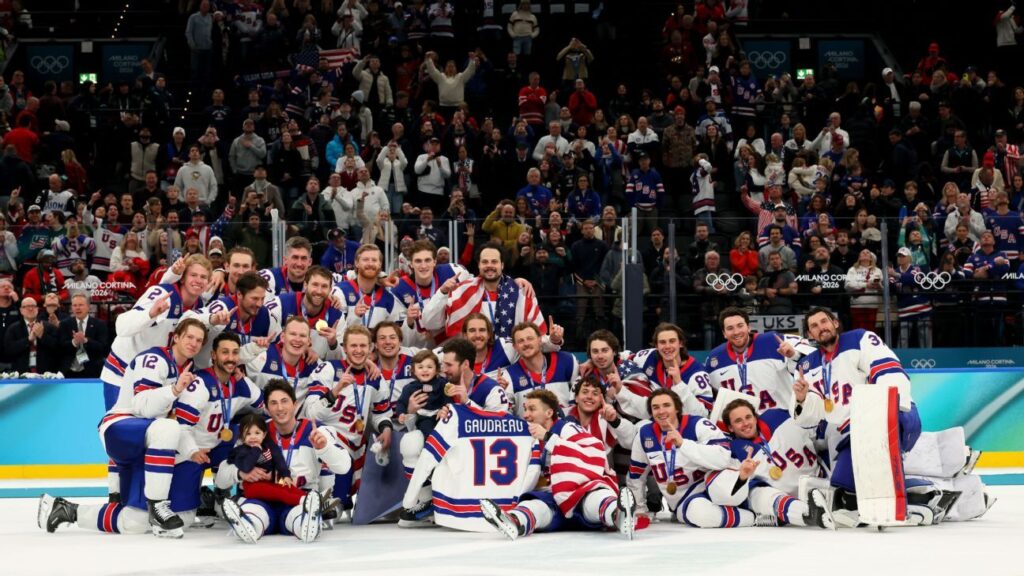
In overtime, Jack Hughes received a pass from Zach Werenski and scored against Binnington, securing a 2-1 victory for the U.S. and marking their first men’s hockey gold since 1980.
Here’s a breakdown of what each team did well and where they struggled, along with the MVP of the match and the implications for their ongoing rivalry.
Why Team USA won
It’s tempting to highlight “Connor Hellebuyck” and leave it at that.
The standout goaltender for the Winnipeg Jets, Hellebuyck is the reigning NHL MVP and Vezina Trophy winner, solidifying his status as the world’s top goalie with a legendary performance in the gold medal match.
He recorded 41 saves on 42 shots from Canada, with 27 of those from the slot and 17 from the inner slot, according to Hockey Stats. His paddle save against Devon Toews was the tournament’s best, as was his breakaway stop on Macklin Celebrini. While the U.S. has seen stellar goalie performances in the past, none can compare to what Hellebuyck accomplished in this gold medal matchup.
THAT WAS ONE HELLE-BUYCK OF A STOP. 😳 pic.twitter.com/N3wCimdBGw
— NBC Olympics & Paralympics (@NBCOlympics) February 22, 2026
yet, relying solely on Hellebuyck to be their standout player was likely not the plan for Team USA against Canada, who largely dominated the final two periods with a 33-18 shot advantage.
Neither team expected their special teams to play such a critical role in the championship match, but their penalty kills turned out to be instrumental. The Americans successfully killed off a 5-on-3 power play for 1:42 in the second period against a formidable Canadian offensive lineup. After failing to score on a double-minor high sticking penalty to Canada’s Sam Bennett late in the third, they had to withstand another Canadian power play when Hughes received a high stick penalty.
At times, it seemed like the Americans were reverting to their traditional role of playing not to lose against Canada, rather than playing to win. This could have led to a repeat of their past disappointments, like in Sochi. But Hellebuyck’s performance kept them afloat.
The U.S. clinched gold for the first time since 1980 by scoring in overtime. Of course, this format doesn’t seem entirely fair to the teams that battled it out for 60 minutes in regulation. There’s a universe where the U.S. and Canada don’t even make the gold medal game if their quarterfinals had different outcomes.
yet, in the context of overtime, few players are more compelling than Hughes. The New Jersey Devils star is not only fast and inventive but has also been a force in NHL overtime with nine game winners in 404 games, ranking second in team history.
JACK HUGHES DELIVERS AMERICA’S GOLDEN MOMENT IN OVERTIME. pic.twitter.com/4foFDOri53
— NBC Olympics & Paralympics (@NBCOlympics) February 22, 2026
Hughes’ goal was made possible thanks to a brilliant forecheck by Werenski, who knocked Nathan MacKinnon off the puck before delivering a pass to the rushing Hughes for the game-winner.
In their celebration, the American players honored the late Johnny Gaudreau by bringing his Team USA jersey onto the ice. Werenski was a teammate and friend, making it a memorable “hockey family” moment.
For Johnny Gaudreau. ❤️ pic.twitter.com/rWycdK8NUo
— NBC Olympics & Paralympics (@NBCOlympics) February 22, 2026
Hellebuyck was the hero of the gold medal game for Team USA, while Jack Hughes stood out throughout the tournament. Initially criticized for his performance in the 4 Nations Face-Off and for switching from center to wing, he started on the fourth line for Team USA but emerged as arguably their best forward in the group stage, earning a bigger role during the elimination rounds. Scoring the gold medal goal felt like a fitting conclusion.
Watch out, Mike Eruzione. While it wasn’t a miracle, it was the most significant goal in the history of American hockey.
Why Canada lost
While it’s clear that Hellebuyck’s performance was a decisive factor for the U.S., Canada also squandered numerous opportunities they should have capitalized on, even against elite goaltending. MacKinnon missed an open net, and Celebrini could muster only six shots on goal, including a breakaway where he failed to replicate his earlier tournament magic.
Coach Jon Cooper experimented with his lines throughout the game, trying to find the right combination for a game-winning goal, but to no avail.
Credit must also go to Team USA’s defense. While much attention centered on the goaltending differences, the depth of the American defense proved to be a major advantage. They effectively disrupted Canadian plays in the attacking zone early in the game and held firm in the later stages, allowing Hellebuyck to make crucial saves. though they didn’t contribute offensively as much due to responsibilities in the defensive zone, they ultimately outperformed Canada’s talented offensive roster.
yet, a pivotal factor in Canada’s loss was the absence of Sidney Crosby. The captain and Pittsburgh Penguins superstar suffered a lower-body injury against Czechia, missed the semifinal against Finland, and was a question mark for the gold medal game. His unexpected absence was significant — especially since Hockey Canada had used his image to promote the final.
Replacing him, Nick Suzuki struggled on faceoffs, losing six of seven, making it easy to think that one of their power plays could have gone differently with Crosby involved. He ranks 12th in NHL history with 607 power-play points, not to mention his considerable leadership experience. In such a closely contested game, having a two-time gold medal winner like Crosby could have made a notable impact.
American fans have spent a year discussing the absence of Quinn Hughes, Charlie McAvoy, or a healthy Matthew Tkachuk during the final of the 4 Nations Face-Off. Canada’s frustration with Crosby’s absence may serve as a comparable talking point.
There has also been some early criticism of officiating from Canadian fans, including a missed slash on McDavid and a non-call for an extra skater penalty on Team USA. yet, they were presented with ample opportunities to beat Hellebuyck but ultimately failed. They dominated possession in overtime but could not find a hero until Hughes stepped up for the Americans.
The Canadians gave a strong effort deserving of gold, but it was the Americans celebrating with the medals around their necks. Now a genuine rivalry has emerged.
Gold medal game MVP: Connor Hellebuyck
As Jack Hughes caught his breath during a postgame interview with NBC, he praised not only the camaraderie of USA Hockey but especially the play of his goaltender.
“He was our best player today by a mile. That was a ballsy, gutsy win. That’s American hockey right there,” Hughes stated.
Hellebuyck performed well during the 4 Nations Face-Off, but the loss in the title game stirred up past critiques of his performance in high-pressure playoff situations. USA Hockey brushed those concerns aside and made him the starter for the 2026 Olympics, despite a shaky audition from Jeremy Swayman in the group rounds.
Entering the gold medal match, Hellebuyck boasted a .947 save percentage, raising it to .956 by the end of the tournament. His goals saved above average count of 5.92 was the highest in the Olympics, showcasing his incredible skill in the gold medal moment.
It was anticipated that the U.S. would have the goaltending edge over Canada, a critique primarily based on Canada’s goalie depth and concerns that Binnington might be a liability. Instead, the true advantage lay in the Americans having a goalie capable of carrying them to gold on his own. As Hughes remarked, Hellebuyck was Team USA’s best player “by a mile” and the reason for the national anthem playing in celebration.
State of the U.S.-Canada rivalry
The rivalry between the U.S. and Canada is now genuinely competitive.
The women’s rivalry has become the most intense in hockey, as both teams are seen as equals. The U.S. triumphed in Nagano, Canada claimed four consecutive gold medals, and now the U.S. has taken two of the last three Olympic titles. The Americans have secured 11 of the last 16 IIHF world championships. Both nations have robust talent pipelines (we’ll raise your Hayley Wickenheiser with a Hilary Knight). Each match feels like an intense battle, and the victor is never preordained — even in Milan, where the U.S. nearly squandered its best-ever roster against its archrivals.
but, the men’s rivalry has largely been one-sided since the NHL began participating in the Olympics in 1998. Canada won Olympic gold in Salt Lake City against the U.S. in 2002, famously defeating Team USA in 2010 with Crosby’s golden goal in overtime. In 2014, they sent the U.S. to the bronze medal game in Sochi. They triumphed in the World Cup of Hockey in 2016, where the U.S. played a minor role. also, they won the 4 Nations Face-Off in 2025, thanks to McDavid’s golden goal in overtime.
Besides a few preliminary-round victories in Vancouver and a skirmish-filled game in the 4 Nations, American performances against Canada have largely been less than stellar. Team USA has often felt like the younger sibling, entering games with the mindset of inferiority and commonly playing to that narrative.
Yet beneath the surface, a rich pipeline of American hockey talent has been burgeoning. The U.S. has thrived in the IIHF World Junior Championship, winning more gold medals (six) than Canada (five) since 2010. The players emerging from their national development program are no longer just the blue-collar grinders that USA Hockey aimed to cultivate post-Miracle on Ice. They are talented stars like Patrick Kane, the Hughes brothers, the Tkachuk brothers, Jack Eichel, and Auston Matthews — elite scoring powerhouses in the NHL.
As such, the Americans arrived at the 2026 Olympics with a belief that they were on par with the Canadians for the first time in the rivalry’s history. This belief isn’t solely founded on previous outcomes — although forcing overtime in the 4 Nations, despite being without Quinn Hughes, McAvoy, and an injured Matthew Tkachuk, boosted their confidence — but rather on the most substantial hockey talent pool the country has ever assembled.
yet, they needed to defeat Canada for this belief to hold weight, and now the Americans proudly wear the gold medal in men’s hockey for the first time since the Miracle.
Canadian fans are already relying on the dual arguments of Crosby’s absence and Hellebuyck’s outstanding performance, which is excellent for this rivalry. The Americans now have the gold, while the Canadians maintain their traditional belief in superiority. This sets the stage for a prolonged competitive relationship.
As Jack Hughes articulated after winning Olympic gold for the U.S.: “We wanted to go through Canada and beat them.”
This rivalry is now real.