








-

Zach Kram
Multiple Authors
The 2026 Winter Olympics have wrapped up, and as expected, the United States did not finish at the top of the medal table. Historically, the U.S. shines more in the Summer Olympics; they haven’t topped the medal count at a Winter Games since 1932, while achieving the highest medal tallies in seven of the last eight Summer Games, with China being the only exception during the 2008 Beijing Games.
Team USA has a strong track record in five-on-five men’s basketball, having claimed five consecutive gold medals, although they faced challenges in recent medal rounds against Serbia and France.
Compounding the rising international competition is a transitional phase for Team USA. The leading scorers from the 2024 Paris Games were Stephen Curry, LeBron James, and Kevin Durant, all of whom may not return for the 2028 Games in Los Angeles. Curry and James have expressed intentions to step back from Olympic play, while Durant indicated a desire to participate, albeit acknowledging the need to maintain his performance levels heading into the Games.
As the Olympic spotlight pivots from Milan to Southern California, it’s essential to evaluate potential candidates for a revamped American roster. We began with an extensive list of over 80 candidates, drawn from past Olympic and FIBA World Cup rosters, as well as player development over recent years. Now, let’s narrow it down to a projected 12-man Olympic team.
Jump to the full roster projection

Why age matters in the Olympics
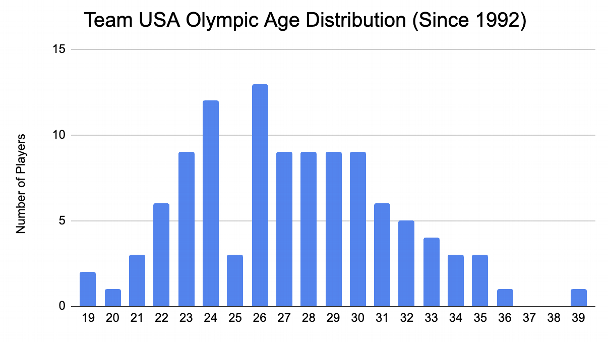
The 2024 Olympic team marked the oldest in Team USA’s history, averaging 30.1 years and featuring seven recurring players. Only Anthony Edwards (22), Tyrese Haliburton (24), and Jayson Tatum (26) were younger than 27.
This distribution is atypical. Since the inclusion of NBA players in the 1992 Games, most Team USA athletes have been in their mid-to-late 20s, with only rare instances of significantly younger or older players.
Age
The notable scarcity of younger players becomes critical when projecting the 2028 team. Only six Americans aged 21 or younger have participated since the ’92 Dream Team: Anthony Davis in 2012, Keldon Johnson in 2021, and four players (James, Carmelo Anthony, Emeka Okafor, and Amare Stoudemire) from the 2004 roster.
This year’s Rookie of the Year favorite, Cooper Flagg, has a strong chance of becoming the seventh such player, turning 21 by summer 2028. Yet if Flagg secures a spot, it may hinder the chances of top prospects from the renowned 2026 draft class—Darryn Peterson, AJ Dybantsa, and Cameron Boozer—from joining him. The only instance of multiple 21-and-under professionals on Team USA’s roster resulted in a bronze medal in 2004.
Conversely, past Olympians unlikely to join the 2028 team due to age or decline include James (43 in 2028), Curry (40), Durant (39), and several others in their late 30s, like Russell Westbrook, Jimmy Butler III, DeMar DeRozan, Paul George, and more.
Since 2000, only two Americans have debuted at age 32 or older: Curry at 36 in 2024 and JaVale McGee at 33 in 2020 after a late roster change.
so, Kawhi Leonard (37), Alex Caruso (34), Josh Hart (33), and several others are unlikely to represent the U.S. in 2028.
Evaluating the USA pool of guards
Given the evolution of the NBA in recent years, the guard position stands out as the Americans’ strongest.
The pool begins with Edwards, projected to be 26 in 2028 and potentially the USA’s top player. He ranked fourth in scoring on the 2024 team, making him a near lock for the next Olympic roster.
Point guard Haliburton is also a strong candidate to return after a limited role in 2024, humorously remarking on his gold medal win. His recovery from a torn Achilles will be crucial, but he fits the international play style perfectly as the best pure point guard available.
Behind these two are several candidates closely competing for spots. Devin Booker aims for a third gold medal at age 31, while Donovan Mitchell and Jalen Brunson will also be 31, eyeing their Olympic debuts after World Cup play.
Younger guards like Tyrese Maxey and Cade Cunningham are slated to be strong contenders as they hit their peak years in 2028, with rookies Kon Knueppel and VJ Edgecombe also making a compelling case thanks to impressive beginnings in their NBA careers.
In addition, candidates in a secondary tier could garner attention with solid development, including veterans like Austin Reaves, De’Aaron Fox, and younger talents such as LaMelo Ball and Keyonte George.
Evaluating the USA pool of wings
If Edwards doesn’t emerge as the best American player in 2028, Tatum might take that title. The two-time Olympian expressed that his “tough” experience during the 2024 Games, where he spent significant time on the bench, won’t deter him from participating in Los Angeles. Tatum will likely remain a strong candidate, especially post-recovery from his Achilles injury.
Flagg, who caught the attention of Team USA’s management with strong performances against the 2024 Olympic roster, also stands out. His rapid ascent during his rookie season positions him well to potentially become an All-Star and top two-way player by 2028.
The pool of American wings also consists of two-way talent. Jaylen Brown and Mikal Bridges may be older options for first-time Olympians (both 31 in 2028), while younger candidates like Jalen Williams, Jalen Johnson, and Scottie Barnes will find themselves peaking in a few years. Brandon Miller offers potential from a younger perspective.
plus, players like Trey Murphy III and Michael Porter Jr. could bring valuable size and shooting capabilities to the international arena, while adept perimeter defenders—Amen Thompson, Tari Eason, and others—might fill bench roles focused on energy and defense.
Evaluating the USA pool of bigs
This position group might see the most changes from 2024 to 2028. The three big men representing Team USA in Paris will each be in their 30s come 2028—Bam Adebayo (30), Joel Embiid (34), and Anthony Davis (35)—while small-ball options like Durant and James will be even older.
Choosing the right bigs is crucial, especially with Team USA facing formidable opponents such as France, led by Victor Wembanyama, and Serbia, featuring Nikola Jokic. To compete effectively with elite big men globally, the U.S. will need agile and skilled centers.
If Embiid and Davis decide to play, they might be kept on the roster. but, their health remains uncertain for the upcoming season and the next Olympic Games. Adebayo, while not as high-profile as Embiid or Davis, holds a key advantage—he’s younger, less injury-prone, and has the mentorship of coach Spoelstra, who has guided him throughout his NBA career in Miami.
The next cohort of big men features the past two Americans named Defensive Player of the Year, Evan Mobley and Jaren Jackson Jr., along with potential candidates like Chet Holmgren. All three are exceptional defenders who can also stretch the floor, though Jackson’s national team performance at the 2023 World Cup raises some questions.
Other candidates for center positions, while not as adept at shooting, include Jalen Duren, Walker Kessler, Jarrett Allen, and Donovan Clingan. Zion Williamson and Paolo Banchero bring significant potential but also inherent flaws—Williamson’s health concerns and Banchero’s inefficiency could hinder their Olympian status.
Projecting the 12-man roster
As is customary for Team USA, the roster will likely consist of nine perimeter players and three bigs for Los Angeles.
Haliburton and Edwards are set to occupy two starting guard positions as returning members from the 2024 lineup. but, the remaining guard slot is allocated to Knueppel, who possesses a 43% three-point shooting percentage on high attempts—an invaluable asset in international play due to his size and playmaking capabilities.
The final guard position demands careful consideration, but Cunningham edges out other options like Booker and Mitchell. even if he lacks some efficiency compared to his peers, his scoring isn’t as crucial on a stacked Olympic team, and his advantages in size and defense make him a favorable choice. It is worth noting that previous reserve positions in 2024 were filled by players like Jrue Holiday and Derrick White rather than purely scoring-focused guards.
Booker is also a contender for that spot, having contributed significantly to the last two Olympic squads. but, his age and slight drop in performance—shooting only 32.6% from three over the past two seasons—raise questions about his long-term prospects in 2028.
On the wing, Tatum and Flagg are guaranteed to start, with Williams included, assuming his wrist issues resolve and his shooting improves after an inconsistency in the current season (down to 31% from 38% in prior years). He possesses the two-way experience necessary for Olympic competition.
Amen Thompson is included next to provide elite perimeter defense alongside Edwards, particularly for guarding talents like Shai Gilgeous-Alexander if Team USA faces Canada. Finally, Barnes rounds out the roster due to his versatility and defensive skills, making him a fitting role player among stars. Future lineups featuring Flagg, Thompson, and Barnes after further development could prove challenging for opponents to penetrate.
Should Durant continue to show commitment and deserving performance, that final spot may be his due to his record as the most decorated Olympian in men’s basketball history with four gold medals. but, concerns about his age and injury history affect his inclusion in current projections.
Lastly, Adebayo remains the lone returning center, with opportunities to either start or back up Holmgren, who presents the best combination of rim protection, mobility, and three-point skills on the roster.
The third center projected is Duren, a choice that may have seemed unexpected recently. but, his remarkable progress with the East-leading Pistons is notable. While Mobley could be considered a better player, his skill set overlaps with Holmgren’s. compared to, Duren offers a different profile and greater size, making him a valuable asset in battling elite international bigs; he is also anticipated to be the team’s best rebounder.
Hence, my current projection for Team USA’s 2028 roster includes:
-
Cooper Flagg (21 years old at the time of the 2028 Olympics)
-
Kon Knueppel (22)
-
Jalen Duren (24)
-
Amen Thompson (25)
-
Scottie Barnes (26)
-
Cade Cunningham (26)
-
Anthony Edwards (26)
-
Chet Holmgren (26)
-
Jalen Williams (27)
-
Tyrese Haliburton (28)
-
Bam Adebayo (30)
-
Jayson Tatum (30)
There’s still ample time for these projections to evolve, especially given close calls. Recent changes have already been noted; after the 2024 Games, Kevin Pelton forecasted a 12-man USA roster including only six players from my current picks: Adebayo, Edwards, Haliburton, Holmgren, Tatum, and Williams.
Kevin’s remaining selections were Banchero, Booker, Brunson, Davis, Embiid, and Maxey. even if all are still viable candidates, it’s important to note that since 2024, Cunningham and Barnes have emerged as prominent stars, while Flagg and Knueppel have quickly made their mark in the NBA, and Thompson and Duren have developed into rising stars.