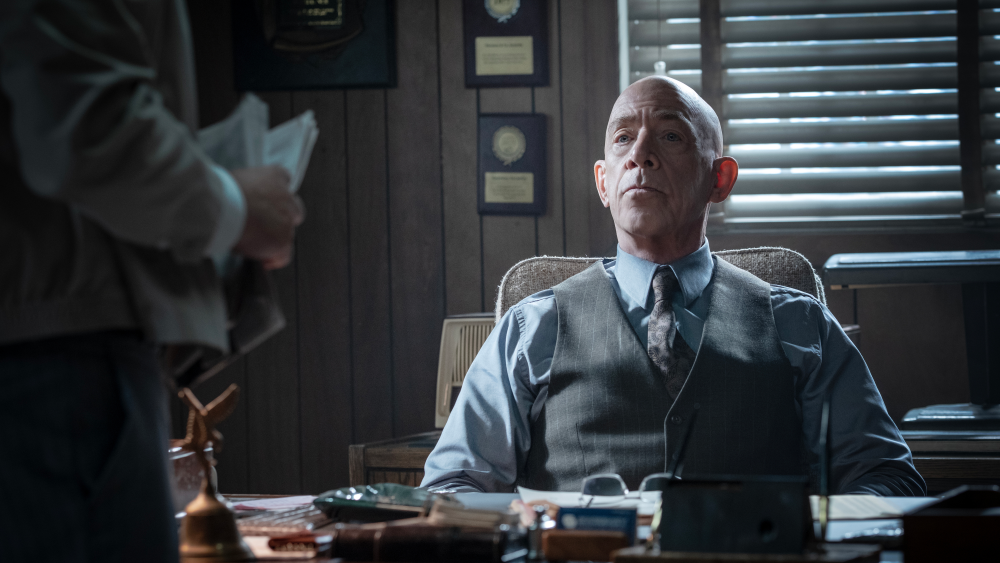










For a show about men — and some women, but mostly men — working to build the future, “The Audacity” feels a little old-fashioned. That’s mostly a good thing: This ambitious, sprawling, talky satire plays like an artifact of prestige television’s recent, but all too distant-seeming, past. especially, “The Audacity” airs on AMC, the linear network that once helped kick off the medium’s modern era with “Mad Men” and “Breaking Bad,” rather than some deep-pocketed streamer. (More distance from which to lob bombs at giants like Apple or Amazon, which now have Hollywood outposts of their own.) Creator Jonathan Glatzer is an alum of “Succession” and “Better Call Saul,” while other executive producers did stints on “Mad Men” and “Killing Eve” — all dramas it’s hard to imagine getting greenlit in the current age of endless, disposable content. The leads are not movie stars slumming it for an all-but-guaranteed Emmy nomination, but TV veterans who’ve worked their way up the call sheet and earned a spot at the top.
Over an eight-episode season, “The Audacity” doesn’t immediately secure its place in the canon alongside its blue-chip forebears, but that’s an unreasonable bar to clear. The series can be unwieldy in scope, slow to unveil its endgame and uneven in its character development. Still, these are minor faults compared to an enjoyably harsh yet perceptive look at the psychology of Silicon Valley elites. Compared to a more straightforward spoof like HBO’s “Silicon Valley,” “The Audacity” distinguishes itself with an oblique set of angles into this tiny, cloistered bubble that has an outsized impact on everyone else — starting with its therapists.
The more traditional antihero of “The Audacity” is one Duncan Park (Billy Magnussen), an abrasive tycoon who’s already rich but still chasing the more elusive highs of greatness and respect. This motivation is revealed not through Duncan’s behavior, but his direct unburdening to Dr. JoAnne Felder (Sarah Goldberg), a Palo Alto shrink whose clientele are mostly titans of industry spending their IPO money on self-improvement. That makes JoAnne’s home office a stuffed vault of valuable information, so much so that she’s unable to resist a teensy bit of insider trading on the side. Who could blame a mere upper-middle class professional for wanting a small cut of her customer’s success? Unfortunately for her, the paranoid Duncan has the entire invasive apparatus of his data startup Hypergnosis on speed dial, and he’s not afraid to use it for a little blackmail. If JoAnne shares some of her confidential dirt, Duncan proposes, he won’t get her license revoked.
There’s not a whiff of romance between Duncan and JoAnne, which is refreshing in itself, but they might just be soulmates, or at least perfect foils. Both practice self-deception as high art: Duncan has cocooned himself so deeply in the genius founder myth that he’s outraged to learn he’s not neurodivergent; JoAnne has dedicated her life to mental health, yet she’s just as materialistic as the proud capitalists she cares for. Both are neglectful parents to teenage children who even attend the same tony private school, making the pretense of doctor-patient boundaries a laughable pretense to begin with — JoAnne’s husband Gary (Paul Adelstein), a child psychologist, also treats Duncan’s daughter Jamison (Ava Marie Telek) as part of a panel of experts working to get her into Stanford. Orson (Everett Blunck of “The Plague” and “Griffin in Summer”), Joanne’s son from a prior marriage who struggles with stomach problems on top of typical adolescent insecurity, qualifies for a scholarship on a technicality. “You’d be surprised how hard it is to find underprivileged youth around here,” JoAnne observes.
Finally, both Duncan and JoAnne are played by performers working well within their wheelhouse. Magnussen has played a controlling tech mogul before, on the whacky sci-fi show “Made for Love”; Goldberg broke out in HBO’s “Barry” as a woman whose self-interest blinded her to the danger right in front of her face. Nor are they the only standouts in the cast. Zach Galifianakis plays the retired Carl Bardolph, who’s considered a gnomic sage by the Duncans of the world even as his sessions with JoAnne uncover an overgrown child beholden to fits of rage. (“The problem is the anger is what made me the money,” he admits.) Playing an elder statesman is a new lane for the ever-boyish Galifianakis, though that quality suits Carl’s arrested development.
A still more surprising turn from a well-known comedian comes courtesy of Rob Corddry as Tom Ruffage, a gay, alcoholic undersecretary at the VA who’s come to the Valley on a fruitless search for a contractor to help modernize the agency’s files. Much like the idea of therapy as corporate espionage, the government procurement process is a counterintuitive way into examining the excesses of tech culture. It’s the presence of people like JoAnne, Tom and the teens that allows “The Audacity” to push past easy punchlines about ayahuasca trips and shareholder rights as human rights. There’s an enjoyably up-front approach to naming the established megacorporation “Cupertino” and its CEO “Big Tim”; nevertheless, Corddry’s performance as a fragile yet principled Desert Storm vet gives the show a needed outlet for our empathy. Everyone on “The Audacity” is flawed. Some are just more accessibly so than others.
“The Audacity” does pay a price in the time it takes to introduce all these players and weave them together, which ends up crowding some characters out. Nearly a thousand words into this review, I still haven’t mentioned Cupertino’s “Chief Ethicist” and Hypergnosis board member Anushka Battachera (Meaghan Rath), nor her husband Martin (Simon Helberg), a recluse obsessed with developing his proprietary AI. That’s because the pair, both as individuals and a couple, are the least well-defined members of the ensemble. The glamorous Anushka mostly functions to roll her eyes at Duncan’s antics and voice vague moral qualms (“I know tech changed the world, but so did the bubonic plague”), while Martin is a means to parody the industry’s latest fixation. Only in the season’s final hours do their stories fold into the main plot and assist its momentum.
As unwieldy as “The Audacity” can be as it works to fold everything from YouTube incels to the surveillance state into its assessment of modern life, the show is most effective when it cultivates individuals as idiosyncratic case studies. Duncan is haunted by the suicide of his college roommate turned business partner five years earlier, which goes a long way toward explaining his perpetual anxiety and aggrievement despite being rich enough to retire. JoAnne is mired in student debt and married to her former professor, fueling understandable jealousy behind her therapist’s poker face. (The scenes where she and Duncan fully unload on each other are among the season’s best.) Glatzer’s “Succession” experience shows in barbed one liners: “I thought you were a unicorn. Turns out you’re just a jackass with a dildo strapped to his head,” Carl scoffs. Helping the audience understand loathsome people without understanding them is a more subtle, if equally essential, inheritance.
“The Audacity” will premiere on April 12 on AMC and AMC+ at 9 p.m. ET, with remaining episodes airing weekly on Sundays.
Source: variety.com