









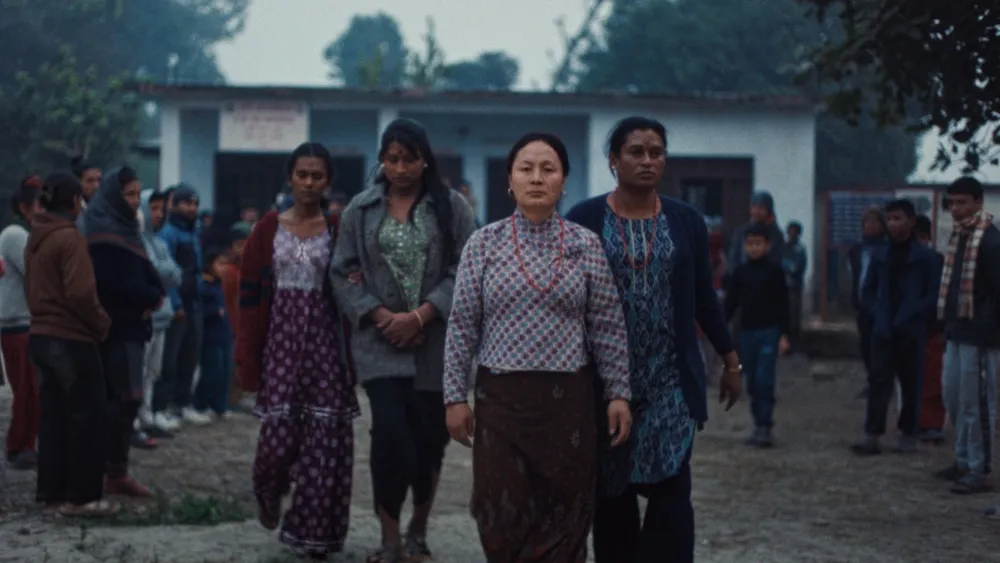
Like the community of transgender women at its center, Nepalese drama “Elephants in the Fog” is gentle, fierce, and full of life and contradictions. Making his feature debut, writer-director Abinash Bikram Shah zeroes in on the transactional nature of trans acceptance in South Asia, a fragile prospect he explores through an authentically cast tale of adopted mothers and daughters — which zig-zags into an all-too-familiar mystery of disappearance, albeit one rendered with rich specificity and audiovisual detail.
A remote village by the forest plays host to Shah’s drama, which begins with shapes in the distance, illuminated by torch flame, wandering through the thickets to ward off wild elephants from farmers’ crops. This sense of everyday ritual permeates the rest of the story, which follows middle-aged trans woman Pirati (Pushpa Thing Lama), the self-assured “mother” of her own house of transgender refugees.
She’s a member of a Kinnar community — legally recognized as part of the country’s meti “third gender” — whose own rules and ceremonies bind them together. Pirati has recently adopted lively newcomer and former sex worker Apsara (Aliz Ghimire) as her daughter, an initiation we see playing out for another new arrival, whose hands are painted bright red as she pledges both fealty and celibacy to an alluring local matriarch (Umesha Pandey), who speaks only in whispers.
This air of mysticism around the Kinnar women — which Pirati initially rejects — is cut by their personable, naturalistic interactions and deeply human wants, even as they engage in their traditional societal roles. They live on the outskirts of the nearby village, but are called upon to bless major life events like weddings and new births, often with pronounced claps with their fingers curled outward.
“Elephants in the Fog” is a story told through human hands; this applauding gesture is often stereotyped to mock trans women across South Asia, but throughout his film, Shah imbues it with a dynamism, allowing it to radiate as an in-group gesture indicating everything from celebration to acceptance to aggression to shame. Ironically, the latter ends up a key part of the Kinnar’s own hierarchy; their houses are spaces of refuge, but only under strict, conservative conditions.
even with her vow of chastity, Pirati is in love with the local male drummer (Aashant Sharma) who scores the Kinnar’s gatherings, and with whom she plans to escape to New Delhi to start a new life. Apsara, similarly, seems taken with married rickshaw driver MJ (Sanjay Gupta), but his feelings aren’t quite as mutual. So, when Apsara disappears one night, there are only so many suspects and possibilities, but it’s here that Pirati and her community finally come up against blockades. For the police, and for the local villages, the Kinnar’s existence is conditional upon their utility, forcing Pirati on a solo pursuit both against this indifference, and against a trans matriarchy that would reject her if they learned of her ongoing romance.
Through hazy rural environments, through gentle, tasteful sex scenes, and through calculated code-switches to navigate social norms (“Use your deep voice,” Pirati tells one of her sisters, as they phone Apsara’s family for help), Shah weaves a potent tale of loss, loneliness and desperation, led by a stunning first-time performance. Lama, a social activist of several decades, sheds any sense of artifice in playing the headstrong Pirati, a woman whose convictions are as compelling as her desires, her vulnerabilities and even her hypocrisies.
While Pirati wants nothing more than to protect her community — which includes keeping her daughters strictly in line — her wish to live a full life places her at odds with the only people who accept her unconditionally. Even as the film transforms into a murky crime saga defined by its striking, gloomy environment, it is buoyed by the dramatic radiance of this tragic contradiction, born of decades (and centuries) of the Kinnar’s survival mechanism.
“Elephants in the Fog” is riveting in isolation, but it’s also the locus of an unfortunate (if incredibly fitting) meta-text, given how frequently characters look to the neighboring India as a relatively utopian escape. In the months since the film was made, India’s own trans communities have come under accelerated legal attacks, quickly robbing them of their rights to self-determination in March of 2026. Watching the film today, its tale of fragile acceptance, and the velocity with which protections can crumble, is all too pressing a thematic point.
yet, what elevates proceedings from mere political proclamation is Shah’s unyielding focus on his trans characters’ multifaceted experience. This extends not only to their immediate objectives — finding safety, love and liberation — but to the more conceptual notions of their long-standing existence in Hindu societies, where they’re shouldered with a spiritual importance than can swiftly be stripped away.
By the end of “Elephants in the Fog,” things are no happier for Pirati, her sisters and their daughters than when the story began, but Shah’s conclusions shift gears in meaningful ways, towards an abstraction that helps artistically realize the spirituality at the core of the Kinnar as a powerful religious instrument. In confronting this notion often taken for granted, his camera performs a rousing restoration of the power often stolen from them, ensuring that by the time the credits roll, they’re finally imbued with the kind of divinity only offered to them in name.
Source: variety.com