









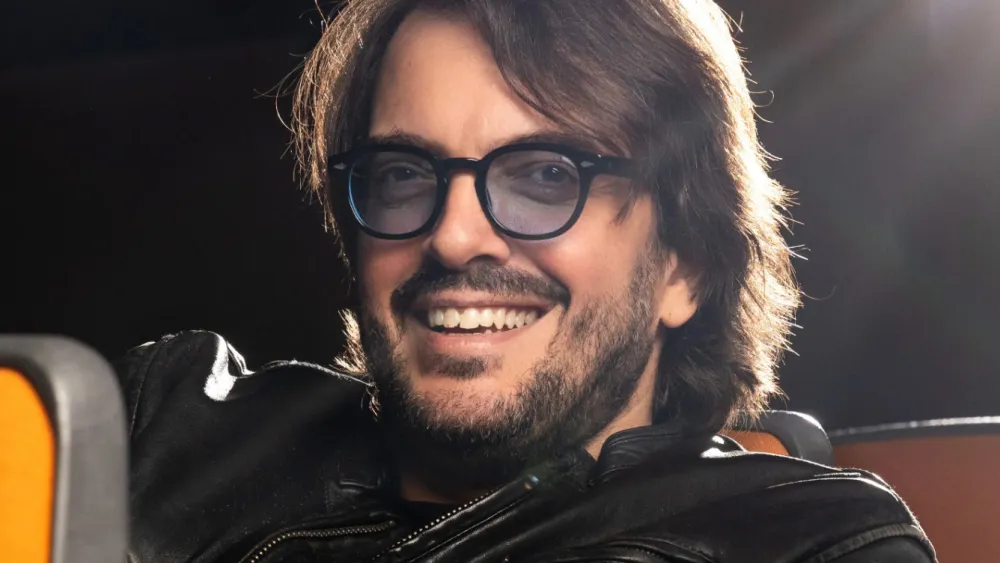
Rodrigo Teixeira, producer of 2025 Oscar winner “I’m Not There” and James Gray’s 2026 Cannes contender “Paper Tiger,” are in development on their fourth film together, to be made in 2027.
“It talks about the U.S. now, not the best moment they have, with probably the worst President in the world,” Teixeira advanced at a masterclass delivered Wednesday at Madrid’s ECAM Forum international co-production market.
“It’s a very difficult time for the U.S. But also, I think it’s a great opportunity because terrible times are a good time to do art.
It’s difficult to do that in the United States, because people who finance [films] are aligned in some way with this government money. Directors will need to do films outside the U.S,” Teixeira added. “American directors will be coming to Brazil to make films in Brazil, The same way they help us, we need to help them. No independent cinema is self-sufficient in any country in the world, not in the U.S. nor any country.
That in fact is already happening. A special guest of Madrid’s ECAM Forum, Teixeira has just wrapped Michael Almereyda’s Don DeLillo adaptation, “Zero K.” It turns on a tech billionaire (Peter Sarsgaard) preparing his young but dying wife (Inga Ibsdotter Lilleaas) for cryonic preservation in a cutting-edge medical facility. Caleb Landry Jones plays the billionaire’s son, battling to build a relationship with his partner (Britt Lower, “Severance”) and her son.
“Zero K’s” key cast is predominately American and international. Wrapping June 6, “Zero K” was shot entirely, however, in São Paulo, Teixeira’s home city and base of his production label, RT Features.
“Shooting an American or a French or a Belgian or a Spanish film in Brazil, I can provide great production value for less money, because we have terrific technicians. Brazilian films are at their peak. We are making great cinema. Brazil’s technicians are film buffs: They are great artists,” Teixeira told Variety.
Teixeira’s ECAM Forum talk comes at a special time for himself and his company. RT Features, which is turning 20. Teixeira will be 50 this December. So he used the talk to reflect on his past, the world’s present and where the global film industry is going.
“Grounded science-fiction,” said Teixeira, and also written by Almereyda, an Alfred P. Sloan Feature Film Sundance winner for “Marjorie Prime” (2017) and “Tesla” (2020), “Zero K.” is produced by RT Features, Keep Your Head, and Oak Street Pictures.
It also forms part of a bigger industry picture. “Peter Sarsgaard and Caleb Landry Jones are American, Inga Ibsdotter Lilleaas Norwegian, Selton Mello Brazilian and Géza Röhrig Hungarian, the director and DP American, the production and costume designer Brazilian,” Teixeira said. “The film underscores a brand new mix with Brazil and you have this new blend in any country and that’s a beautiful blend,” he added.
“We are much more globalized now. What’s happening with the world is a movement, a geopolitical movement. The landscape of cinema is much more international than Hollywood right now. Hollywood now is much more streaming and blockbusters and independent cinema is international,” Teixeira told Variety. “So independent film production will feature either collaborations between the U.S. and countries, or countries alone by themselves,” he told Variety. “Original projects, even American ones, are all together in this worldwide place. The first time you see this is at festivals, and after that, you go to crazy award seasons where you need to travel like a rock band, going to all places, trying to convince people to stay in your side in the end of the day.”
Teixeira should know. Launching RT Features in 2006, few producers anywhere outside the U.S. have lifted off by consistently backing icons of U.S. independent cinema.
The breakthrough, he said in Madrid, came with Noah Baumbach’s “Francis Ha.”
Teixeira, a rarity in Latin American cinema, finances his own films. He was offered the chance to put up $500,000 to make “Francis Ha.” Teixeira loved Baumbach’s films, but hadn’t heard of his partner, then an unknown Greta Gerwig, nor another key cast member called Adam Driver, an ex marine who was going to make a U.S. TV movie. Also the film would be made in black and white.
Yet Teixeira was already into low-budget filmmaking, after his second feature in Brazil, Hector Dhalia’s “Drained,” an edgy obsession dramedy headed by a young Selton Mello, already a telenovela megastar in Brazil. It made back 10 times Teixeira investment.
“I thought, O.K., I have something here. I know how to do this. This is easy for me. And I was learning, and Noah Baumbach was for me, a major director at that time,” he recalled. Baumbach showed him a cut on June 12, 2012 – Teixeira remembers the date. “I saw the film on the screen and I thought, I know I have a success, the same feeling when I first saw ‘Drained.’”
World premiered on a big screen at a basketball stadium at the Telluride Festival, the audience response to “Frances Ha” was “unbelievable,” Teixeira said. And Teixeira, who had spent his early career as a film developer, was suddenly recognized in the U.S. as a film producer.
Teixeira went on finance and produce Kelly Reichardt (“Night Moves,” 2013), Ira Sachs (“Love Is Strange,” 2015; “Little Men,” 2016), Robert Eggars (“The Witch, 2015; “The Lighthouse,” 2019) and Baumbach again (“Mistress America,” 2016) while in 2014 launching with Martin Scorsese Sikelia, a film fund for new directors.
Yet from Luca Guadagnino’s “Call Me By Your Name,” nominated for Best Picture and winner of Best Adapted Screenplay at the 2018 90th Academy Awards, Teixeira has broadened out, making three films with James Gray – “Ad Astra” (2019), “Armageddon Time” (2022) and “Paper Tiger” but also producing Olivier Assayas’ “Wasp Network” (2019) Mia Hansen-Løve’s “Bergman Island,” 2021).
Most notably, along with VideoFilmes and MACT, he produced Walter Salles’ “I’m Still Here,” the first Brazilian Portuguese-language film by a Brazilian director to be nominated for Best Picture and to win an Academy Award in the International Feature Film category.
RT Features’ upcoming slate takes in not only “Zero K,” but also “Glaxo,” directed by Argentina’s Benjamin Naishtat and starring Lali Espósito, Esteban Lamothe, Esteban Bigliardi, and Marcelo Subiotto as well as Guatemalan Jayro Bustamante‘s upcoming dramatic thriller “República Luminosa.” Teixeira announced Wednesday with Variety just before his masterclass “Bodies of Summer,” a new film directed by Argentina’s Iván Fund. RT Features is also in post-production on “Wolves,” directed by Rami Kodeih and inspired by the real-life collapse of Lebanon’s banking system in 2019.
In 2025, Teixeira shot eight films, two in Brazil and Romania, and one in the U.S., Chile, Argentina, and Lebanon. In 2026, “I’m doing a film for the first time in Asia in Cambodia and a film from a director from Singapore who is based in New York which we might bring as an American film to shoot in Brazil.” That fits in with one of Teixeira’s missions going forward.
“I am trying to internationalize Brazilian technicians. As a producer, that’s part of my job, to introduce these technicians to the world. At 50, I’m much more able to do that and much more mature to present these people to other audiences. I love to do that. That’s my new moment. I’d love to be able to do that for a while. If I’m able, I will do that.”
Teixeira’s surge into international reflects a sea-change on independent cinema finance and his own personal passions, Teixeira confessed at ECAM Forum. Teixeira loves to travel, literally and metaphorically. He will shoot Bustamante’s “República Luminosa” because that gels with the issues in the film.
Also, “Why not? I have never been to Guatemala,” he said at ECAM Forum where he talked about how he chooses his projects – I go with my instinct” – and his responsibility as a producer – “to take bullets for directors.”
“In the 80s, I was crazy about National Geographic magazines because I could travel reading them,” Teixeira said in Madrid. “Now I travel making films. I’m going to go to Guatemala to make a film. With James Gray I’ve traveled to the moon, Mars, Neptune, Saturn and Uranus. With a film you can go back to the 18th century. That’s what films give to me: I travel in time, space and countries. That’s the best for me. I’m not going to have a better life.”
Source: variety.com