








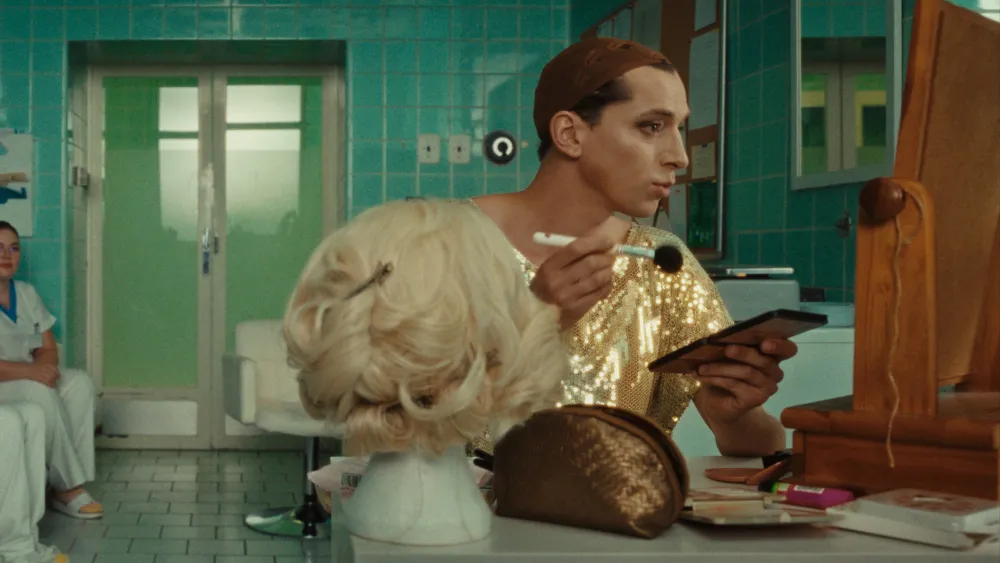
Momentous events such as the sale of the family home, a young man coming out to his family, or the staging of a drag performance in a small town would seem like perfect ingredients for an intensely dramatic, conflict-ridden film. But in his fourth feature “Chica Checa” — premiering in the Crystal Globe competition at the Karlovy Vary International Film Festival — young Czech director Šimon Holý seems determined instead to lower the temperature as much as possible, crafting a pleasant comedy-drama where there is never any doubt that all will be fine in the end.
although the film’s festival profile, then, it is better approached not as an arthouse proposition, but as a commercial, middlebrow crowdpleaser aimed at local audiences, albeit with slighty edgier subject matter than most titles of its ilk. But even from this particular perspective, Holý’s film remains an unconvincing work, too clumsy both formally and thematically to leave much of an impression.
Zdena (Pavla Tomicová) is a middle-aged woman living alone in a rather large house in a Czech village, spending most of her time at her ailing mother’s bedside in the hospital. In one of many small but nagging inconsistencies, characters repeatedly refer to her isolation and reluctance to socialize since the death of her husband some years ago — despite the film opening on Zdena at a dance, and her later attending a house party.
That feeling of will-this-do filmmaking is pervasive, from the unflatteringly garish, TV-level costume design, to the inexplicable use of a wide lens on several random occasions. It is most palpable, however, on the level of the storytelling itself. Potential sources of tension are introduced in such wooden and contrived ways, to make such obvious and worthy arguments, that the film in such moments comes to resemble an educational video.
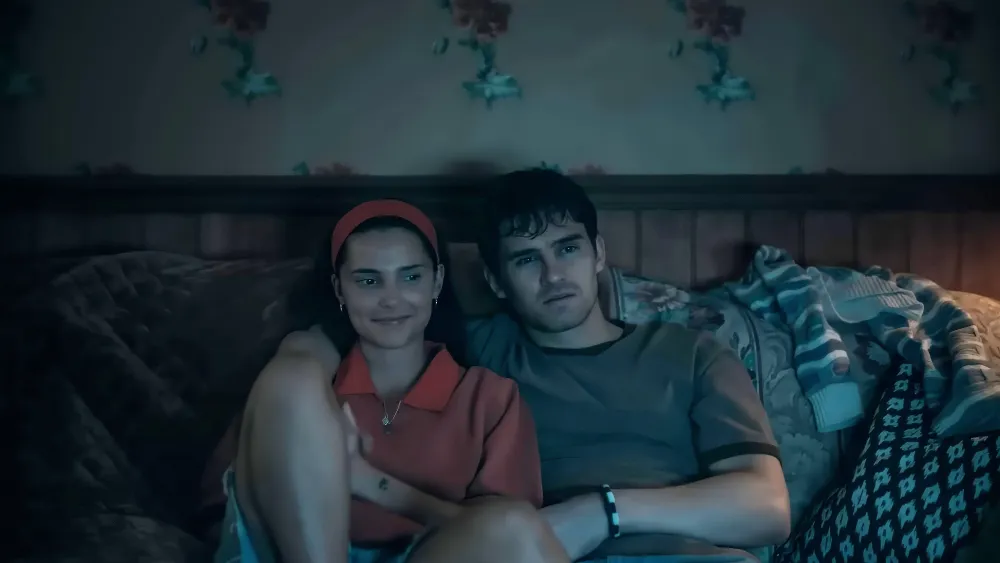
Soon after she gets an offer to sell her family home to a rich woman from the city, Zdena gets a rare and extended visit from her adult son, Lukáš (Jan Cina), who lives in France. As they watch TV together one evening, she uses a homophobic slur, prompting Lukáš to come out to her as gay, and tell her that he works as a drag queen: a textbook example of a coming-out story, complete with the mother’s tearful reaction, now in illustrated form.
Yet when the two characters wake up the next day, both of them are immediately over the hurtful argument from the night before. On the one hand, this kind of easy resolution comes across as lazy writing. But there is also in “Chica Checa” a recurring suggestion that people are too nice and too reasonable for conflicts to ever truly last. This naive point of view could work well in a more finely crafted, confection, with the clichés becoming part of the pleasure. “Chica Checa” at times promises precisely this kind of low-effort delight, but is too uneven to make it work.
While relying on established tropes for its story and characters, their flow is interrupted by inconsistencies and clunky mistakes. One particular sequence, where Lukáš throws a tantrum about his mother being stuck in the past, comes out of nowhere, its sole apparent purpose to inject a very small dose of conflict — soon resolved — in a film that threatens to flatline.
There’s a bigger problem here, however. In its relentless positivity, “Chica Checa” could be seen as an attempt to normalize, through positive representation, lifestyles and sexualities that may seem abhorrent to older generations such as Zdena’s. But there’s a very thin line between this worthwhile impulse and the glib idea that motherly love shall always overcome deeply ingrained intolerance. The film draws much of its mild humor from various moments where Zdena plucks up the courage (!) to tell an acquaintance that her son has a boyfriend — but it is reasonable to wonder what might happen should she meet someone who does not react with a harmless little quip.
This gaucheness around homophobia is echoed in the film’s tonal indecisiveness. Because it is Zdena’s sunny disposition that papers over every crack and solves all conflicts in “Chica Checa”, it is Tomicová’s job to make her optimism believable. The actor opts for an intensely expressive performance of wide-eyed wonder and motherly meekness, so mannered as to pull the film towards artifice. But Cina’s naturalistic turn as Lukáš, and the much higher stakes for his character, ground the film in a semblance of reality. The friction between the two registers only produces a feeling of disjointed awkwardness; perhaps a less earnest, more screwball-esque approach could have pulled off this uneasy combination.
Source: variety.com