








-

Myron Medcalf
WACO, TEXAS — THE MOST controversial signing in men’s college basketball history began with an unexpected proposition.
During an October visit to Baylor, Deirunas Visockas — a former Boston College player-turned-agent — discovered the Bears were in need of a big man due to injuries. Coincidentally, he represented a player looking to revive his career.
“I suggested, ‘What about James Nnaji? Would you guys be interested in exploring that option?'” Visockas recounted to ESPN. “And here we are now.”
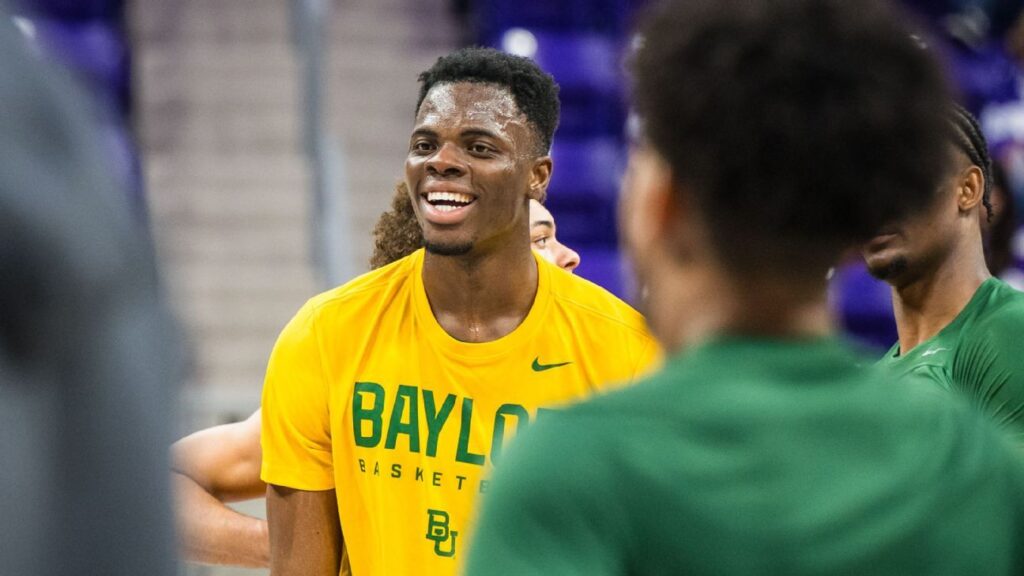
This fortuitous meeting triggered a series of events that positioned Nnaji — the No. 31 pick in the 2023 NBA Draft and the first men’s basketball player cleared by the NCAA — at the center of a significant controversy. Baylor’s announcement of his signing on Christmas Eve drew sharp criticism from esteemed coaches like Tom Izzo and John Calipari. Fans at his debut in TCU jeered him, and social media lit up with hostile remarks directed at him through his recently reactivated Instagram account.
“I was receiving a torrent of insults and profanities — really harsh things aimed at me,” Nnaji expressed. “I thought, ‘What did I do wrong? I’m as young as everyone else here.’
Nnaji didn’t foresee that his choice would ignite a nationwide conversation on who should be eligible to play college basketball. Prior to moving to Texas, the 7-footer from Nigeria had played professionally in Europe. After being drafted, he participated briefly in the NBA Summer League but didn’t secure a contract. Still within the five-year time frame from what would have been his high school graduation, this meant Nnaji met the NCAA’s eligibility criteria.
As the landscape of college sports continues to shift, teams are exploring every possible avenue to gain an advantage — including navigating the blurred lines defining a professional versus an amateur basketball player. Prior to Nnaji’s arrival at Baylor, two G League players were signed by Division I teams, while former European professionals are increasingly seen within college basketball. Though some coaches criticized the midseason timing of Nnaji’s addition, the Bears felt they were ahead of the curve.
“You have two options: participate or be left behind,” Baylor head coach Scott Drew stated. “At first, I was against the idea of recruiting G League players. I didn’t want to go that route, but we don’t make the rules. If they say you can drive 80, then you drive 80. If you stick to 70, you’ll be overtaken.”
Nnaji has become a focal point for the discussions surrounding the inclusion of experienced, elite talents with NBA backgrounds in college basketball, which could lead to disparities in competition. but, it’s crucial to remember that Nnaji, now 21, is still recuperating from back surgery and is in search of a fresh opportunity with a Baylor team that began Big 12 play with an 0-3 record.
“Okay, I got drafted, but many players I competed against in Europe are now living the same life. So why is there so much animosity directed at me?” Nnaji, currently averaging 2.5 points and 4.3 rebounds, questioned. “I didn’t break any rules. I wasn’t trying to circumvent anything.”
NNAJI DIDN’T start playing basketball until he was 12.
At 6-7 and wearing size 13 shoes, Nnaji stood out among a group outside his mother’s store in Makurdi, Nigeria, when a former professional soccer player recommended introducing him to basketball. He went to the gym that day and fell in love with the game. He quickly honed his skills with his newfound size and athleticism and shared a highlight reel on Facebook in 2018 that caught the attention of a professional league in Hungary. Just months later, only two years after first touching a basketball, Nnaji left for Europe on the first flight of his life.
“We didn’t even know how to get to the airport,” he recalled.
In Hungary, he found himself among more experienced players. He even questioned his coach, “Why are we running plays?” The structured approach was foreign to him, as was a community speaking an unfamiliar language. After a rough first week abroad, when he fell off a bed that was too small, he contemplated returning home.
“I realized this was my chance to improve my family’s circumstances,” he reflected. “So I had to stay strong.”
Choosing to remain in Hungary transformed his life. He grew close to teammates who became lifelong friends and adjusted to his new surroundings. He also began to excel, which led to FC Barcelona — one of the elite EuroLeague teams — signing him at just 16 years old. Three years later, he entered the 2023 NBA Draft just a couple of months before his 19th birthday. That evening in Brooklyn, he was selected by the Detroit Pistons and subsequently traded to the Charlotte Hornets, a team without a spot for him on its roster due to having five players 6-9 or taller.
Younger international prospects like Nnaji, whose rights were later traded to the New York Knicks in connection with the Karl-Anthony Towns trade with the Minnesota Timberwolves, are often labeled as “draft and stash” players. The teams that select them don’t always have detailed plans and generally allow them to return to Europe. Should they develop later, teams can then pursue contracts.
Unfortunately for Nnaji, that scenario didn’t unfold. He returned to FC Barcelona post-draft, and his closest interaction with the NBA happened during two summer league stints in 2023 and 2025. A chronic back issue ultimately sidelined him, requiring surgery in June 2024. After a lengthy recovery process, he re-injured his back during the summer league the following year, necessitating another six months for recovery. afterward, in August, he and FC Barcelona mutually decided to part ways.
When Nnaji came onto Baylor’s radar that fall, he was staying in Spain. He had journeyed through four countries in pursuit of his basketball aspirations and hadn’t returned to Nigeria since he was 12. also, he wasn’t fit enough yet to join team scrimmages.
He craved the fresh start that Baylor represented.
“I had just begun rehab when my agent called and asked, ‘Would you like to attend college?'” he recalled. “And I said, ‘Yes, I just want to play basketball and grow because I’ve been through a tough past couple of years. I’m looking for something new, a fresh start to get back on track.’
WHEN NNAJI’S SIGNING was revealed by Baylor in late December, Izzo voiced his discontent: “Shame on the NCAA,” he remarked to reporters. Calipari pointed out that “players who are 28 years old, guys from Europe” were infiltrating college basketball. Meanwhile, Dan Hurley tweeted, “Santa Claus is handing out mid-season signings…that’s absurd!!”
but, prior to Nnaji’s signing, Louisville (with London Johnson) and Santa Clara (with Thierry Darlan) had signed players with G League experience — additional acquisitions that Izzo had previously criticized.
“I’m not enthusiastic about the NCAA or whoever is making these choices without consulting us, just permitting this,” Izzo said in October. “They’re anxious about being sued.”
Izzo’s remarks highlight a common concern among his colleagues — that the NCAA may lack the authority to block a young NBA or two-way player from securing an NIL deal and returning to college basketball.
Division I regulations stipulate that any professional player who has received more than “actual and necessary expenses” — which include health insurance, meals, lodging, and travel — is ineligible to play college basketball. but, there’s considerable debate over what specific amount constitutes that limit, especially with the NCAA recently allowing European professionals making six figures or more abroad.
For many years, players desiring the highest pay had to look beyond college basketball. Yet with the introduction of NIL and profit-sharing, college programs occasionally offer more than any league outside the NBA. A G League player’s average salary hovers just above $40,000, while average EuroLeague players reportedly earn between $500,000 and $800,000. Some Division I athletes are earning more than all those salaries combined this season.
With complex regulations and substantial financial incentives available to elite talents, more professionals may feel empowered to challenge current NCAA policies.
“I believe an NBA player [or a player on a two-way deal] could mount a solid legal case for eligibility,” suggested Mit Winter, an NIL attorney and former Division I player. “What’s the difference between European pros in top European leagues and NBA players — aside from the fact that perhaps NBA players are more skilled?”
In response to Nnaji’s signing, NCAA president Charlie Baker clarified that NBA and two-way players would not be eligible to play college basketball. Yet it wasn’t long ago that players weren’t allowed compensation until courts ruled against the NCAA. They could potentially do so again if a case arises.
The backlash and fears surrounding this situation fell squarely on Nnaji. Admittedly, the Knicks — who still possess his NBA rights — could decide to bring him back at any time. Yet for Nnaji, enrolling at Baylor was merely a route back to playing basketball. He never anticipated that his quest to return to the court would make him a figure of disdain.
“We anticipated the feedback because a former NBA draft choice moving to college is a significant event,” Visockas, Nnaji’s agent, shared. “but, we didn’t expect it to escalate to this degree.”
STILL NAVIGATING life on an American college campus, Nnaji hasn’t yet furnished his apartment. He arrived in Waco in late December and is still cautious about walking the streets, worried he might end up on a highway. He initially focused on finding a great place to eat.
“I enjoy all the rice, beans, and meat. I have come to like it,” Nnaji said while gesturing to express his enthusiasm for a new culinary find. “I’ve forgotten the name of the place. Oh yes, Chipotle.”
Having secured fast-casual accommodations, Nnaji turned his focus to basketball.
A mere 72 hours after his arrival, Nnaji made his debut in a college game, scoring five points in 17 minutes against TCU. Every time he touched the ball, the crowd responded with boos. One opposing player reportedly told him, “You don’t belong here.”
In Europe, he competed against fans lighting fires and police shielding players from objects hurled from the audience. Nnaji stated these experiences equipped him for an antagonistic environment — but the level of hostility he faced at TCU was unprecedented.
“The difference was this time it was personal,” he stated, reflecting on the ire he encountered compared to European games.
Nnaji, cleared to resume workouts in early December, is striving to regain his fitness. During a recent practice, he utilized a stationary bike during downtimes, perspiring until summoned back to the court. Baylor coaches continuously guided him through the abbreviated version of their offense.
He’s resolute in his commitment to improve. Following his team’s loss to Iowa State last week, he approached Baylor strength coach Charlie Melton and declared: “I need to get stronger.” They immediately embarked on a late-night squat session.
In addition to the basketball learning curve, he’s working to bond with his teammates. He now leans in for their pregame shoulder-bumps. Team sushi dinners also foster camaraderie. They have embraced him without judgment. On the day he arrived, he participated in a game called “hot seat,” where he answered light-hearted questions in front of the team.
“One of the questions was, ‘What would you like your teammates to do to help you feel more at ease with the team?'” senior guard Dan Skillings Jr. shared. “And he replied, ‘Just talk to me.’ It’s real and simple because … anyone joining midseason would appreciate their teammates reaching out to them.”
Nnaji is scrutinized more for symbolism rather than his actual identity. He isn’t a national award contender or a game-changing player for Baylor. He is simply a young athlete with dreams in a new city.
“Let’s prioritize being human before focusing on the sport,” he emphasized. “Let’s show empathy. in the end, the controversy doesn’t disturb me because I’m here to fulfill my role, contribute to the team, and improve.”