








-

Ed Dove
Morocco has openly expressed its ambition to create history at the 2025 Africa Cup of Nations, yet even in their wildest dreams, they, like the rest of us, could not foresee the dramatic conclusion that unfolded—filled with bitterness, rivalry, and near diplomacy crises, as two footballing nations approached the brink of conflict in Rabat.
The aspirations of the hosts now lie in ruins.
Their lengthy 50-year wait to reclaim dominance in African football remains unfulfilled. There was no dreamy title celebration on home soil, no triumphant moment for FA President Faouzi Lekjaa, cherished by his own supporters, summoned by the King, and accompanied by Gianni Infantino and Dr. Patrice Motsepe, as this 15-year dream culminated on January 18, 2026.
That alternative scenario is now impossible.
What we were left with was a sensational, perplexing, and chaotic finale to this captivating month of football, featuring 20 minutes of second-half stoppage time that will be examined, scrutinized, and debated for years to come.
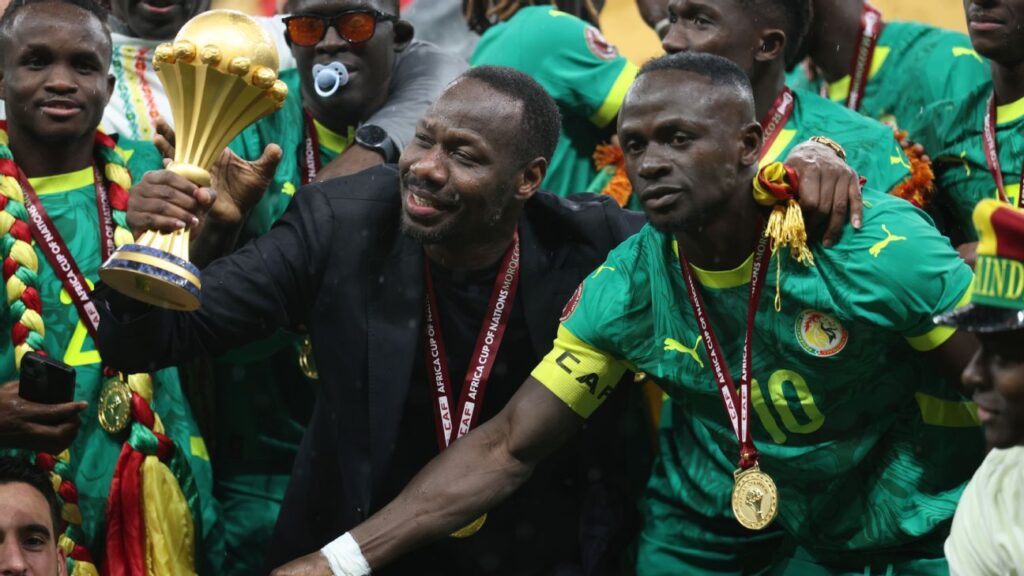
Let’s outline the main facts: Senegal secured the title, their second in three tournaments and only their second overall, with Pape Gueye scoring an explosive winner during extra time, as Morocco missed a last-minute penalty that could have clinched victory in regular time… or, at least, during the final moments of stoppage time in the second half.
Yet amidst the uproar surrounding this match, the result and the title almost felt secondary to two pivotal penalty decisions that nearly led to an unprecedented abandonment of a major international final… one could certainly argue that an abandonment would have been the right choice.
Initially, Senegal seemingly scored the decisive goal in the third minute of the eight allotted minutes of stoppage time—an extended duration due to a facial injury suffered by Neil El Aynaoui that required considerable medical attention.
Ismaïla Sarr, bending low, headed in after Abdoulaye Seck’s header bounced off the crossbar beyond Yassine Bounou.
Senegal erupted in celebration, marking their first goal in an AFCON final, having previously failed to score in 2002, 2019, or 2021. but, their joy was short-lived as they soon realized that referee Jean-Jacques Ndala had blown his whistle preceding the goal, citing a push by Seck on Achraf Hakimi while securing space for his initial header.
While Seck’s hands did appear to be on Hakimi, the Paris Saint-Germain defender was also engaged in the tussle. Yet, the nature of his exaggerated fall suggested the foul was not as conclusive as Ndala initially deemed.
The referee chose not to consult VAR, ignoring Senegal’s fervent calls to do so, and allowed play to continue.
Moments later, a Morocco corner resulted in Brahim Díaz—who had shone throughout the tournament—falling under the challenge from El Hadji Malick Diouf, an incident which Ndala seemingly overlooked at first.
but, Díaz was incensed, refusing to let Diouf’s challenge go, and began to confront the linesmen, getting in the referee’s face and rallying the 66,000-strong crowd at the Prince Moulay Abdellah Stadium to support his cause. The jumbotron conveyed his emotional appeals, while VAR was signaled and tensions grew among the crowd, who sensed an opportunity to capitalize on the minor incident that could secure them a title.
Eventually, Ndala relented, and by that time, it seemed half of Morocco’s bench had flooded onto the pitch, imploring him to check the monitor. Receiving instructions through his earpiece indicating a review was necessary, he approached the touchline screen, with players and coaching staff from both sides gathering around him as he recounted the incident.
When he awarded the penalty, it was reminiscent of West Side Story, as both teams—previously celebrating the unity of these two brother nations ahead of the final—confronted each other, tensions rising as they debated the fairness of resorting to VAR to confirm one pro-Morocco incident while ignoring a similar opportunity concerning Senegal.
The palpable sense of injustice reached Senegal’s supporters, a small cadre of yellow and green amidst a sea of red. The renowned Gaindé supporters group, typically known for their peaceful, inclusive nature and spirited dancing, seemed ready to take action.
Some were intent on storming the field to confront officials and protect their players amidst Morocco’s physical challenges, while others clashed with stadium stewards, attempted to vault barriers, and rushed toward police and officials, as Moroccan authorities sent reinforcements to control the situation.
Some supporters, draped in yellow, were escorted away by officials, while others launched projectiles at the stewards, one of whom required stretcher assistance due to an upper-body injury.
Some fans climbed onto the electronic advertisement boards, attempting to dislodge them, trampling the 1XBET boards until they collapsed, rendered powerless.
Gradually, the overwhelming presence of riot police and officials from Morocco succeeded in restoring order, albeit after considerable delay, while on the pitch, matters took a different direction.
Seemingly spurred by enraged head coach Pape Thiaw, Senegal’s players began to exit towards the tunnel, leaving only Sadio Mané to mediate in an effort to salvage the match.
Thiaw’s motives were unclear, with theories suggesting a mix of ongoing security threats and disapproval of the officiating as the main reasons for his actions.
“What we felt was injustice,” said match-winner Pape Gueye in an interview with ESPN. “There had been a foul against us earlier, and the referee opted not to consult VAR, leading to our frustration.”
For several tense minutes, the outcome of the match was uncertain. Would Senegal abandon the final moments of a major continental game? Could Morocco’s 50-year quest end in such a manner? Were Thiaw’s security concerns a legitimate excuse for withdrawing his players?
After discussions with former Senegal head coach Claude Le Roy and others, Mané eventually signaled for his teammates to return to the pitch. but, by that stage, tensions between the players were once again flaring into physical confrontations, with Seck and Ismael Saibari glaring at each other.
“Sadio encouraged us to come back on the pitch, to refocus,” Gueye shared, noting that in a week where conversations around the Nobel Peace Prize swirl, Mané’s display of composed leadership in the face of such turmoil deserves recognition.
It felt surreal as Díaz, who had waited over ten minutes to take the penalty he ardently sought, finally stepped up to the spot amidst additional riot police maintaining order across the stadium.
Should the game even continue under such circumstances?
Díaz’s demeanor shifted noticeably; he appeared almost disheartened and isolated as he approached the ball, placing it on the spot that Édouard Mendy had been cautioned for attempting to scuff.
And then he missed.
1:29
‘Worst penalty I’ve seen in my life!’ – Udoh on Brahim Diaz’s Panenka
Colin Udoh analyzes the chaos in the AFCON final between Morocco and Senegal ahead of Brahim Diaz’s missed penalty.
This was not merely a missed penalty; it was a notorious blunder as the Real Madrid star approached the spot with intensity, then slowed his stride, delivering a lackluster panenka straight into Mendy’s hands.
Instantly, murmurs arose that perhaps he had intentionally botched the kick, choosing to fail as a hero over winning as a villain. but, this theory is difficult to validate given his determination in arguing for the foul, his affectionate gesture to the ball prior to kicking, and his decision to attempt a panenka instead of blasting it wide.
If Díaz did experience a sudden change of heart, perhaps believing that, considering the injustices of the preceding minutes, victory in that manner wasn’t worth pursuing, the shift in his demeanor was conspicuous.
The absence of any celebration from Senegal following Mendy’s save produced an eerie acceptance, and Díaz’s immediate retreat to the center-circle suggested an unspoken agreement. Where were the reactions and responses expected amid such high-stakes tension? Why did no player rush to thank or congratulate Mendy for keeping their AFCON hopes alive?
Another alarming possibility casts a harsh light on Díaz—did he, amid the historical pressures bearing down, opt for a chip shot against Mendy, a goalkeeper known for his prowess on panenkas, instead of simply driving the ball home—or even allowing Youssef En-Nesyri to take it—and ultimately heap humiliation upon himself, denying Morocco a glorious moment while an entire nation held its breath?
Perhaps he simply lost his composure as pressure mounted, with emotions heightened by the delay and the stakes. Maybe his nerve faltered precisely when it mattered most.
We may never know if Díaz sacrificed himself for fair play’s sake or if he merely performed the most calamitous failure the sport has ever witnessed, but that moment was as bewildering as it was astonishing.
In hindsight, it might be preferable that the match concluded with Gueye’s thunderous extra-time strike rather than Díaz’s stoppage-time penalty, which could have lingered in history as a tainted outcome, potentially damaging Morocco-Senegal relations irreparably.
Thiaw could rival Díaz as a figure of controversy, especially if it is confirmed that he withdrew his players as a protest against officiating.
“Considerable time lapsed before [Brahim] could take the penalty, and that affected him,” asserted Morocco’s head coach Walid Regragui to ESPN. “The match exemplified disgrace for Africa.”
“What Pape [Thiaw] did tonight does not honor Africa. He is now an African champion and can voice his opinions, but halting the match for over ten minutes is unacceptable,” he continued. “That doesn’t absolve Brahim for his penalty miss—he did what he did, and we must own it. We should focus on moving forward and acknowledging that Brahim missed.”
It’s essential to note that Thiaw’s actions should not solely be viewed through the lens of those two incidents; they stemmed from a broader narrative that arose during the tournament reflecting a belief that Morocco had skewed circumstances to their advantage in their zealous quest for AFCON victory.
From Hugo Broos’s remarks regarding South Africa’s training conditions to Tom Saintfiet’s complaints about unequal officiating in Mali’s group-stage match against the hosts, to Akor Adams’s insistence that reporters interview the referee following Nigeria’s semifinal exit to the Atlas Lions, and the football staff’s consistent interference—these themes have developed throughout the tournament, evoking echoes of Argentina’s manipulation of the 1978 World Cup.
Senegal too has faced these challenges, but they came well-prepared.
On Friday evening, Senegal’s federation issued a statement lamenting four key issues regarding the treatment they received leading up to the final—accommodation, logistics, training facilities, and ticketing—pressuring the Confederation of African Football to acknowledge the impartiality of the organizers.
They were also ready for attempts to disrupt play, such as during the final when Mendy’s goalkeeping substitute had to forcibly retrieve the keeper’s towel from four Moroccan assistants, who were supposed to help maintain the match’s integrity, not interfere.
Even Hakimi got embroiled in this towel-snatching incident, reflecting Morocco’s desperation to extract every possible advantage they could muster beyond their formidable technical and tactical prowess.
This is not to condone Thiaw’s conduct, but rather to place it within a context that illustrates the scope of his actions as part of a wider protest—not merely a response to two controversial calls.
“When a head coach instructs his players to exit the field, particularly against a backdrop of claims that started in the press conference [where Senegal denounced Morocco’s unsportsmanlike conduct], he must maintain dignity in both victory and defeat,” Regragui remarked, holding Thiaw accountable for igniting the chaotic scenes that surrounded the extended stoppage time.
It remains uncertain whether Senegal will face repercussions for their threat to abandon the match, or how such behavior would play out at the World Cup, particularly in a clash against France, for instance; whether this will establish a precedent whereby teams threaten abandonment following contentious VAR decisions.
As with Díaz, how will history judge Senegal? Will they be remembered for standing against injustice on the grandest platform, displaying resolve and risking their AFCON campaign? Will they be perceived as revolutionaries against VAR? Will they be criticized for their petty behavior and poor sportsmanship, having won the Nations Cup despite abandoning the contest mid-way through? For delaying the restart in a bid to disrupt Díaz to the extent he collapsed under pressure, only to return to seize victory?
And what about the Africa Cup of Nations itself? This tournament is at a crossroads, grappling with crises of identity, reputation, and existence—largely exacerbated by its own stakeholders—and its global standing (entertainment notwithstanding) is unlikely to improve from a night that will be remembered for its infamy.