








-

Andrea Adelson
MIAMI GARDENS, Fla. — A year ago, Indiana made its mark in college football, but many found it hard to envision the historically struggling program maintaining its momentum. Critics scrutinized their schedule, labeled them a fluke, questioned their right to participate in the College Football Playoff, and dismissed them following an early exit against Notre Dame.
A charming tale, those Hoosiers. But seriously, they should let the real football be played by the true blue bloods.
Enter the Curt Cignetti staredown.
Look him up again for context. The man has an impeccable record.
Critics might’ve branded Indiana as a one-hit wonder after they started 2025 ranked No. 20 and were pegged to finish sixth in the Big Ten according to preseason media predictions.
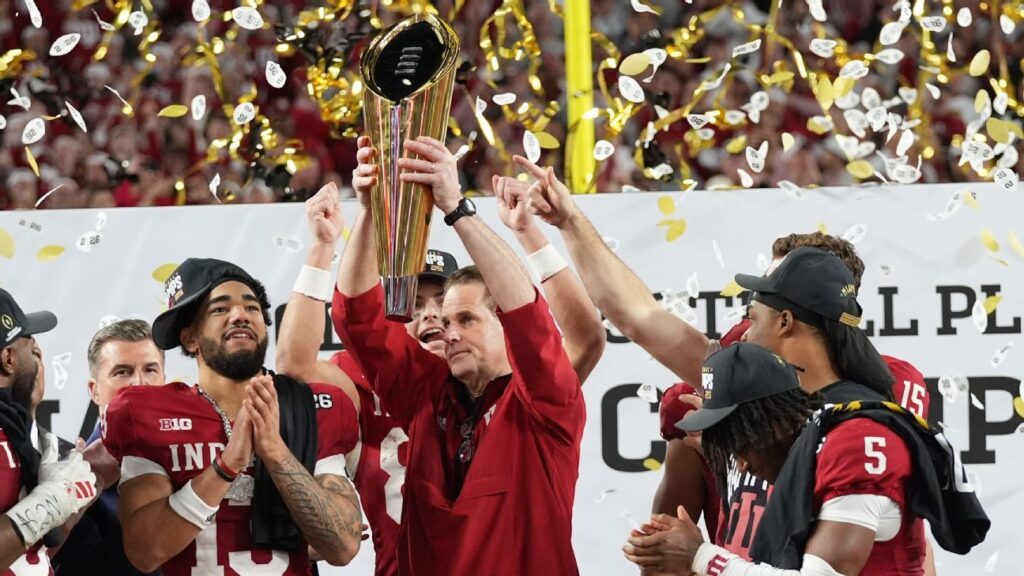
Motivated by perceived slights and determined not to revert to mediocrity, Indiana orchestrated a remarkable turnaround, completing a legendary journey reminiscent of “Hoosiers” — clinching its first national championship while becoming the first major college team since Yale in 1894 to complete a 16-0 season.
“It’s a remarkable story,” Cignetti stated. “Most informed observers would agree it’s one of the greatest stories in sports history.”
While Indiana may not have triumphed by a wide margin as in previous playoff performances, the Hoosiers displayed the same confident style. The pivotal play: on fourth-and-4 from the Miami 12 with Indiana leading by three, Cignetti called a quarterback run for Fernando Mendoza. He surged through the Miami defense, breaking tackles to cross into the end zone.
This moment encapsulated the season: Cignetti trusting himself and his players, with Mendoza rising to the occasion.
When asked if Indiana could be considered a “Cinderella story” given its prior success, Cignetti replied in his signature manner, playfully asking, “Define ‘Cinderella story’ regarding Indiana. I’m not entirely certain what you mean.”
For those interested, a quick search of “Cinderella story” yields the following:
Noun. Referring to a situation where a person or team of low status or importance unexpectedly achieves significant success or public recognition.
Back in 2022, Indiana became the first Division I college football team to reach 700 losses. Now, they stand as national champions, having defeated Miami 27-21.
After providing the definition, Cignetti concluded, “I think that’s factual. Considering Indiana’s football history relative to our success over the past two years, we’ve shattered numerous records regarding wins, championships, postseason games, and top-10 wins.”
“It feels almost unreal.”
Though a sense of disbelief may linger around this title victory, Cignetti confidently proclaimed upon his hiring in 2023 that the Hoosiers would win, even addressing the top teams of the Big Ten the next day at a basketball game.
Hey, I’m really excited about this opportunity. I’ve never backed down and don’t plan to. Purdue is inferior! So are Michigan and Ohio State! Go IU!
While outsiders might have scoffed, those within the football program, athletic department, and in Bloomington rallied together.
Cignetti ensured this unity.
WITH THE FIRING OF coach Tom Allen in 2023, university leaders were ready to elevate the football program. School president Pamela Whitten laid the framework for these changes.
Upon her hiring two years prior, Whitten’s responsibilities included enhancing Indiana athletics. This transformation occurred amidst a significant period in college sports, where the transfer portal and NIL agreements allowed for a more competitive landscape, providing opportunities for more than just a select few programs to vie for championships.
“We needed to secure substantial funding for both financial and physical resources,” Whitten explained. “When we were ready to onboard a coach, he needed a favorable ecosystem to thrive.”
Whitten and athletic director Scott Dolson, an Indiana lifer who had once served as a student manager for Bobby Knight, discussed the qualities they envisioned in their next coach. During their meeting with Cignetti, Whitten remarked, “It felt less like an interview and more like a harmonious blending of our approaches, values, and objectives—like seamlessly merging on a highway.”
though Cignetti didn’t promise a national title in two years, he avoided imposing any restrictions on Indiana’s potential.
Dolson reflected on a conversation with his brother-in-law, a former Indiana player from the 1980s under Bill Mallory, who led the Hoosiers to six bowl appearances.
“He asked me, ‘Why don’t we ever think big enough? We should aspire for championships, not just bowl games,'” Dolson recalled. “That mindset stuck with me. Crafting a comprehensive plan to build a winning program is vital. Coach Cig expressed the same vision from the start.”
After leaving his position as an Alabama assistant at the end of the 2010 season to become head coach at Indiana University of Pennsylvania, where his father had once coached, Cignetti took a significant pay cut and invested in himself. Now, his investment was on Indiana.
Cignetti set about constructing the program as he had previously done at Division II IUP, Elon, and James Madison, where he reached the FCS playoffs in his inaugural season as head coach. Remarkably, he achieved playoff appearances at all three programs within two years.
Cignetti prioritized character and productivity over four- or five-star recruits, seeking hard workers who would prioritize the team above individual interests. He personally approved every personnel decision, recruiting 23 players who either coached or played under him at James Madison.
In his 13 seasons as head coach, Cignetti had never experienced a losing season. Now, at the historically losing FBS program, changes were inevitable—but not at the expense of Cignetti’s resolute approach.
AFTER GOING 11-2 AND losing to Notre Dame in the first round of the 2024 College Football Playoff, Indiana used this experience to launch its next season. Cignetti believed the team could achieve even greater heights and sought new talent via the transfer portal.
One of his first calls was to Mendoza, then California’s quarterback. Mendoza had the qualities Cignetti sought. An overlooked high school recruit who had almost committed to Yale before Cal made an offer, Mendoza overcame numerous quarterback competitions and setbacks to enjoy a stellar 2024 season. He gained notoriety after leading a dramatic 98-yard game-winning drive against Stanford, famously stating, “I’ll remember going 98 yards with my boys.”
Team above self.
Mendoza received interest from various programs but recalled Cignetti’s specific pitch: “If you come here, you’ll develop into an exceptional quarterback.”
Among the 22 transfers joining Indiana were running back Roman Hemby, receiver E.J. Williams Jr., center Pat Coogan, right tackle Kahlil Benson, defensive tackle Hosea Wheeler, and defensive backs Louis Moore and Devan Boykin. They arrived to find a team motivated not to be defined by their playoff loss.
“There was significant skepticism about last year’s success being a fluke,” Cignetti said. “That initial team achieved remarkable feats that laid the foundation, and much of the negative media sentiment fueled the returning players.”
As the squad’s quarterback, Mendoza recognized the importance of bonding with his team immediately. His first task was memorizing every teammate’s name, aided by keeping roster photos handy.
“If I didn’t get them right the first time, I kept trying until I did,” Mendoza shared. “Whether someone is a star linebacker or a walk-on, I care about you because I aim to enhance our team and lead effectively.”
Leadership manifested in various ways during offseason workouts. Tight end Riley Nowakowski recalled receiver Elijah Sarratt encouraging teammates to complete one extra rep after their sessions, soon inspiring others. “One more rep” became a mantra, with Sarratt rallying his teammates just before the national championship game, shouting, “One more rep!”
“Finishing the last season with a loss to Notre Dame prompted us to ask, ‘What’s next?'” Sarratt recounted. “I committed to putting in that extra effort. Initially, I was working hard alone, but soon I motivated a fellow receiver, and now the entire offense has joined in.”
“This reflects the desire to commit fully to being the best, pushing oneself, and recognizing that excellence requires special discipline, work ethic, and focus,” Cignetti remarked. “These players strive for improvement daily.”
They were eager to showcase this dedication when the season commenced on August 30 against Old Dominion.
“even if social media labeled us as a ‘Cinderella story’ pre-season, we held internal belief in our potential behind closed doors,” Mendoza stated.
STARTING THE YEAR RANKED NO. 20, Indiana secured victories over Old Dominion, Kennesaw State, and Indiana State, but the first major test loomed in Week 4 with No. 9 Illinois visiting.
Disregard that — Illinois proved to be no challenge.
Indiana steamrolled the Illini 63-10, with Mendoza throwing five touchdown passes and only two incomplete throws, marking their first top-10 win in five years. Following the game, Cignetti commented, “This performance is bound to catch attention.”
“In the locker room beforehand, we emphasized that ‘This game doesn’t have to be close,'” defensive lineman Mikail Kamara noted. “Even with the hype surrounding it, we believed we could win by a wide margin. We started strong, and though they weren’t our biggest challenge, we defeated a dragon.”
Indiana gained even further recognition after going on the road to upset No. 3 Oregon 30-20 on October 11. With the score tied early in the fourth quarter, Indiana scored the final 10 points, securing victory with an 8-yard touchdown pass from Mendoza to Sarratt with 6:23 remaining. Historically, Indiana had been winless (0-46) in road games against top-5 opponents, but that was a thing of the past.
This team defied the odds.
This team surpassed last year’s achievements.
An unofficial motto soon resonated: “Make a team quit.”
Then, James Franklin was dismissed. The Nittany Lions, initially favored to win the Big Ten, fired their coach after a disappointing 3-3 start in mid-October. Speculation arose that Penn State officials were keen on Cignetti as their leading candidate.
Dolson swiftly addressed Cignetti in his office, ensuring he understood Indiana’s commitment.
“I wanted him to know we were invested in him,” Dolson shared. “It wasn’t about merely achieving last year’s success. I told him, ‘We recognize your market value and how sought-after you are. We will do what it takes to ensure you feel that appreciation.’
Four days after Franklin’s firing, Indiana unveiled an eight-year contract extension for Cignetti, worth $11.6 million annually, solidifying him among the top-paid coaches nationally.
When Indiana faced Penn State, ranked No. 2, the Nittany Lions were reeling from six consecutive losses.
Displaying their best football of the season, Penn State briefly took a 24-20 lead with 6:27 left. But Mendoza worked his magic once again. The Hoosiers received the ball with less than two minutes remaining, and Mendoza orchestrated a series of precise completions, bringing Indiana down to the Penn State 7-yard line with 36 seconds to spare.
On third-and-goal, as time ran short on their undefeated season, Mendoza targeted Omar Cooper Jr. in the back of the end zone. Cooper soared, leaning back to secure the catch, seemingly defying gravity as he tapped his left foot inside the end zone before tumbling out of bounds. Touchdown, Indiana.
Completing an 80-yard drive with his teammates, this clinched Indiana’s first-ever win at Penn State.
“Fernando placed it perfectly,” Cooper expressed. “I just tried to make a play. I caught it and focused on keeping my feet in bounds while being pushed by the defender. Everything happened rapidly, and I fervently hoped my foot remained in. The thrill of seeing the ref’s reaction was indescribable.”
This incredible play not only preserved Indiana’s perfect season but also highlighted resilience and trust.
“I can’t quantify the impact of the Penn State game on this team,” Cignetti remarked. “When everything seemed against us—second-and-17, time running low—and we composed ourselves to achieve that victory, it was extraordinary.”
Even as Indiana appeared unstoppable, so did No. 1 Ohio State. The two teams faced off in the Big Ten championship game, each secure in their CFP placements, while Indiana sought its first conference title since 1967.
With both teams boasting elite defenses, scoring opportunities were scarce. Mendoza stepped up once more, delivering a 17-yard touchdown pass to Sarratt in the third quarter, sealing a 13-10 win over the Buckeyes and affirming Indiana’s status as champions.
A week later, Mendoza claimed the Heisman Trophy, becoming the first in school history. Reflecting back, he views that initial conversation with Cignetti as pivotal.
“I’ve developed significantly into the quarterback I aspired to be this year,” Mendoza stated. “I’m grateful that he committed to honing my skills as a quarterback, which influenced my decision to choose this school.”
CIGNETTI DELIVERED A crucial message at the press conference prior to Indiana’s matchup against Alabama in the College Football Playoff quarterfinals at the Rose Bowl. Highlighting travel disruptions, Cignetti noted that their initial practice in California “didn’t meet the standards,” and there were numerous “loose ends” to tie up before confronting the Crimson Tide.
Since the CFP’s expansion to 12 teams, no squad that received a first-round bye had triumphed in the quarterfinals.
Indiana shattered that trend, dominating Alabama 38-3. They continued their success in the semifinals, obliterating Oregon 56-22. Their comprehensive victories distinguished Indiana as the first team to win multiple CFP games by 30 or more points.
“I wouldn’t characterize it as unusual for us, to be honest,” receiver Charlie Becker asserted. “Coach Cignetti assured us of victory, and we all embraced that belief; it’s simply our standard now.”
As the season progressed, Indiana emerged as a frontrunner for the national title, led by a coach who had waited four decades for his FBS head coaching opportunity with a roster comprising mostly undervalued players. Only eight rostered players rated four or five stars.
This pattern of underestimation and the quest for new surprises have become second nature for Cignetti and his players. So, with the national championship approaching, Indiana executed as they had all season.
“A consistent theme this year has been the need to believe in ourselves, whether it’s preseason skepticism or rising to challenges during crucial moments like against Oregon, Penn State, and Iowa. We always find solutions,” Mendoza explained. “Whenever they called that play, we were determined to outdo ourselves one last time on the grandest stage.”
Whether Cignetti embraces the characterization or not, the Cinderella story is now complete. yet, the same motivations that drove the Hoosiers to this moment will continue to propel them forward beyond this extraordinary two-year journey.
“One lasting element will likely be the chip on our shoulder, a continuous need to prove our worth while remaining vigilant against regression,” Dolson noted. “Our mentality reflects a recognition that there’s still much to achieve.”
“I aim to establish a legacy like Alabama, where this level of success becomes the norm,” Kamara expressed. “Once we clinch this victory, everything will transform.”
Heather Dinich and Adam Rittenberg contributed to this report.