








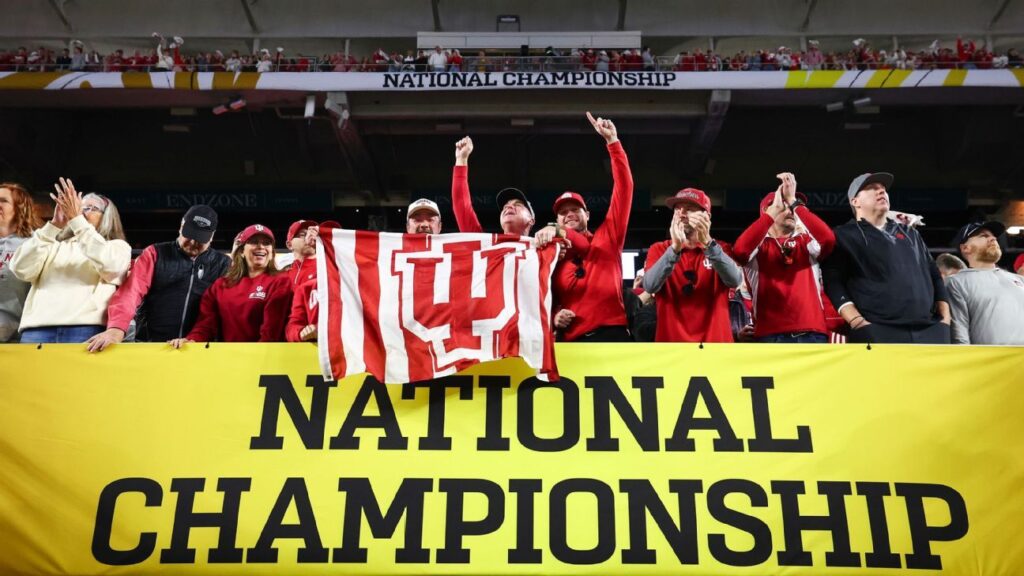
MIAMI GARDENS, Fla. — The distance from the frigid 50-yard line at Memorial Stadium, home to the Hoosiers of Bloomington, Indiana, to the center of Miami’s Hard Rock Stadium—where those same Hoosiers celebrated a College Football Playoff national championship with snow angels in red and white confetti on Monday night—is 1,166 miles.
But it’s significantly more than just that distance.
It’s also a staggering 715 losses, the highest ever recorded by any team in the 156 years of college football. An all-time bowl record of 3-8. Zero double-digit win seasons since 1887. The promise of numerous coaches hired—nine from 1982 to 2023—who brought optimism to the program, including Lee Corso, Cam Cameron, Gerry Dinardo, Kevin Wilson, and Tom Allen. They all flirted with success, tantalizing the fanbase with hope, yet ultimately departed as just another disappointment, leaving behind a portfolio of losing records.
No outright Big Ten titles since 1945. No appearances in the Big Ten championship game. Zero weeks atop the AP Top 25 poll. No Heisman winners. No Rose Bowl victories. No national championships.
Was. Was. Was. Was.
All that history—more accurately, all that failure—was washed away in a wave of was on Monday night. So many years. So many games. So many accepted moments of realization that Indiana simply wasn’t meant to be good at football. Gone. Erased by a thrilling 27-21 victory over the revitalized Miami Hurricanes, played in Miami’s own stadium. The kid who won that Heisman clinched the game not with his gifted arm but with a bulldozer 12-yard touchdown run. A team known for relentless scoring sealed the deal with a red zone interception in the final moments.
Some might argue that the multiverse doesn’t exist. But we now inhabit a college football timeline where the worst program in history has transformed into one of the most unforgettable national champions ever.
“I know Indiana’s football legacy hasn’t been great, with a few bright spots throughout,” said coach Curt Cignetti, who led his team to a 16-0 season, removing them from the all-time loss rankings. “The focus just wasn’t on football, to be blunt. It has always been a basketball school. Coach [Bobby] Knight’s teams were exceptional. But it’s about being competitive in football nowadays. … Our alumni base is the largest in the country. They are fully invested. We have a lot of momentum.”
Indiana. A football school. It’s a hard truth to swallow. But we needn’t feel guilty, as the Hoosiers themselves are grappling with this reality, too.
“I wish I could travel back to the 1990s and tell everyone this would happen, because I wouldn’t believe it myself, and I’m standing here on the field right now,” reflected Adewale Ogunleye, who encapsulates the Indiana football saga. A three-time All-Big Ten defensive end and Indiana Athletics Hall of Famer, he had an 11-year NFL stint that included a Pro Bowl nod. Yet from 1996-99, his four Indiana teams compiled a 13-31 record without any bowl appearances, finishing no higher than eighth in the conference.
The former team captain and honorary captain of this year’s squad gestured toward the crowd as they chanted for Heisman-winning quarterback, Fernando Mendoza, with ABBA’s “Fernando.”
“I’m thrilled for all the fans who have jumped on board with Indiana football this year and last year. But what I truly wish is that every old-school fan who supported us back in the day could be here tonight,” Ogunleye expressed, peeking at his phone and beaming. The messages were flowing in from his NFL buddies from prominent football schools, including some Miami “U” legends who had just wrapped up their own game. “Those loyal supporters who braved a cold Saturday in November, knowing we would likely lose to Ohio State or Michigan, all the schools those fans text me from. They earned this moment as much as the players up on that stage with the trophy. They deserve to celebrate.”
Many such fans did make the journey. They drove 1,166 miles south over the weekend, many at the last minute and many without tickets. A modern-day echo of scenes from the film “Hoosiers.” A parade of cars and trucks heading down I-95 to South Florida, as if following the Hickory High bus to the championship game. Inspired by their team’s astonishing postseason run, taking down Ohio State, Alabama, Oregon, and now poised to challenge The U on their home turf.
Like Harry Davis of Indianapolis, sporting a red and gold Hickory High T-shirt bought from the Hoosier gym in Knightstown, Indiana—where the film’s scenes were shot. The back proudly displays Gene Hackman’s quote: “My team is on the floor.”
“I won’t disclose how much I paid for this ticket, as I don’t want my wife to find out and leave me for being irresponsible,” Davis quipped from his seat just four rows from the top of Section 345. Secondary market ticket prices soared due to the participation of the local Miami Hurricanes, but a ticket seller outside the Indiana team hotel remarked, “It’s due to the Indiana fans.”
“But what choice did I have?” Davis continued. “Wait and hope for lower prices next year? Do you know how long I’ve been waiting for next year? There’s no way I’m waiting for another opportunity!”
He politely declined further conversation, stating that there was a game underway. The same sentiment echoed from fraternity guys wearing vintage 1991 Final Four T-shirts. “I snagged mine from my Dad’s closet. The others got theirs online.” The Johnson brothers from Terre Haute proudly wore the jerseys of Indiana legends, dual-threat quarterback Antwaan Randle El and running back Anthony Thompson, who famously finished second in the 1989 Heisman race. “We went with Dad to Wisconsin when Anthony scored four TDs and nearly 400 yards,” one brother shouted over a crowd singing The Killers’ “Mr. Brightside.” The other added, “That team went 5-6. Welcome to Indiana football.”
Was. A reflection of what Indiana football used to be.
It was, like Thompson’s career, all about great moments leading to great letdowns. Pretty good. Never great. No disrespect to Corso’s 1979 Holiday Bowl champions or Vaughn Dunbar’s feats in the 1991 Copper Bowl; that was as good as it got. The Bloomington faithful were content to let Notre Dame hold the title of the state’s football school, occasionally lending to Purdue, while everyone in red awaited the onset of basketball season.
“Even last year, it felt amazing, but you could sense people questioning if they’d revert to their old ways,” Alberto Mendoza, Fernando’s younger brother and backup QB, remarked as the CFP title confetti nestled on his shoulders in the same stadium where Miami locals used to witness Hurricanes games. He was referring to 2024, Cignetti’s first season at Bloomington, which resulted in a then-school record 11 wins and a playoff berth that ended in the first round. “I understand. After being beaten down for so long, you have to temper your expectations. Now, don’t you think those expectations have shifted?”
Absolutely. What many believed—what those outside the Indiana locker room presumed—was merely a Cinderella story, a one-time phenomenon, now feels like the beginning of a powerful Midwestern force.
“I’ll indulge in a beer and maybe allow myself a day to bask in this. Maybe. A day seems excessive, doesn’t it?” Cignetti said, a smile breaking through his now-iconic scowl. “Nobody anticipated this. despite some believe tonight, I recognize they don’t expect Indiana to continue this run. So, let’s get back to work.”