








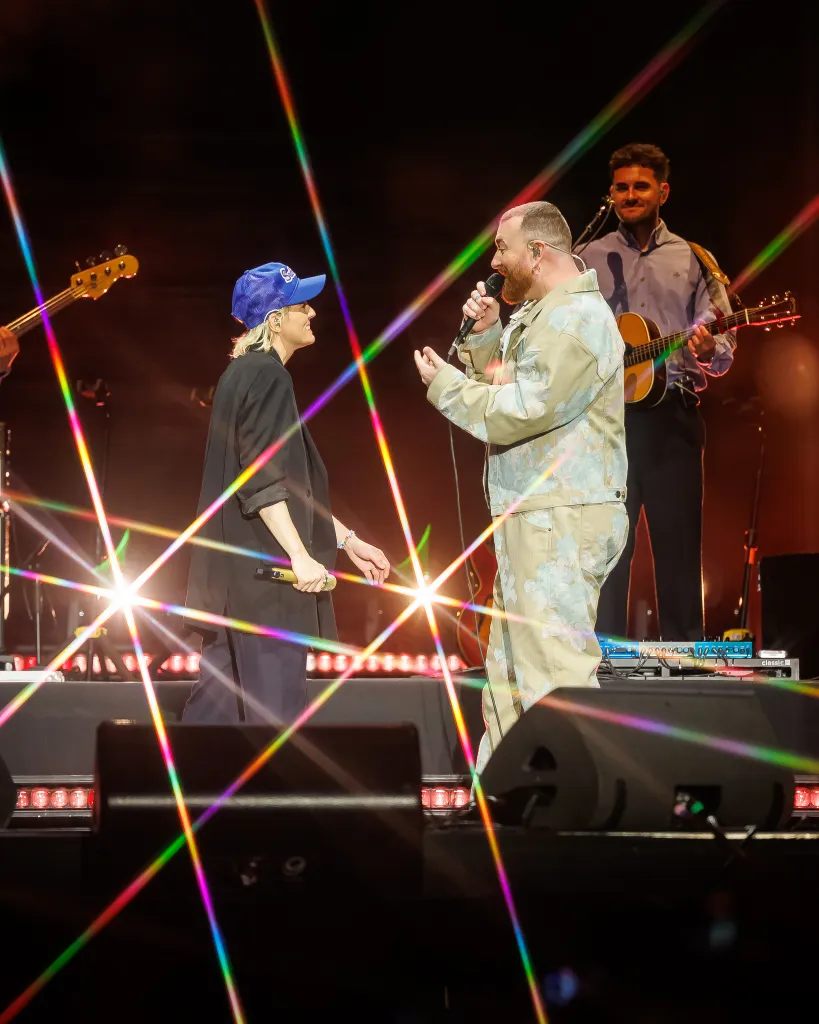
When the history of great voices in 21st century pop is told, Brandi Carlile and Sam Smith will both be part of the discussion. That’s before getting to the conversation about queer icons of the era: Smith and Carlile might be standing on the shoulders of several generations of giants when it comes to gay rock stars, but they’re still pioneers as part of the first real generation of music superstars who were inclined and able to be out from the very start of their careers. So it felt like some kind of historic summit, musically and culturally, when these two figures sang each other’s verses — and inevitably, each other’s praises — as part of Carlile’s annual Girls Just Wanna Weekend festival in Mexico.
“I am so proud to welcome to the stage our first nonbinary headliner,” said Carlile, introducing the first bill-topper in the seven-year history of the festival to be sporting a mustache and beard. Marking that milestone wasn’t necessarily the main reason for asking Smith to fill out a bill alongside fellow headliners herself and the Chicks. “This is one of those nights where we’re gonna choose to heal a little bit,” Carlile told the crowd, “and there are very few people that do this job — or any job — who are sent here to be healers, and to heal with their actual voice. And my friend Sam does exactly that with theirs. I just heard them backstage and I still have full-body goosebumps,” she said. Those might’ve been compounded for the crowd when Carlile reemerged on stage later in Smith’s set for duets of her song “Party of One” (a track that Smith sang a vocal duet part on for a remix eight years ago) and John Prine’s “Angel From Montgomery.”
And, in the history of unique segues, “Angel From Montgomery” was immediately followed by the un-angelic “Unholy.” But Smith did not play that risque hit up for all the provocation it was worth, and their costuming was limited to demure designer denim. “I am not gonna get my ass out tonight,” they announced. “I’m sorry, I can’t. I can’t. It’s just been Christmas, so everything’s staying in. But I am gonna sing my ass off.” On a more serious level, Smith spoke to the uniqueness of the predominantly female crowd. “I have watched this festival happen every single year from behind my phone, and it’s an honor to be here tonight and to be doing this,” they said. “And it’s come to my attention there are some lesbians here tonight. Hello! This is the first opportunity I’ve ever had to say to you that everything I am is because of you. There’s lesbians behind this stage who have supported me and given me strength throughout my entire career, and so I’m forever in debt to you — and thank you so much for the safety that you give me.”
There was more to be said about Smith’s and Carlile’s friendship and mutual admiration society than could be said in a few moments on stage. Later on Saturday night, long after the crowds and even backstage scene had dispersed, the two performers lingered in a dressing room behind the stage at the Barceló Maya Riviera resort to discuss what sets them apart and what binds them.
You two have a history that goes back to Sam joining you for a duet remake of a song from your “By the Way, I Forgive You” album in 2018. The connection you’ve fostered makes for real chemistry.
Carlile: We are in love with each other — properly. When Sam did “Party of One” with me, I had never won a Grammy. No one paid any attention to anything I was doing. I was selling 50,000 albums, and a folk singer, basically. “Party of One” was such a labor of love for you, and I’ll never forget that.
Smith: I fell in love with that song. You sent me your vinyl and a little note, and I was in my house and then I used to put your vinyl on, and that was a song that just helped me through loads at that time and hit me to my core. So the chance to get to sing it was insane.
Carlile: And before everybody was doing collaborations. Collaborations is like the point of everything now, but like before all that shit, I was like, “Whoa, would you sing it with me?” And you were like, “Absolutely.”
Smith: Collaborations when they’re real are different. I think the audience can feel it when it’s authentic.
What was the impetus behind having Sam as the first nonbinary headliner at a festival that is so famous for following in the tradition of Lilith Fair’s female lineups?
Carlile: Sam sent me a song that we were experimenting with for a little while where we were talking about gender a little bit — you know, what pronouns to use for who, whether I should say “he” or “she” on this romantic interest in the song or whatever. And it just got me thinking about how cool it would be to celebrate Sam’s kind of feminine energy at this festival and how needed that was, to expand our understanding of the feminine, to include Sam in a really profound way. And tonight I saw that play out, and it was stunning.
Smith: I was surprised, actually, at the end of it. From what I’d seen online and just from knowing Brandi over the last few years, I had a feeling of what this would be. But being on stage tonight and actually seeing and feeling the audience… The kindness in the whole festival is incredible, and something I’ve never actually felt before on stage. I felt very safe and just free to be myself on stage. I felt no judgment, and it’s way more beautiful than I could ever have imagined, although the beauty does come across online as well. … It is the first time I’ve ever actually got an opportunity to speak to women, actually, in this way.
Carlile: What you said about lesbians tonight was so moving.
Smith: It’s annoying that I haven’t had the opportunity before now. I owe everything that I am to women. And, Brandi, you just met her —I’ve worked with an amazing woman called Gemma Peacock (as tour manager), and she has been the only gay person on my tour with me since I was 24 years old, and she’s really nurtured my spirit and my soul and been through so many ups and downs of my life. And you two have come in amazing times and helped me out in so many beautiful ways. I really owe so much of my mental health to lesbians. So it was nice to get an opportunity to say thank you.
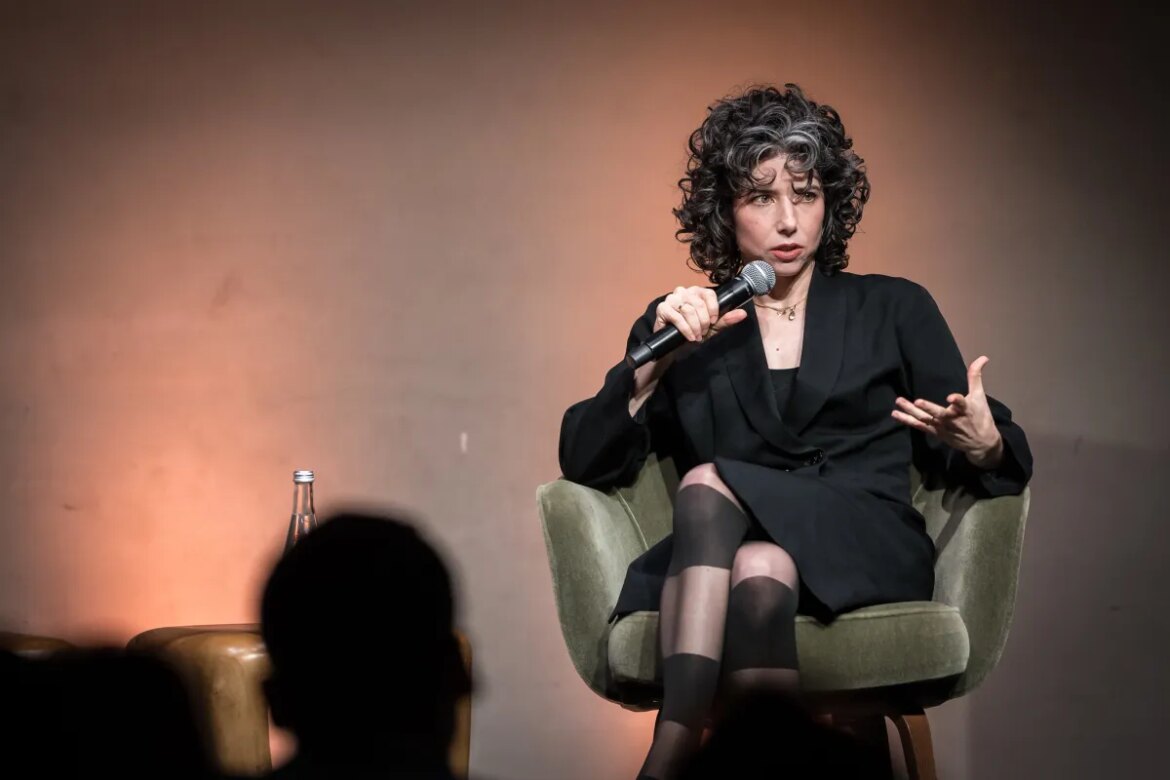
Brandi Carlile’s Girls Just Wanna Weekend 2026 Music Festival held at Barcelo Maya Riviera in Cancun, Mexico on January 15-19, 2026. (Photo by ALIVE for 100x Hospitality)
ALIVE for 100x Hospitality
How different is it singing for an audience that consists mostly of women, and of gay women in particular?
Carlile: I saw Sam’s audience in New York recently, and actually it was a really interesting and diverse mix, with a lot of young people that were queer and cis.
Smith: When I first started out on my first album, my audience was pretty much just straight. And so it’s been just so fascinating over the years to see how that’s diversified and changed.
Carlile: One thing that is different between us is down to being from different countries. Recently touring over in the U.K. and Europe, having neglected it for so long, because I had little kids, I noticed: God, there’s so many men at the shows. And it feels so good to look out and see all those men. I’m not begrudging all the women and all the amazing lesbians I get to play for over here. But it’s crazy how much less gendered music is in the U.K. and Europe. And you go into the bar and these men are just out there with their pints, listening to women’s music in the bar, whereas like a straight man in the States wouldn’t get caught dead in that room.
Smith: Oh my God, I wish I had your audience. Men don’t come to my shows.
Carlile: Really?
Smith: Really. It makes sense because I understand with your music, there’s a deep love for a singer-songwriter with a country soul, and there always has been in the U.K. But I do think there is sometimes a blockage when a man, or a queer person who people see as a man, steps into those shoes and expresses themself. It is not the same.
Carlile: So they’re not immune to that (in the U.K.)?
Smith: No. Maybe it’s just because it’s my home, but I find that when I go to America, I feel like I’m doing a victory lap, I feel so at home in America with my crowds. I love the English crowd, but I think that sometimes the non-binary/queer stuff has been hard to get for them to get their heads around. But also [looking to Carlile], you are on stage singing songs, and I’m on stage in a thong, so it’s a bit more confronting, I guess. [Laughter.]
Carlile: Fair enough! … We do have such different audiences, and I think that’s why when we come together, it’s so life-affirming.
Smith: And I’ve got so much to learn from you, and I have over the years. We are on a global stage as queer people. And there’s really not a lot of us.
Carlile: Yeah, because we’re, like, super queer. If there’s a concentrated mixture, we’re very powerfully queer.
Smith: It’s a gift to get to know each other, and to get to collaborate like we have, along with all the other people that we get to. But there’s not many people, are there, on the stages that we’re on…?
Carlile: More now than ever, but yeah, there’s not many. One thing about this (Girls Just Wanna Weekend) crowd that is true for me is that at least some contingency of it is present every night, so I do kind of get this anytime I decide to step foot on a stage. Which is a major privilege that I didn’t think would happen when I was young and actually quite afraid of coming out.
Smith: My audience has always mainly been women, honestly, always, since I was young, and I’ve loved that. But more men, more gay men, especially, have started to come to my shows over the last three or four years. But in the U.K., there’s this amazing kind of football male scene that come out to support music, like the men you were talking about with their beers, just watching music and enjoying it. I haven’t tapped into that myself yet. I would love to, but with my music, I don’t know if it will, ever. It’s interesting.
Carlile: They would grow if they did.
Smith: It would be lovely to have them there. … If more men came to my concert in the U.K., I think I’d be quite excited by that. I’ve never felt in the club in the U.K. with that stuff. I would do more to appease them if they came.
Carlile: Like maybe you would start covering “Wonder Wall” and Radiohead and shit?
Smith: No, see, I’ve always admired that from afar, but I’ve never embodied it with my music. I’ve just always loved the girls. I love the Black soul culture of the U.K., and that’s always been where my roots are in the U.K.
Let’s talk about about your admiration for each other vocally. Brandi, you said tonight that Sam’s voice is a healing voice, and it takes one to know one.
Smith: Well, I nearly cried when you said that tonight. That blew me away.
Carlile: I was worried I didn’t say enough, but I didn’t want to take up any more of your time, just flapping my gums. It’s just that I can’t say enough about your voice. I think it’s in the top three greatest voices I’ve ever heard in my life. And it’s just unbelievable. Like, if you walked in front of a bus tomorrow, nobody would ever get that voice ever again. Your voice is singular. In all of the world, like, no one has ever sounded like Sam Smith. Sam Smith has never sounded like anyone else. And really, you cannot say that about anyone’s voice. Even my voice is a mismatch of just idolatry…
Smith: I disagree.
Carlile: …of idolizing other singers…
Smith: I absolutely disagree!
Carlile: …of stealing tricks and just making a voice that’s unique based on obsession with other people’s vocal tactics. And I can’t hear any of that influence in Sam, actually, apart from George Michael, and some women, like when Aretha went into her head voice in her mix. I’m not really sure exactly where this voice came from that you have. I can find maybe a couple things here and there — a touch of Joni, touch of Aretha, touch of George — but it’s still you. It’s just only you.
Smith: Thank you. That’s one of the most beautiful compliments I’ve ever had. Your championing of me has meant so much to me over the years. It It keeps me going, honestly. And I’m not just saying this in return, but your voice… I’ve never, never, ever heard anything like it in my life. I’ve never felt so safe on stage with someone, ever.
Carlile: I’m steady. I won’t miss. That’s the thing: I will not let someone down on stage.
Smith: It’s not just that you won’t miss, though. You deliver in a way that is incredible, and hard to explain, when singing with Brandi. I’m a lazy singer, and I’m kind of all over the shop, and Brandi is this guide as a singer. It’s insane. You’re an entire bed and track in one voice.
Carlile: For a minute there, I only wanted to be a guide. I’ve had these last five or six years of working with Joni and Dolly and Tanya and Elton and then Kris Kristofferson and John Prine and just magical, wild-card, unicorn people. I was like: What if I just want to be steady? What if that’s actually what gets me off, is just being an oak tree?
Smith: It’s a perfect, perfect explanation. Your voice is like my oak tree. But when I say you’re a guide, I think even before that … People flock to you for comfort and inspiration. You sing the blues, to me. when you sing, I hear the blues. It’s the greatest sound ever.
Carlile: Do you love Bonnie (Raitt, who recorded the most famous version of “Angel From Montgomery”)?
Smith: Fucking hell, I love Bonnie. But I love you. You don’t understand. I really think that you are one of the greatest ever to come. The way you sing “A Case of You”…
Carlile: You’re the first person I sent that to when I did it.
Smith: It’s mind-boggling. To sing that song is such an Everest of a song to sing that I would never attempt. And you gave me the gift of sitting with her. I sang “My Funny Valentine” to Joni Mitchell, and it’s honestly probably my most treasured memory of my life, as a singer, as an artist, getting that moment. And this is the first time I’ve really spoken to anyone about it. And she hummed along with me. It was just, being around her with you in that environment, with Reuben (James, her sometimes pianist), was so magical.
Carlile: She looked you up online and she loved you. I think that was only our second Joni jam ever. And I think that because Sam was such a big star, it scared Joan a bit, and she didn’t come out of her bedroom for like two hours. Do you remember? We just talked, waiting for her. I was panicking. You were probably just like, “Ooh, a party.”
Smith: I was panicking. I was shitting myself the whole time…
I have to say this. You embody to me what music’s about. As a child, I loved music, and you’ve managed to keep that purity for me. And when I’m around you and I meet the people you hold company with, and the advice you give me and the music you share with the world, it just oozes togetherness and everything that I think that music is about. In the world that we’re in, the music industry, I was so shocked, at 20 years old, of how divided things were and how judgmental people could be. And you’re such a safe landing space for me, because you just brought me back to what it’s about.
In both of your cases, your sense of style has evolved so much, and varies even now. Brandi, you’ve gone from kind of Seattle-punky in your earliest days to designer suits and embracing full-on glamor. Yet we still see you a lot of the time looking like you’re ready to chop wood.
Carlile: What do you mean? [Laughter.]
And Sam, you were first seen starting out in formal suits, and then it gravitated to where we saw you in some pretty crazy outfits. But we saw you on the Colbert show a couple of months ago and you were back in a suit. But we know that before the suits, in the beginning in your college days, you were very colorful and flamboyant. So you both kind of are comfortable in sort of different realms of fashion and looks and personas even while being very essentially yourselves at all times without really changing that core — which is not exclusively a queer way of going at style, but there is something to it…
Smith: I love fashion. You love fashion.
Carlile: I do too. And honestly, there’s oppression around queerness globally and domestically, but we have a pass, in some ways, that I really want to take a moment to appreciate. We get to really fuck with gender and fashion. And it’s such a fun part of being an artist. And you really do it well.
Smith: I feel like I’m a flow person. That’s the only way to explain it. Every day I wake up and I feel like a different me, and there’s different things I want to wear. And I felt as though I was locked into a kind of a look for the first five years of my career, which I found so hard. It was the longest in my life that I’d had (to stick with one style mode).
Carlile: Was it because there was pressure on you?
Smith: It wasn’t. I put pressure on myself. Because I was like, “Oh my God, I’ve made it. I’m an artist and I want to give people continuity and be this thing.” I’d look at Frank Sinatra, I’d look at Adele and people like that and be like, I wish that I could stick to my look… an iconic look. And I can’t. It’s just not in my body and it’s not for me.
Carlile: In the last two years, I have to say, I love the beard-and-mustache look. It’s so sexy. And then when you play with fashion at the same time, it’s just really nice.
Smith: It’s so fun. And after, like, getting my clothes off the last few years and doing all of the kind of crazy stuff, it’s really beautiful now to go back to just wearing a suit. Or wearing denim…
Carlile: These denim ensembles. I think I’ve seen three now. Is this the same one you wore on stage in New York?
Smith: No. I work with Vivian Westwood now, and Andreas, who works with Westwood and is a creative director, makes all my clothes for me, and he works with my flow. He will make me an incredible gown, but then he’ll make me this amazing cowboy-fitting attire that looks worn, and it’s beautiful. Fashion’s become a huge passion in my life. My boyfriend’s a fashion designer, so I now get this awesome eye into the worldof fashion, and he shows me all these archival things… Fashion is armor. It’s so powerful, and for queer people for so many hundreds of years, walking on stage feeling like you have the right armor on, I think, has been so important. It helps me sing.
Carlile: Do you know what’s crazy? Fashion is, so often, I think, associated with maybe a bit of opulence or privilege. But when I was a kid and I was growing up on food stamps and living in a single-wide mobile home, I got my clothes from a Catholic church mission clothing bank. And to go into the clothing bank was actually wild, because there was this crazy diversity of clothes and genders. There were old ladies’ sequin dresses and their Sunday best. There were kids’ clothes. There were suits that people had got buried in. There were people’s uniforms. There was just anything that gets donated, and the shit that gets donated is wild. I could spend hours in there, just putting together these clothes that were free and vintage — and that were men’s, a lot of the time. My first stage outfit that I ever wore was a white men’s suit that I pulled from the Black Diamond Catholic Clothing Mission and wore on stage to do “Honky Cat” by Elton John.
Smith: Oh my God.
Carlile: And that clothing bank wasn’t about money; it wasn’t about access to brands. It wasn’t about anything other than just art — making my body and my clothes into art.
Smith: Exactly. RuPaul says it right: “You’re born naked and the rest is drag.” That’s the truth. But we all make a choice every morning when we get up. In what we all wear, we all make a choice. And I’m actually passionate about imploring people — if people don’t want to, it’s fine — that if you do want to, it is OK to start again! To throw it out and start again, and choose a different character. Because it can be so wild when you do that. And the way people treat you or see you, it’s really fun. People are just having more fun with clothes. But you’re right, and that’s how I used to dress up as a kid: I’d go into charity stores and just absolutely raid everything.
Carlile: Me too — like, my first big shirt was on the cover of my (debut) album. It was in all my first photo shoots. I had one shirt, and it was a Boy Scout shirt that I got from the Red Light on Broadway in Seattle, and that shirt was with me for years, and it was my favorite shirt. … But I have a stylist now too. Have you met her, Maryam Malakpour? She’s amazing. And she has to go with my flow, too, and it changes — and needs to change — all the time.
Along with evolving in style, another way you change things up is, in your music, changing the style of your shows and even the venues you perform in. You are kind of going in opposite directions, ironically. Brandi, you’re experimenting with going into being an arena headliner in the U.S. for the first time with your touring all this year, and Sam, you’re experimenting with playing thousand-seaters, with multi-night runs at Warsaw in New York and coming up at the Castro in San Francisco.
Carlile: That is interesting.
Smith: Wait, so… this is not the first time you’re doing arenas.
Carlile: Yes, it is. And I’ve been watching you do ’em on Instagram, and seeing your shows, you are probably in the forefront of my mind, in doing it. I’m really intimidated.
Smith: No, you’re gonna kill it. The only thing I’d say is, remember, those rooms are rough. Because the backstage is like concrete… I find those rooms tough, but I feel like the more you make it feel like a festival, the better. Like, on my arena shows up until this point, I was always very dramatic and trying to be Beyonce the whole time, with turning off the lights and having this big intro.
Carlile: This the first time I’m gonna have a (big) production.
Smith: I found that it can put pressure on me, to walk on stage (after a big buildup). So if you want to do that, do it. But just remember the pressure. It’s actually kind of nice, sometimes, I’ve found, to have the lights up and let everyone go in and then just walk on stage.
Carlile: That is such good advice.
Smith: That would be my advice. Because I think sometimes the pressure in those rooms, if you turn off the lights and you have the rumbling of the music starting, it could… I’ve done it now for 10 years, and the pressure can be really intense to meet.
Carlile: Maybe I’ll just go out with an acoustic guitar and just start.
Smith: I think that would be incredible. I really do. And I don’t know if you’ve done the production stuff already, but bunting… if you could put some lights across the crowd, and make it feel like like you’re in someone’s home…
Carlile: You’ve gotta make it feel small. That’s the goal. And that’s my goal with this festival. It’s getting really big, and it started really small, and I feel like my job every year is to make this feel so small. You know?
Smith: Yeah. Which you’ve done an incredible job of doing.
Carlile: Until you came and made it epic.
Smith: It’s gonna be epic next year, when I come back here and just party the whole time.
Source: variety.com