








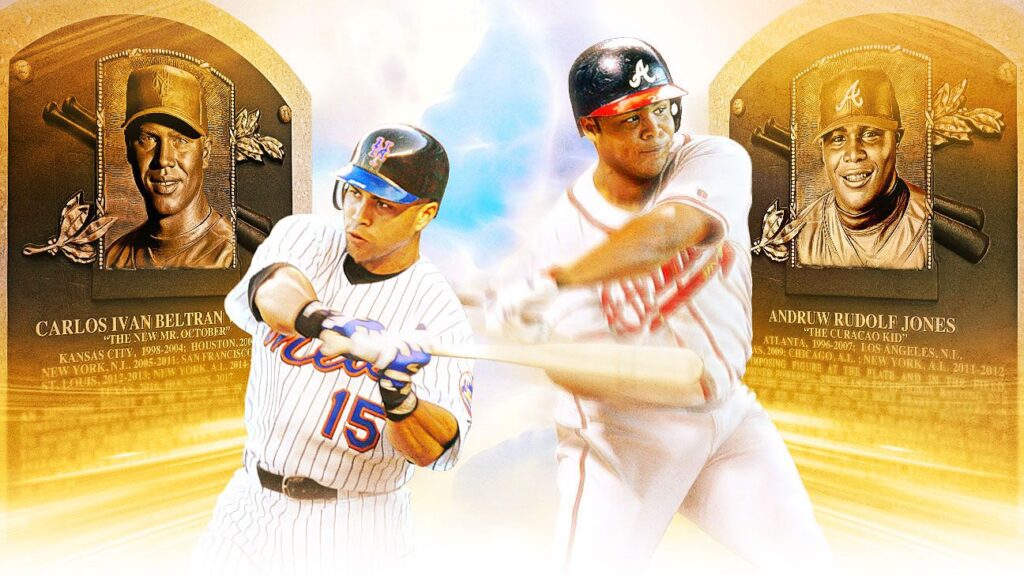
The votes are in! Carlos Beltran and Andruw Jones have officially been inducted into the Baseball Hall of Fame.
The Baseball Writers’ Association of America has chosen this dynamic duo for Cooperstown’s Class of 2026, receiving 84.2% and 78.4% of the vote, respectively. They join Jeff Kent, who made it in thanks to the contemporary baseball era committee in December.
ESPN MLB analysts Buster Olney, Bradford Doolittle, Jesse Rogers, and Jorge Castillo discuss the implications of the 2026 election and preview the 2027 ballot and beyond.
Who else made a mark on this year’s ballot?
Olney: Last year, Felix Hernandez garnered only 20.6% in his first year on the ballot, but this year he surged to 46.1%, marking a promising trend toward eventual election. There was a time when King Felix was considered one of the best pitchers globally, clinching the AL Cy Young Award in 2010. It appears that voters are increasingly willing to overlook his modest totals of 169 wins and 2,524 strikeouts.
Rogers: Chase Utley is trending positively. In his third year on the ballot, he jumped from 39.8% to 59.1%, indicating he might be on the path to induction sooner rather than later. This increase mirrors the trends seen with Jones and Beltran before their election. especially, Utley achieved the highest vote percentage among players who didn’t get in this year, putting him next in line. With seven years still on the ballot, he’s positioned well for Hall of Fame entry.
Castillo: Felix Hernandez, along with other elite modern starting pitchers with impressive peaks but lacking traditional counting stats, is gaining traction. His jump this year suggests he might reach 75% of the vote sooner than anticipated, closing his career with a 3.42 ERA across 2,279 ⅔ innings. This is encouraging for him and other future pitchers who lack the hefty stats of past legends.
Doolittle: King Felix. I’ve been concerned about the under-representation of contemporary starters in the Hall. (More on that later this week.) Hernandez’s increase in support is a positive sign. His career will likely be compared to the typical Hall of Fame starter in future generations, unlike those of Justin Verlander, Max Scherzer, and Clayton Kershaw. If they set the standard, we may see fewer starters in Cooperstown. That said, Hernandez still has a way to go.
Who faced the biggest setback in this year’s voting?
Olney: The Hall of Fame has become a steadfast entity regarding steroid era perspectives. Once, it was thought that opinions on PED use would evolve over time, with younger voters possibly being more forgiving, but that hasn’t materialized. Notable figures like Manny Ramirez and Alex Rodriguez saw no improvements in their voting percentages, aligning with the trends of Roger Clemens, Barry Bonds, Sammy Sosa, and Mark McGwire. Instead of fostering understanding, the Hall seems focused on penalizing a select few while overlooking that many current members could have made similar choices.
Rogers: By definition, Manny Ramirez faced the largest loss this cycle, as this was his final year on the ballot. He didn’t come remotely close to election. As Buster noted, HOF voters maintain a consistent stance against known PED users; if you were caught and sanctioned, induction is unlikely. Ramirez received 38.8% of the vote, revealing a voting bloc willing to overlook players who breached PED rules, though it’s insufficient for election.
Castillo: Five years ago, Omar Vizquel seemed a strong candidate for Cooperstown, earning 49.1% of the ballots in 2021, nestled between other inductees like Scott Rolen and Billy Wagner. but, he received just 18.4% of the vote this year. His chances plummeted after allegations of domestic abuse from his ex-wife and a lawsuit from a former bat boy over alleged sexual harassment. Debates surrounding his credentials were ongoing before these claims—despite being a defensive standout with 11 Gold Gloves and 2,877 career hits, his .688 OPS and 82 OPS+ over 24 years may not withstand these allegations.
Doolittle: It’s primarily the PED-associated players. Manny Ramirez added minimal support and has now exhausted his BBWAA eligibility. A-Rod saw an increase of less than 3%. Ryan Braun fell off the ballot after just one year, failing to secure 5% to remain. compared to, Andy Pettitte saw over 20% growth in his support, which leaves me puzzled. Actually, I’m certain—it doesn’t make sense.
What stood out to you from this year’s voting results?
Olney: Utley’s voting percentage of 59.1% indicates a shift among voters, moving away from an over-reliance on statistical milestones—like 500 home runs and 3,000 hits—and towards appreciating peak performance. At one point, Utley was among the most elite players. This is a promising sign for future candidates like Buster Posey.
Rogers: Felix Hernandez’s jump serves as a clear indicator that we are entering a new threshold for evaluating starting pitchers. Wins will likely become less significant—considering Hernandez managed just 169 career victories yet received 46.1% of the vote in his second year on the ballot without ever competing in the postseason. Andy Pettitte, despite winning 256 games, is also receiving increased attention. This offers hope for future candidates, including Jon Lester, who will be on the ballot next year.
Castillo: Candidates penalized for PED use aren’t likely to see induction anytime soon. Alex Rodriguez faces a daunting path after five years on the ballot, while Manny Ramirez’s candidacy effectively faded away—his final year yielded only a 4.5% increase, leaving him about halfway to achieving the necessary votes.
Doolittle: Chase Utley’s continued ascent now seems inevitable for Hall of Fame induction. but, I struggle to understand the significant gap in support compared to contemporary middle infielders like Jimmy Rollins and Dustin Pedroia.
Which player’s vote total surprised you the most?
Olney: Cole Hamels opens his candidacy with a commendable 23.8%, surpassing Felix Hernandez’s first-year percentage last year. This suggests that Hamels may eventually gain induction. even with never finishing in the top three for a Cy Young Award, he was undeniably a key player for the Phillies, with career numbers closely mirroring those of Hernandez.
Rogers: Cole Hamels made an impressive debut. His statistics closely align with Hernandez’s, who received double the votes. While this trend is encouraging, it doesn’t guarantee Hamels will eventually get in—it merely suggests he may reach the 40% range next year.
Castillo: Andy Pettitte, who admitted to using HGH twice but claimed it was purely for recovery and not performance enhancement, is gaining momentum with two years left on his eligibility. He surged from 27.9% to 48.5% this year, ranking behind only Beltran, Jones, and Utley and ahead of fellow PED users Rodriguez and Ramirez.
Doolittle: It’s definitely Pettitte. I acknowledge his accountability regarding PED use, and he deserves kudos for it. I’d support his induction regardless. What puzzles me is the inconsistency in how usage is treated among different players, and what has shifted since last year?
Based on this year’s voting results, who do you think will make it into the Hall of Fame in the next two ballots?
Olney: Two candidates who should be unanimous choices will grace the ballot in the coming years—Buster Posey, a cornerstone of the San Francisco Giants’ dynasty, will headline the 2027 Hall of Fame class, while 2028 is set to celebrate Albert Pujols, one of the game’s all-time great hitters. Utley is also expected to get in next year, given his impressive initial showing.
Rogers: Of the returning candidates, I see Utley as the only definite inclusion over the next two years. Newcomers will likely dominate the votes, which could hinder others, even though a vote for one doesn’t negate the chance for another. Writers tend to prioritize clear-cut selections—Utley will likely make it, but others may have to wait.
Castillo: Buster Posey next year and Albert Pujols in 2028 are virtually guaranteed first-ballot entries. Chase Utley and Felix Hernandez could also join them.
Doolittle: Utley could surpass the threshold as early as next year, particularly since first-time candidates beyond Posey are unlikely to generate much excitement. Hernandez’s momentum should keep propelling him forward toward the 2028 ballot, during which Pujols ideally will be a unanimous selection—or at least deserves to be.