









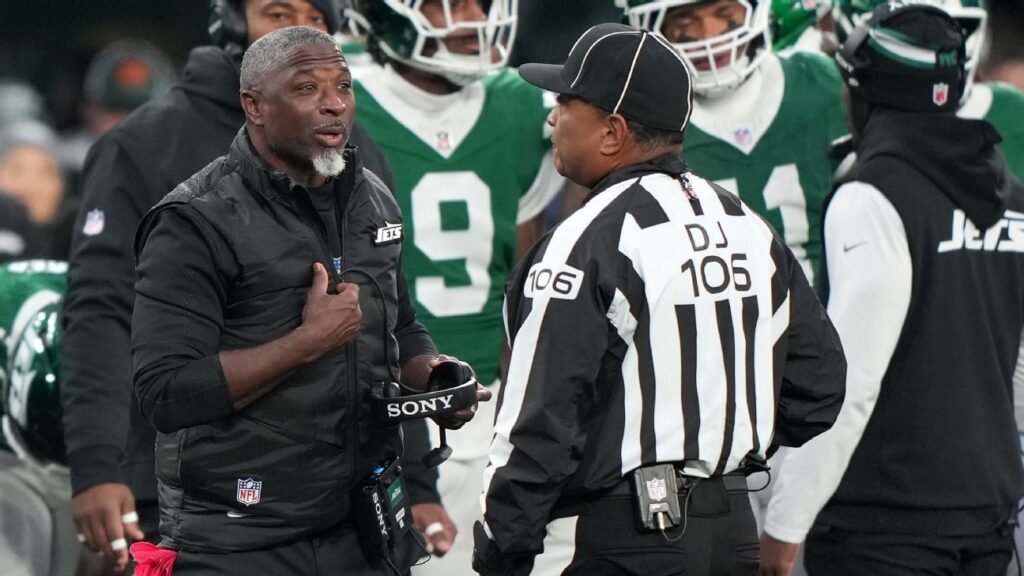
FLORHAM PARK, N.J. — Just before training camp kicked off, Aaron Glenn took an evening stroll around the New York Jets’ facilities, passing by the vacant practice fields and the temporary seating. This was a part of his daily routine during his inaugural season—breathing in fresh air and clearing his mind, a momentary escape from the coaching hustle.
It was a delightfully calm day on July 22. The sun was shining, the grass freshly trimmed, and Glenn—a lone figure clad in black sweats—was moments away from realizing a long-held dream as he traversed his new territory.
He would rise at 3:30 a.m., unable to sleep out of excitement for his first practice as the Jets’ head coach. “Just be A.G.,” his wife comfortingly texted him in the middle of the night.
A week later, he found himself nearly in tears as the temporary stands filled with hopeful fans shouted, “J-E-T-S! Jets! Jets! Jets!”
“Man, it hit me pretty hard,” a reflective Glenn shared.
It was the quintessential homecoming narrative, a former star returning to the team that drafted him, committed to transforming defeat into victory. On that inaugural day, he expressed his deep understanding of the “pain” felt by Jets fans and vowed to “make sure that pain goes away.”
Six months later, the hurt has only intensified.
Under Glenn—a coach who took over a franchise burdened by nine consecutive losing seasons—the Jets navigated one of the bleakest campaigns in their 66-year history, finishing 3-14. This season was marked by a record number of blowout losses, staggering records of futility, the trading of homegrown stars Sauce Gardner and Quinnen Williams, the dismissal of defensive coordinator Steve Wilks along with seven assistant coaches, clashes with the media, the shocking death of franchise legend Nick Mangold, and the near-fatal shooting of current player Kris Boyd on a Manhattan street.
even with these challenges, Glenn remained steadfast, according to both players and coaches. Embracing the advice from his wife’s midnight text, A.G. stayed true to himself. Now, as he reaches the one-year mark since his introductory press conference, the pressing question is:
Will that be enough?
GLENN FACES A CHALLENGE as he stands among 23 coaches since 2000 who have won three games or fewer in their debut season. Out of that group, only four managed to rebound into playoff contention—Dan Campbell and Jim Schwartz (both with the Detroit Lions), Zac Taylor (Cincinnati Bengals), and Leslie Frazier (Minnesota Vikings). Nine of the 23 did not make it to a second season, and 13 were unable to see Year 3.
Based on these statistics, Glenn is three times more likely to be dismissed before the 2027 season than to guide the Jets to the playoffs.
The organization hopes he can emulate his previous role as defensive coordinator for the Lions, where the team, under Campbell, transformed from a 3-13-1 record in 2021 to a playoff berth in 2023. Glenn wears that achievement like a badge of honor, frequently referencing it when asked about his unwavering confidence amidst adversity.
“I’ve been there, and I’ve done that,” he stated at the season’s end.
The Jets have significant hurdles ahead. Not only did they tie for the league’s worst record this season, but their point differential (-203) was also the worst since the 2021 Jacksonville Jaguars. New York began the season with seven consecutive losses and concluded it with an additional five straight defeats, punctuated by narrow victories over three losing teams led by backup quarterbacks.
“It’s not the coaching,” one starter reflected after the season concluded. “We need more pieces, a lot more pieces.”
The roster was lacking in several areas, particularly at quarterback, but the team also struggled with overall execution. Before the season started, Glenn emphasized that the final four minutes of each half were under the head coach’s purview—a statement about the critical nature of game management. Those words left a mark.
In those critical moments, the Jets were outscored 119-59.
A notable error occurred against the Denver Broncos in Week 6 when Glenn allowed the final 30 seconds of the first half to lapse without attempting a 53-yard field goal or a Hail Mary. That misstep proved crucial as the Jets lost 13-11.
Glenn, who approached the season with confidence, later admitted that the learning curve as a first-time coach was “substantial.” He recognized that game management needed improvement and remarked, “There are things I know I have to rectify.”
Selecting the right players and coaches, he noted, would also be a part of his self-assessment. His choice to sign quarterback Justin Fields and his reluctance to bench him during the 0-7 slump turned out to be a costly misjudgment. By the time he benched him in Week 12, the season was essentially over. Glenn eventually started rookie quarterback Brady Cook—an undrafted player—for the final four games.
Glenn admitted it was a mistake to hire Wilks, who was let go with three games left in the season. Glenn had no pre-existing relationship with Wilks, but made the decision partly because of his past head coaching experience, thinking it would be beneficial. plus, Glenn valued Wilks’ familiarity with a San Francisco 49ers-style defense, which the Jets had employed under the previous coaching staff.
Wilks implemented a defense that bore little resemblance to what the Jets had previously utilized, leading to frustration among players at all levels of the defense, sources reported.
even with the turmoil—the Jets became the first team in NFL history to go an entire season without an interception—Glenn chose to give Wilks space to manage his team. This decision startled some players, who believed Glenn’s defensive expertise could have steered a sinking ship.
Determined to allow his coordinators their autonomy, Glenn refrained from intervening and might reconsider this approach during the offseason. He is currently in search of a replacement for Wilks and has mentioned the potential demotion of offensive coordinator Tanner Engstrand.
but, there was a moment when Glenn couldn’t hold back. His first in-season address to the defense was intense and filled with passion, as players described it. Defensive tackle Harrison Phillips hesitated to disclose specifics but labeled it the defining Glenn moment of the season.
“It showcased how passionate and demanding A.G. is, and how much he yearns to revitalize this organization,” Phillips noted.
A former general manager with decades of experience in personnel evaluation remarked that he grades coaches and executives based on their pivotal decisions, asserting that Glenn’s choices in his inaugural year were lacking. He pointed specifically to the quarterback switch (Fields-for-Aaron Rodgers) and the hiring of Wilks, arguing that it was troubling a defensive-minded coach like Glenn struggled to make sound judgments in his area of expertise.
“He didn’t cultivate the team culture,” the former GM remarked. “He spoke about grit and resilience, but I didn’t observe any of that. They played like individuals merely clocking in; they didn’t seem invested.”
PLAYERS HAVE COMMENDED GLENN for his strong communication skills and transparency regarding both short- and long-term goals on a weekly basis. They reported that he was consistent and remained composed even when the season spiraled downward.
This juxtaposition portrays Glenn as a competent leader off the field but struggling on game days. His ability to keep the locker room united through turmoil may have been his greatest achievement. Even during the bleakest moments, players echoed his messages, perhaps out of concern for repercussions. Glenn’s approach was stricter and demanded more accountability compared to the previous coaching regime, according to players. He advocated a “one voice” philosophy he learned from Hall of Fame coach Bill Parcells.
“He conveys his thoughts clearly and simply, which resonates with a lot of us,” defensive back Isaiah Oliver remarked. “Those messages have remained consistent from OTAs through to the closing weeks of the season.”
A firm believer in leveraging team dynamics, Glenn shared a philosophy for success that resonated with younger players, many of whom noted it in their notebooks.
“That’s something I’ll carry with me for a long time,” cornerback Qwan’tez Stiggers mentioned.
Center Josh Myers, who played at Ohio State and for the Green Bay Packers, praised Glenn: “I’ve encountered numerous strong leaders; he is a remarkable one.”
Jets owner Woody Johnson, who mentioned he shares a hug with Glenn whenever they meet, praised his coach’s ability to command respect within a room. He referred to Glenn as “the real deal.”
“There’s no B.S.; no hidden agendas,” Johnson said. “What you hear is the truth. Often, players are fed a lot of nonsense.
but, Johnson made those remarks in October, prior to the team’s historically poor finish—the first in NFL history to lose five straight by 23 points or more. He has not engaged with the media since then, although a source close to him indicated he was upset about how the season ended. Those familiar with Johnson’s mindset revealed that he is not a gracious loser, even when games are labeled “meaningless” during a rebuild.
Throughout his 25 years of ownership, Johnson has never terminated a coach after just one season. He has a significant investment in Glenn—both financially and personally. Johnson offered a lucrative five-year contract reportedly worth $12 million per year to Glenn. Unlike the previous two coaching hires, made while he was serving as a U.S. ambassador, Johnson played a significant role in the decision to hire Glenn.
Glenn is regarded as “Woody’s guy,” according to another source close to the owner.
Johnson’s tolerance may be put to the test in 2026 if the team begins with poor results. Even Glenn’s former Jets teammates, some of whom continue to maintain close ties with him, found the 2025 season challenging to witness.
“The season was a disaster, to put it mildly, but I have faith in A.G., and a lot of players I’ve spoken to appreciate his passion and energy,” former safety Victor Green commented. “He didn’t have optimal resources. That’s not his fault—it’s what he inherited—but it’s his challenge now.
“in the end, it’s up to him to resolve it. He has another year. If the outcome is the same, I don’t think Woody will grant him another chance.”
THE 2025 SEASON was anticipated to be a transitional one for the Jets. Internally, it was viewed as a chance to rebuild competitively. Veteran kicker Nick Folk realized this sentiment when he signed in July. During their initial conversation, Glenn conveyed, “If wins come early, fantastic. The aim is to establish a foundation. You can’t build a house without one.”
even with modest expectations, the Jets didn’t live up to potential. They dismantled the project by Thanksgiving.
The late October/November timeframe was one of the most chaotic periods in team history. Over three weeks:
Mangold, a Ring of Honor member with numerous friends in the franchise (including Glenn), passed away from kidney disease at 41; beloved players Gardner and Williams were traded in shocking moves at the deadline (the same day as Mangold’s funeral); Fields was benched, never to return; and Boyd suffered an abdomen gunshot wound, requiring multiple cardiovascular surgeries to remove the bullet from his lung.
The coaching manual offers no guidance on how to handle such overwhelming adversities. In each instance, Glenn stood before the team, striving to offer perspective. He poignantly spoke about Mangold’s legacy, players relayed. The locker room was rocked by the two trades, with some expressing their discontent with the decisions, creating a cold atmosphere where no one felt secure.
Nevertheless, the Jets remained competitive for an additional month, managing to split the first four games following the blockbuster trades.
“I’m not certain if reading people is my strongest attribute, but you can usually gauge when someone’s having a rough day,” Phillips said. “I’ve never seen [Glenn] out of sorts. With all that transpired—I know he’s human and experiences emotions—I never witnessed him falter.”
The team’s performance on the field, however, was lacking. While there were slight improvements in rushing offense and penalty discipline, the Jets’ special teams were the only facet that consistently thrived. They appeared unprepared in several games, as reflected in their first-quarter scoring margin, which was -56, ranking third worst in the league.
After the final game, Glenn took responsibility, admitting he let the organization and players down. The fiery coach appeared introspective, revealing a rarely seen vulnerability.
This sentiment was short-lived. Within moments, his humility transformed into defiance.
“Once the offseason commences, we will work fervently, and we will keep every detail in mind,” Glenn proclaimed. “That’s all I’ll say: We will remember everything.”