








-

Brady Henderson
Multiple Authors
RENTON, Wash. — The Seattle Seahawks have developed a nearly unstoppable play heading into the Super Bowl, stemming from a low point in their 2024 season.
This moment occurred in overtime during their Week 9 home defeat against the NFC West rivals, the Los Angeles Rams.
In the extra period’s opening possession, the Seahawks were aiming for a sudden-death touchdown. Needing less than a yard from the Rams’ 16 to keep the drive alive, Kenneth Walker III was stopped on both third-and-1 and fourth-and-1. Defensive penetration thwarted both attempts, even as former offensive coordinator Ryan Grubb employed a heavy package on the second try. After the turnover on downs, Rams quarterback Matthew Stafford sealed the game with a quick four-play touchdown drive.
“We need to be able to cover half a yard in two tries,” said coach Mike Macdonald following that loss. “Great teams convert on third- and fourth-and-short, and right now, we’re not doing that.”
Finishing their first season under Macdonald with a 10-7 record, the Seahawks saw themselves missing the playoffs after losing a tiebreaker to the Rams for the division title.
Fast forward to Week 16 of this season when the Seahawks welcomed the Rams, with first place in the division and the NFC’s No. 1 seed at stake. This time around, Klint Kubiak was responsible for play-calling.
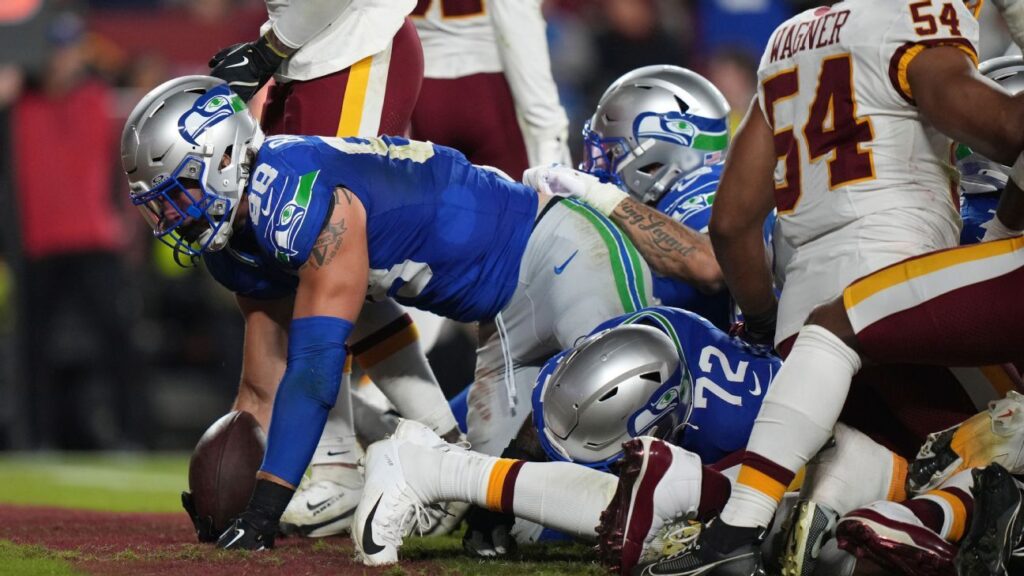
When the Seahawks faced a crucial third-and-1 in the third quarter, Kubiak turned to their innovative short-yardage solution: the tush push, affectionately nicknamed the “Barnyard” by fans.
Tight end AJ Barner took the direct snap, leveraging pushes from running back Zach Charbonnet and fullback Robbie Ouzts to secure the first down. Walker then sprinted for a 55-yard touchdown on the subsequent play, granting the Seahawks a 14-13 lead before they triumphed 38-37 in overtime.
Barner has been a quietly instrumental part of Seattle’s offensive prowess, contributing seven touchdowns during this breakout second season. The “Barnyard” play alone accounted for an additional 13 first downs with only one unsuccessful attempt. This effective play has transformed the Seahawks’ short-yardage struggles from 2024 into a strength for 2025.
It could prove pivotal in Super Bowl LX against the New England Patriots.
“It’s been fantastic,” said Macdonald regarding the tush push as the playoffs approach. “We must remain sharp and continue our successful execution. I’m confident we can develop some wrinkles off it too. It’s a key component of our short-yardage strategy.”
THE PHILADELPHIA EAGLES first adopted the tush push extensively in 2022, adding their own modifications to the classic quarterback sneak. A notable feature includes aligning two players behind quarterback Jalen Hurts to help drive him past the line. This maneuver has become the hallmark play in short-yardage situations for the reigning Super Bowl champions.
yet, opposition from other teams regarding the play’s safety sparked discussions for a proposed ban before a vote in May. even if most of the NFC supported the ban, it fell short by two votes from the necessary 24 for approval. The Seahawks were not among the 10 teams advocating for the preservation of the play, despite Macdonald and general manager John Schneider previously expressing their support for the tush push.
“It’s an effective play, and we need to defend against it,” Macdonald remarked earlier this offseason, “and perhaps we’ll try executing it one day.”
With the play still permitted, and an NFC rival set to leverage it on their side, the Seahawks recognized the advantage and decided to implement it too.
Having struggled with short-yardage conversions last season, the Seahawks’ 58.8% success rate (20-of-34) on third- and fourth-and-1 ranked among the bottom five in the NFL, per ESPN Research. Following Macdonald’s hiring of Kubiak to succeed Grubb, they began incorporating the tush push — with Barner in the role rather than quarterback Sam Darnold.
Why Barner?
“He’s a formidable presence,” said Macdonald.
At 6-foot-3 and 225 pounds, Darnold doesn’t possess the substantial build of Bills quarterback Josh Allen (6-5, 237), who frequently engages in tush pushes. Hurts (6-1, 223) has the physique of a running back, coupled with a capacity to squat 600 pounds.
In his former role as the Ravens’ defensive coordinator, Macdonald observed Baltimore occasionally deploying 6-foot-5, 250-pound tight end Mark Andrews for tush push situations. He believed Barner, measuring 6-foot-6 and 251 pounds, could adequately manage Seattle’s approach.
“I don’t ask for much,” stated Macdonald, who heads Seattle’s defense, “but I insisted on this from our offense.”
The Seahawks largely kept the play concealed throughout the offseason. Its initial public execution outside of closed practices occurred with rookie quarterback Jalen Milroe during the preseason. From the beginning, they planned for Barner to fill this role. Barner, a fourth-round selection in 2024, began his high school career as a quarterback at Aurora High School near Cleveland, thus he was familiar with taking snaps.
“We decided on this in the spring, and it’s a tribute to everyone involved,” said Macdonald. “Handling the ball is critical. Ensuring proper care is paramount, and our players have devoted considerable effort to this aspect throughout the offseason.”
Across the regular season and playoffs, the Seahawks converted 10 of 11 tush push attempts, all executed on third- or fourth-and-1. Barner has effectively utilized hard counts to draw defenses offside four times.
Besides scoring a touchdown through that play, the 13 first downs it garnered extended 11 scoring drives, with four leading to touchdowns.
Darnold has maintained a deep alignment in the backfield during each tush push play, staying out of harm’s way. This tactic, while sacrificing a potential blocker, does not signal that the tush push is imminent. It also grants Seattle the flexibility to revert to a play with Darnold under center.
“AJ is a cornerstone of our offense,” Kubiak noted. “We can depend on him. If it’s not going to be the quarterback with the ball, then AJ has effectively managed it. His physicality has made this evolution possible, starting back in April when we amassed substantial practice reps.
BARNER WAS VIEWED primarily as a blocker rather than a receiving threat leading up to the 2024 draft, having recorded only 22 receptions in his final college season while aiding Michigan in winning a national championship. yet, he has evolved into a well-rounded tight end over two NFL seasons.
During his rookie year, Barner outperformed expectations in the passing game, finishing with 30 receptions for 245 yards and four touchdowns. This promise influenced Seattle’s decision to part ways with veteran Noah Fant in the prior summer, promoting Barner to the starting role after serving as the second option in 2024.
Barner significantly improved as a receiver in 2025, more than doubling his rookie yardage total with 519 during the regular season, ranking third on the team. His 52 receptions and six receiving touchdowns were second only to Pro Bowl wideout Jaxon Smith-Njigba.
Though he appeared on the Seahawks’ injury report in seven of the 10 weeks leading up to their divisional round victory over the 49ers, Barner has participated in all 19 games.
“I enjoy playing physically … it can take a toll on my body,” he said. “But I’m all good on my end. I’ll do whatever is required to be game-ready.”
This includes undergoing hyperbaric therapy, massage therapy, and acupuncture. Over the recent offseason, he trained with Chuck “The Iceman” Liddell.
After connecting with NFL reporter and training expert Jay Glazer, Barner began collaborating with the UFC icon at Proactive Sports Performance in the Los Angeles region, where he spends much of his offseason.
“I have a wrestling background, and when I’m performing at my peak, I tap into this UFC mindset of survival,” he shared. “While it’s not literally life or death, it is intense. Channeling that energy helps me play at my best. I was fortunate to train with these elite individuals this offseason. … Few athletes do that, which I believe gives me a competitive edge.”
Barner utilized those sessions — around 10 of them, each approximately an hour long — to complement his standard workout regimen.
“A lot of grappling, a lot of leverage work, and just training with the legendary ‘Iceman,’ man,” Barner said. “It was incredible. Discussing his experiences as a fighter when it’s time to compete was invaluable.”
This preparation has notably benefited the tush push, a maneuver where leverage is crucial.
Thanks partly to the tush push, the Seahawks have successfully converted 26 of 36 attempts on third- or fourth-and-1 across their 19 games. Their conversion rate during the regular season (73.5%) places them eighth in the league. Charbonnet was instrumental in five of these conversions and scored six of his team-leading 12 rushing touchdowns from one or two yards out.
With Charbonnet sidelined for the remainder of the playoffs due to an ACL tear incurred during the divisional round, more of the short-yardage responsibilities could fall to Barner during Super Bowl LX.
The Patriots’ defense, despite conceding the fourth-fewest points and the eighth-fewest yards in the regular season, has permitted opponents to convert 33 of 42 attempts (78.6%) on third- or fourth-and-1 during their 20 games.
Barner expressed his enthusiasm about running a tush push in the Super Bowl.
“I’d love that opportunity,” he said. “It would be amazing to execute it on such a big stage.”