









-

Jeff Borzello
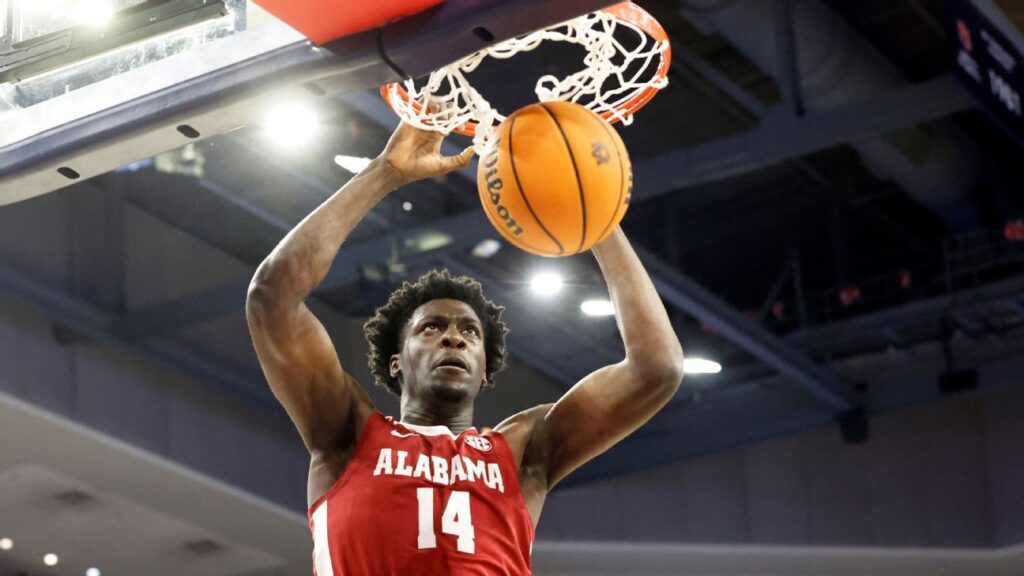
Alabama’s head coach, Nate Oats, announced on Friday that he intends to have Charles Bediako play against Tennessee on Saturday. This follows a recent court ruling that granted the former Crimson Tide center the ability to return to college basketball immediately.
“We are planning to play him,” Oats stated. “He’s eligible to compete. We’ll adhere to the court’s directives.”
Bediako competed for Alabama during the 2021-22 and 2022-23 seasons before declaring for the NBA draft prematurely. After going undrafted, he did not make an NBA appearance and has spent the last three years with different G League teams, most recently appearing for the Motor City Cruise last weekend.
He filed a lawsuit against the NCAA seeking immediate reinstatement after the organization rejected Alabama’s appeal for his return.
Oats emphasized that Bediako is still within the five-year timeframe following his high school graduation, comparing his situation to several former European professionals who have been permitted to play college basketball.
“The NCAA has already permitted professionals to play—almost every team we’ve faced this year or will face has a former pro on their roster—so how am I supposed to explain to Charles and the team that we’re not going to support them when he’s been declared legally eligible to play?” Oats queried.
“Charles shouldn’t face consequences for opting for academics after high school instead of pursuing a professional career like many international players did.”
Tennessee’s coach, Rick Barnes, was direct when discussing Bediako’s eligibility for Saturday’s matchup.
“Choosing to give up your college eligibility is a choice that’s been made,” Barnes said. “It applies regardless of whether someone has been in the service and returned. Once you start that clock and make that choice, you’ve made it.”
Unlike former professionals who gained eligibility through the NCAA, including Baylor’s James Nnaji, the first drafted player cleared for men’s college basketball, Bediako had signed a two-way contract with multiple NBA teams, a boundary the NCAA has previously defined for eligibility.
Dan Gavitt, the NCAA’s senior vice president of basketball, released a statement on Friday, reaffirming the rule that states anyone who remains in the NBA draft past a specified date—like Bediako did—loses their remaining college eligibility.
“If those rules cannot be upheld, it would destabilize the environment for student-athletes, schools constructing rosters for the upcoming season, and the NBA,” Gavitt stated.
The NCAA had previously put out two statements regarding Bediako’s case. On Tuesday, before a judge confirmed Bediako’s eligibility and declared that the NCAA would not punish Alabama in relation to the ruling, the organization reiterated that it “has not and will not grant eligibility to any prospective or returning student-athletes who have signed an NBA contract.”
Following the judge’s decision, the NCAA appealed to Congress for help in addressing ongoing threats to its eligibility standards.
“Efforts to circumvent NCAA regulations and recruit individuals who have completed their college tenure or signed NBA contracts are taking opportunities away from high school students,” the NCAA stated on Wednesday. “A court ruling that allows a former NBA player to compete against actual college student-athletes highlights why Congress must intervene and empower college sports to enforce our eligibility standards.”
A complete hearing regarding Bediako’s request for a preliminary injunction is set for Tuesday morning.
In his press conference on Friday, Oats advocated for a reform of the NCAA’s system, describing it as “clearly broken.”
“In my view, we require a consistent and transparent system that does not penalize American players, eliminates hypocrisy, and treats both American and international players equitably while providing high school athletes with necessary opportunities post-graduation. There should be a way to create a system that checks all those boxes,” he said. “But for now, we will continue to support Charles.”
Bediako averaged 6.6 points, 5.2 rebounds, and 1.7 blocks during his time at Alabama.
Information from the Associated Press contributed to this report.