








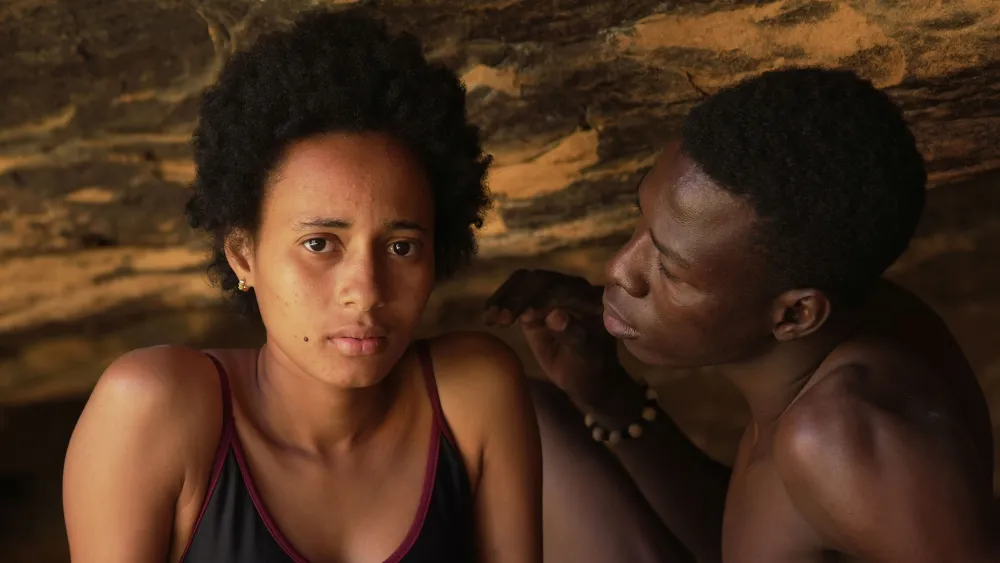
Chadian director Mahamat-Saleh Haroun sets his latest film, “Soumsoum, the Night of the Stars,” in the Ennedi desert of his native country. Following Kellou, a young woman who sees distressing visions of the past and future, the film is both a mystical parable and a metaphor-heavy narrative. While the story takes place in contemporary times, some of the characters have extraordinary gifts and tell tall tales of a world beyond the realm of most people. The journey it takes the audience on, however, is only intermittently entertaining. It has moments of beauty and even poetry, but too many others of tedium.
Maïmouna Miawana plays Kellou with an open-hearted and gentle determination that suits this character who thinks of herself as an outcast. In her tiny village she’s called a “blood girl,” because her mother died while giving birth to her. Her father Gabra (Ériq Ebouaney) is a stranger who moved to the village before she was born, yet has never been fully accepted in this community. When Kellou starts having haunting visions that foretell the future, she feels scared.
The bright spot in her life is the love of Baba (Christ Assidjim Mbaihornom), a teenage villager whose family doesn’t approve of the courtship. Kellou becomes even more isolated when she befriends Aya (Achouackh Abakar hearteymane), an older woman and fellow outcast. Yet Aya opens a new world for Kellou, where she feels accepted, and where she finds that what she yearns for above all is freedom from the traditions and customs imposed on her.
Haroun and his co-writer Laurent Gaudé find the film’s center in the budding friendship between Kellou and Aya. Recognizing a kindred spirit in Kellou, Aya acts as both a mentor and a pal, assuring her that the visions she sees do not make her a freak. In return, Kellou recognizes that Aya, who’s always coughing, is sick, and promises to take care of her. The closer they become, however, the more the villagers shun and isolate them — threatening Gabra with eviction if he doesn’t stop his daughter from visiting Aya — while even Baba starts keeping his distance. Aya is not seen by them as the wise free spirit that she is, but rather as a woman with a sullied reputation, blamed for many of the catastrophes that befall this tiny village. Babies are dying, a deluge of rain has destroyed much in its path, and Aya is regarded as the cursed cause of this misfortune.
When Aya describes how she was conceived, the film reaches its fantastical apex. Kellou is amazed by Aya’s story of a feast where men and women dance with abandon while wearing masks, and eventually couple up. All Aya’s mother knew of the man who impregnated her was that he wore a monkey mask. The audience is not privy to whether this tale is real or a fantasy, though either way, Haroun renders it beautifully in collaboration with cinematographer Mathieu Giombini.
But once the relationship is established, the film loses momentum. Magical realism elements fade to the background, replaced with metaphor. Gabra is perhaps a symbol for all immigrants, while Kellou’s search for freedom is a call against the patriarchy enforcing its rules on the women of the community. It’s all well-intentioned but earnest, and less entertaining than the flights of fantasy realized before.
The film’s rhythm turns lethargic as Kellou has to deal with her promise to take care of Aya, and while the audience is taken on a long journey where some of Kellou’s visions come true, nothing dramatic actually happens. Instead, we are treated to repetitive scenes of Kellou standing up to the villagers, and then finally leaving. Haroun has conjured rich elements of the magical free world, but hasn’t managed to follow through with a compelling narrative.
Source: variety.com