








DENVER — Doug Moe, a pioneering figure in the ABA who became well-known for his laid-back, irreverent style and sometimes R-rated approaches as the coach of the Denver Nuggets during the 1980s, passed away on Tuesday at the age of 87.
Moe’s son, David, informed numerous friends of the coach that his father had died after a lengthy battle with cancer, according to Ron Zappolo, a longtime Denver TV personality and close friend of Moe’s, who spoke to The Associated Press.
In a social media tribute, the Nuggets referred to Moe as “a truly unique leader and an individual who led one of the most thrilling and successful periods in Nuggets history.”
Over 15 seasons as a head coach, Moe achieved a record of 628-529, including tenures with the San Antonio Spurs and Philadelphia 76ers. even if he never secured a championship, his most notable achievement was during the 1985 season when his top Nuggets team lost to the Los Angeles Lakers in the Western Conference finals. He was recognized as the NBA Coach of the Year in 1988.
Beyond the statistics, Moe is remembered for his innovative motion offense and the captivating displays he delivered while coaching from the sidelines.
His Denver teams led the league in scoring for five consecutive seasons in the early `80s, rarely employing set plays.
Moe had a knack for referring to those he favored as “stiffs” (or worse) and often used colorful language to emphasize his points to some of his favorite players—Kiki VanDeWeghe, Danny Schayes, and Bill Hanzlik particularly stood out.
The coach was often seen on the sidelines in one of his well-loved sports coats, typically without a tie (he kept a few “emergency suits” for special occasions), his hair tousled and his voice strained by the end of many games.
The Nuggets’ bench and the ten rows behind it weren’t exactly family-friendly, yet within hours, Moe could be found at a bar or coffee shop bonding with many players he’d criticized, often pondering where that foul-mouthed coach on the sidelines had come from.
“Sometimes I think I have a Jekyll-and-Hyde personality. I joke around a lot before and after games, but once the game starts, my emotions just take control,” Moe remarked in a 1983 interview with The New York Times.
Years before John Elway made his mark, Moe was Denver’s foremost sports figure. Zappolo, the sportscaster, noted there was a soft side beneath the game-day bravado.
“I’m not sure there’s ever been a more significant sports figure in Denver—not just due to his success, but because of his vibrant personality and kindness,” Zappolo remarked. “Many people today feel like they were Doug’s best friend.”
Douglas Edwin Moe was born on September 21, 1938, in Brooklyn, New York. As a teenager, he gained recognition within New York basketball communities, sometimes playing under alias names to join teams he wouldn’t traditionally have qualified for.
He teamed up with his dear friend Larry Brown at North Carolina, earning All-America honors twice as a 6-foot-5 small forward. but, Moe’s college career was cut short due to a point-shaving scandal, where he was paid $75 to attend a meeting; he would not go along with the scheme.
After spending a few years in Europe, Moe reunited with Brown, navigating the nascent ABA together. Over a five-year career, Moe was a three-time All-Star, although his time in the league was shortened by persistent knee issues.
After his playing days, he joined Brown as an assistant coach first with the Carolina Cougars and later with the Nuggets during the franchise’s final ABA years.
Moe insisted he never aspired to be a head coach—feeling he didn’t want to put in that much effort—but Brown convinced him to take the helm in San Antonio. With George Gervin’s help, he claimed the division title twice and reached a conference final in four seasons.
Moe’s next chapter began in Denver, where he took over after another of his Carolina friends, Donnie Walsh, was let go in 1980. The following decade marked a legendary era for the Nuggets, who donned rainbow uniforms and rewrote records while remaining overshadowed by the Lakers and Celtics dynasties.
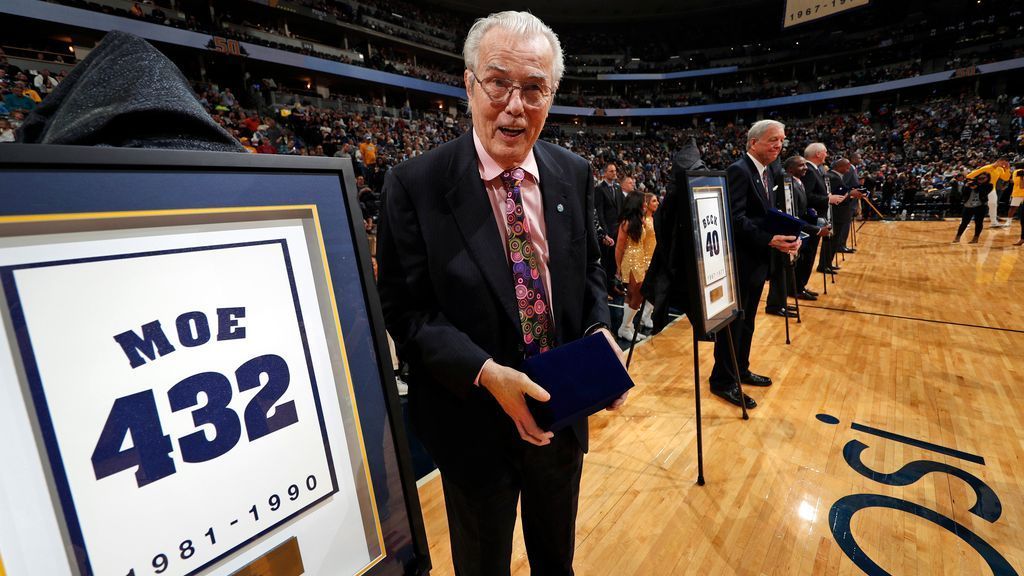
Alex English and VanDeWeghe topped the scoring charts in the 1982-83 season, a rare feat for teammates. The Nuggets suffered a 186-184 loss to the Pistons in 1983, which remains the highest-scoring game in NBA history. Moe secured 432 wins with the Nuggets, and the franchise honored that number by retiring it alongside his name.
It took over 30 years after Moe’s retirement and a return to San Antonio for the Nuggets to finally become NBA champions.
Ironically, one of Moe’s more theatrical coaching moments came at the expense of the Nuggets on the final day of the 1977-78 season when he was with the Spurs. Earlier that day, Denver’s coach Brown allowed David Thompson to score 73 points against Detroit, temporarily placing him ahead of Gervin in a tight race for the scoring title.
That evening, Moe instructed the Spurs to let “Ice” score, culminating in Gervin putting up 63 points against the Jazz to win the title by a mere 0.07 points.
Moe’s coaching peak was with the Nuggets, where the arrival of Fat Lever and Calvin Natt via trade in 1984 significantly enhanced the team. Unfortunately, both players were sidelined during the 1985 conference finals against the Lakers. The Nuggets lost the final three games for a 4-1 series defeat, and Moe never reached that level of success again.
While the Nuggets focused primarily on offense, Moe placed considerable emphasis on defense—arguing that it was defense, rather than scoring, that dictated victory or defeat.
In an incident of frustration during a lopsided loss in Portland, he ordered his team to stop defending altogether and let the Blazers score freely in the waning moments to record a franchise-high for points in a game. This decision led to both a fine and suspension, shortly after he incurred a fine for splashing water on an official.
For the most part, however, Moe’s career was built on not taking himself too seriously—a humorous contrast to the polished Pat Riley and the Laker Showtime teams that dominated the NBA in that era.
Moe even lightened the mood following one of his lowest points—his firing by the Nuggets in 1990—by appearing at the news conference in a Hawaiian shirt, popping open champagne while his wife, whom he called “Big Jane,” looked on. A joyous occasion, he insisted, as he would now be paid to do nothing.
He concluded his head coaching chapter with a brief, unsuccessful term in Philadelphia before returning to Denver in various support roles, including a stint back on the bench as George Karl’s assistant.
“I guess I’m just foolish, or something like that,” Moe responded when asked why he returned to coaching.
Far from it.
although claiming he merely tossed the ball out there, there was a deliberate method behind what appeared to be the chaos of his high-paced passing game.
“There will never be another sports figure like Doug Moe,” Zappolo reflected. “He truly was one of a kind.”