








LONDON — even if the EuroLeague is not particularly excited about the NBA’s intention to establish a new competition in Europe, it is also not overly worried.
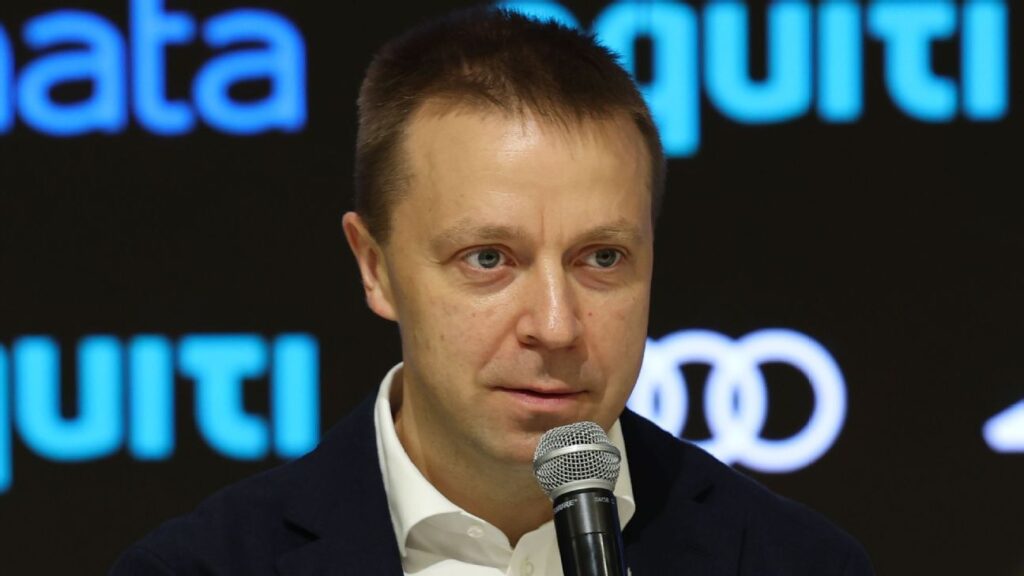
“We’ve only been exposed to the idea and the buzz surrounding how incredible it could be, what its potential entails,” EuroLeague CEO Paulius Motiejunas remarked about the NBA’s planned league. “But theorizing is one thing—making it successful is another.”
Motiejunas continued, “We’ve been operating for 26 years. We understand how Europe works.”
Featuring teams like Real Madrid and Bayern Munich, the EuroLeague is regarded as the premier men’s professional league outside the NBA. The 20-team league includes 13 “shareholder” clubs that are safe from relegation, with the remaining teams either qualifying through their domestic leagues or by invitation.
With support from FIBA, the NBA is exploring a 16-team setup with 12 permanent members, aiming for an October 2027 launch. Potential host cities include Athens, Istanbul, Paris, Lyon, Munich, Berlin, Rome, Milan, Madrid, Barcelona, London, and Manchester.
The focus is currently on three EuroLeague shareholder clubs that have yet to renew their decade-long licenses: Real Madrid, Fenerbahce in Istanbul, and the Tony Parker-owned ASVEL near Lyon, with Parker expressing his support for the NBA.
Barcelona, which had previously hesitated, has indicated it would extend its license for another 10 years beyond the current season.
“It’s significant, of course. It’s a key brand, and we’re pleased they’ve committed,” Motiejunas said regarding Barcelona, which has remained silent on the matter publicly.
In a conversation with The Associated Press, Motiejunas expressed confidence that all 13 clubs would remain.
“The NBA has been making announcements for a year now, yet nothing substantive has materialized,” Motiejunas stated. “These team owners, as businessmen, are starting to perceive it as a repetitive cycle of ‘we will announce later.’ … The 2027 start date is fast approaching.”
EuroLeague clubs reportedly hold a €10 million ($11.6 million) exit clause, but Motiejunas only mentioned that contracts may be broken “through consequences and legal teams.” He added that there is no opt-out option for the NBA.
The EuroLeague insists it remains open to some form of collaboration with the NBA. yet, it has also sent a letter to the NBA warning of potential legal action if discussions with EuroLeague shareholders continue.
NBA commissioner Adam Silver dismissed the threat during an event in Berlin before the Orlando Magic’s 118-111 victory over the Memphis Grizzlies, marking the NBA’s inaugural regular-season game in Germany.
He also downplayed the EuroLeague’s significance.
“If I believed the upper limit was the current EuroLeague and its fan engagement,” Silver stated, “we wouldn’t be channeling this level of effort and focus into this initiative.”
Media reports suggest that the NBA is aiming for a franchise fee of at least $500 million. Silver noted that prospective investors would need to be patient, as “it will require time before it becomes a viable commercial operation,” indicating the process would take “multiple decades.”
He warned that “potentially” initiating a new league is a “massive undertaking” and categorized discussions with Real Madrid and other Spanish teams as primarily for information gathering.
The European basketball landscape resembles that of soccer, where domestic leagues feed into continental competitions; the EuroLeague functions similarly to UEFA’s Champions League. Other international basketball leagues exist but are less known compared to their soccer equivalents, often leading to confusion among fans. For example, FIBA has its own Basketball Champions League, which could serve as a possible pathway to an NBA-affiliated league.
Silver sees potential in the market since basketball ranks as the second most popular sport in Europe after soccer.
“Rather than view us as taking market share from [soccer], I consider the commercial aspect of basketball as it stands in Europe, which likely comprises about 1 percent of the overall commercial sports market,” he explained.
Many European basketball teams, including several from the EuroLeague, have faced financial challenges, often relying on affluent owners to cover annual debts. To encourage financial sustainability, EuroLeague has introduced spending regulations.
In a strategic move, the EuroLeague held its “Final Four” championship outside Europe—specifically in Abu Dhabi—for the first time last season, showcasing a taste of Euro basketball excitement. plus, Panathinaikos’ majority owner, Dimitris Giannakopoulos, received a five-game suspension for “threatening actions” directed towards referees.
EuroLeague also granted a multiyear license to a new team in Dubai and recently renewed its collaboration with global sports marketing agency IMG.
“We focus on our own progress,” Motiejunas asserted. “We will adapt, there’s no doubt, and we will keep fighting.”
The Associated Press contributed to this report.