








-

Myron Medcalf
Multiple Authors
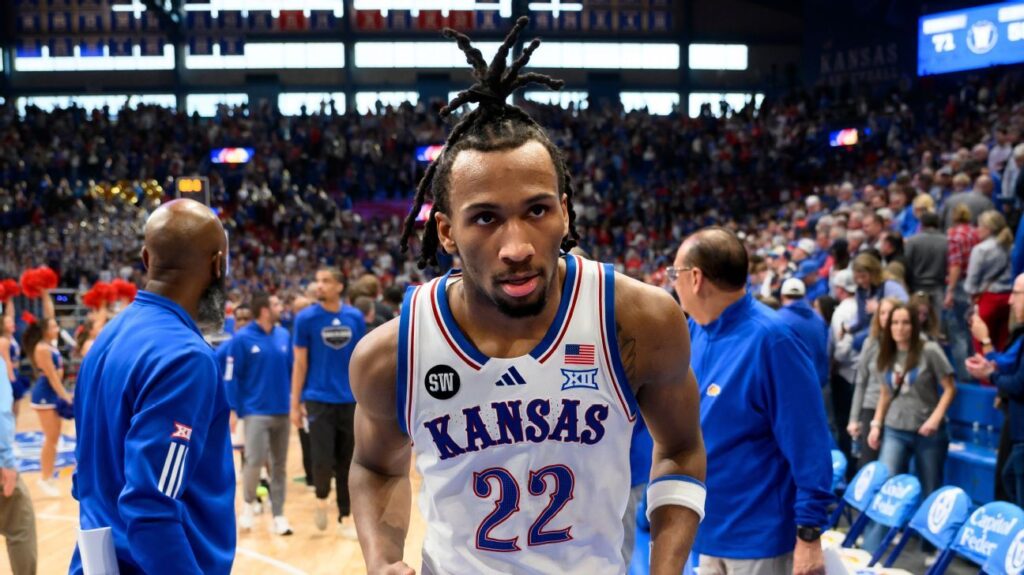
LAWRENCE, KAN. — Bill Self isn’t known for being warm and fuzzy. So when he danced across the Allen Fieldhouse court after Kansas stunned No. 1 Arizona on Feb. 9, embracing his players like it was a celebratory New Year’s Eve, it caught them off guard.
“That’s three hugs in my career,” sophomore Flory Bidunga remarked after the game. “He’s giving hugs now? We need to put a stop to that.”
Uncommon as it is, Self’s celebration echoed the significance of the occasion: The Jayhawks had just dealt the undefeated Wildcats, who were 23-0, their first setback of the season. Remarkably, they achieved this victory without their top player, Darryn Peterson — the expected No. 1 pick in the 2026 NBA draft — who was a last-minute scratch due to flu-like symptoms.
This was just one moment in the unpredictable season for Self. His precautionary hospitalization before Kansas’ Jan. 20 match-up at Colorado served as a subplot for a team that has been preoccupied with the constant uncertainty surrounding Peterson’s status. The freshman has missed 11 of the Jayhawks’ 27 games and has logged less than 25 minutes in seven of his 16 appearances due to hamstring and ankle injuries, accompanied by recurrent cramping.
The situation took a turn nine days post the Arizona victory when Peterson opted to sit out the second half during a win at Oklahoma State, Self’s alma mater. It was his shortest outing to date (18 minutes), triggering a wave of national media scrutiny. ESPN’s Stephen A. Smith even advised NBA teams against selecting the promising prospect as the top pick in the forthcoming draft.
“I thought we had moved past it, but evidently we haven’t,” Self told reporters following the game in Stillwater. “It’s definitely a concern. Entering the NCAA tournament, facing a team that’s just as skilled as you, you need all your top players available. One slip-up like that could derail not just a game, but an entire season.”
The reality is stark: Kansas has struggled to build chemistry while riding the unpredictable roller coaster of Peterson’s availability. This became evident when the Jayhawks fell to a mediocre Cincinnati team at home last Saturday, only managing 68 points with Peterson playing 32 minutes, compared to 82 points without him against Arizona. Now, with No. 2 Houston arriving on Monday (9 p.m. ET, ESPN) and less than a month until the NCAA tournament, the narrative morphs into a tale of two teams in Lawrence, raising questions about the implications for March.
It’s a complex situation, even for Self.
At this stage in most seasons, the seasoned coach with 23 years at Kansas is usually confident about his team’s potential. yet, without his star player consistently on the court, he finds himself in a state of uncertainty. The two national championships and 644 wins with the Jayhawks have made him adept at navigating the final month of the season to prepare for the rigors of the NCAA tournament. Nevertheless, he knows he requires Peterson to be fit for the marathon ahead. “The time is now,” Self told ESPN after the Arizona win.
“He’s exceptional, but I’ve asked [Peterson], honestly, ‘Have I truly had a chance to coach you yet?'” Self continued. “Have I been able to say, ‘This is absolutely unacceptable. This is how we will do it’? Have I had the opportunity to truly convey my points to him?”
TWO DAYS after missing his team’s key victory, Peterson entered Allen Fieldhouse maintaining his typical neutral expression.
“On the court, no, I probably don’t smile,” he admitted. “Off the court, I think I have a decent smile.”
Jayhawks supporters have had little reason to smile this season, either, as Peterson has faced a barrage of criticism from fans and analysts alike. He recognizes the concerns. Eager to play more and find a rhythm with his teammates, he acknowledges the difficulties thus far.
“Everyone has their opinions,” Peterson shared with ESPN prior to the Oklahoma State game. “Basketball is my life. If I could have participated in every game this year, I certainly would have. If you had asked me last year about my goals for this season, missing games wouldn’t have made the list. All this has just occurred, but I must learn to handle it.”
Things have not unfolded as Peterson had envisioned. Earlier in the season, he expressed confidence in his ability to elevate the Jayhawks’ performance.
“I see myself as a leader and a hard worker. I lead by example, demonstrating the right behavior both on and off the court,” he remarked at the Big 12 media day in October. “That’s beneficial for a team; seeing a young player stepping up. I aim to set a high standard.”
Fast-forward four months, and Peterson’s average of 27.2 minutes per game starkly contrasts the numbers from his peers atop ESPN’s 2026 NBA draft big board. BYU’s AJ Dybantsa and Duke’s Cameron Boozer boast averages exceeding 30 minutes. Boozer has clocked in over 34 minutes in 15 games, a benchmark Peterson has only reached once. “If they need me to play 40 minutes, I’ll play 40 minutes,” Dybantsa stated following his full 40-minute performance in a crucial win over Iowa State on Saturday.
If picked No. 1, Peterson would be only the third player since 2000 to sit out over 10 college games, following Kenyon Martin (17 across multiple seasons) and Kyrie Irving (26 during his injury-laden season), per ESPN Research. Alongside the 11 games missed, mid-game cramping has necessitated Peterson’s exit several times, where he’s been seen utilizing a massage gun. He wishes he could contribute more but hasn’t detailed the specifics of those moments.
The narrative suggesting Peterson is intentionally abstaining from games puzzles him, leading to perceptions that undermine his work ethic, a notion he has not encountered until now. His father would have him practice passing into trash cans after school, adapting an all-star skills challenge in their hometown of Canton, Ohio. This was still easier than the 108 stairs at Monument Park he’d train on weekends, regardless of harsh Midwest winters.
“Those sessions were tough,” Peterson said. “We’d run up those stairs 20 times, alternating the way we ascended, whether jumping or springing up. It was often grueling.”
Peterson avoids social media but still hears the discussions that call his commitment as a player and athlete into question, and he’s prepared to respond. He insists he has never shied away from challenges. Yet, the major concern remains: Can anyone accurately foresee his availability come March, when the stakes are highest?
“Let’s make it happen,” Peterson said when asked about his message for Kansas fans anxious about his participation in the NCAA tournament. “That’s the goal.”
In many respects, the question transcends whether Peterson will be available in March. It’s also about his capacity to contribute to the team chemistry necessary when on the court, especially given the team’s record of 9-2 sans him. Self acknowledges the urgency for a Kansas team with lofty aspirations and an erratic roster.
Peterson is a prolific scorer on a team that often relies on him when he’s available. Conversely, the Jayhawks exhibit more cohesion and chemistry when he’s sidelined. With just three weeks until Selection Sunday, Self aims to create a seamless integration of both dynamics.
“I believe it’s two distinct mindsets when Darryn is healthy; the team wants him to succeed and acknowledges his talents, but they often suppress their own aggressiveness in his presence,” Self noted after the Arizona victory. “We must figure out a balance where he can assert himself while enabling others to thrive as well.”
“I’ve mentioned several times that I don’t see it as two teams, but it’s evident we’re not close to reaching our full potential if everything aligns perfectly.”
FOR 327 DAYS, Self endured a winless streak.
During the 1993-94 season, he was a rookie head coach at Oral Roberts, facing a 15-game losing streak that extended into the subsequent season’s first three games. On one occasion, the coaches faced the team in a scrimmage and triumphed. The pressure was profound that season, marked by all-nighters and a doctor advising him to de-stress.
Yet, not all was lost. That team maintained high spirits and taught Self invaluable lessons that resonate with the 2025-26 season.
“It provided significant insights,” he explained. “They deeply cared for one another and played for each other. It was immensely gratifying.”
Self observed that last season’s team liked each other but didn’t wholeheartedly play for one another, a factor contributing to their first-round NCAA exit last March. This season, he’s entrusted his emotional and competitive leaders, Bidunga and Melvin Council Jr., to prevent a repeat letdown.
“[Council] is exhilarating because he’s uninhibited and plays aggressively,” Self praised. “He isn’t weighed down by the situation—he drives to the basket no matter the odds, and that approach can yield positive outcomes.”
“I admire his mindset.”
These players have weathered the challenges this season by depending on one another, fostering camaraderie that hinges on Council, Bidunga, and Bryson Tiller, a promising redshirt freshman who contributed 16 of the Jayhawks’ first 22 points against Arizona. Self has termed Council “the most popular” player on campus, while Bidunga’s on-court impact is statistically vital — Kansas exhibits a plus-27.3 point differential per 100 possessions when Bidunga is active, according to advanced analytics site EvanMiya.
“I keep telling him, you need to share the ball,” Bidunga playfully advised Council before the postgame news session after the Arizona win.
0:30
Flory Bidunga delivers an impressive alley-oop jam for Kansas.
Flory Bidunga electrifies the crowd with a slam dunk.
Having navigated nearly a dozen games without Peterson this season, the team embraces that possibility. Nine of Bidunga’s 11 double-doubles have occurred in matches Peterson sat out (six) or played fewer than 25 minutes (three). The Jayhawks triumphed in three games during the Players Era Festival without Peterson during Feast Week. Since then, the unknowns have fostered stronger bonds among teammates through bonding experiences over Hibachi dinners and Nintendo’s Wii U tennis matches, a console many players were introduced to in elementary school.
“I tell everyone I feel like I’ve known these guys far longer than my time here,” Council, a first-year transfer from St. Bonaventure, expressed. “It feels as if we’ve been together for four years. We just mesh well.”
Yet, this journey hasn’t been without challenges.
Following a recent defeat to West Virginia, the players organized a meeting to hold one another accountable. This gathering has driven increased performance—yet did little to resolve the team’s core dilemma.
“I truly believe we can be something special,” Bidunga remarked. “We simply need to discover our identity.”
The national champions from previous years? They had their identity established by this point in the season, placing Kansas further behind. although this, the Jayhawks maintain a top-10 defensive ranking while their offensive performance is similar whether or not Peterson is playing (KU is only plus-0.7 points better per 100 possessions with him, per EvanMiya). The victory against Arizona illustrated the Jayhawks can thrive in March, irrespective of the uncertainty surrounding Peterson’s participation.
“Without a doubt, Kansas is an outstanding team,” remarked Arizona coach Tommy Lloyd after his team’s defeat in Lawrence. “Let’s not minimize this to just Darryn Peterson. He missed the game due to illness. They triumphed over the No. 1 team at home. They executed superbly, and their coach performed magnificently. That should be the focus.”
AFTER A STRING of health issues, Self claims he’s no longer preoccupied with trivial matters.
The previous years drained some of his “joy,” prompting a feeling of merely going through the motions while coping with challenging seasons, both personally and professionally. Those hugs and smiles this season? They represent a coach who has faced serious health questions in recent times.
“I believe I’m stressing over minor issues considerably less than before,” he reflected. “yet, I still worry about the significant challenges.”
At the forefront of those worries is the ongoing uncertainty regarding Peterson’s absence, complicating Self’s efforts to cultivate team cohesion as Selection Sunday looms. Following the Arizona game, Self only learned of Peterson’s absence upon his exit from the locker room just prior to the starting lineup announcement.
“I felt off throughout the day, but I thought I’d try to warm up and see if the fans could provide some motivation,” Peterson admitted about missing the game. “But it just didn’t pan out that way. My legs felt heavy, and I didn’t want to hinder the team, so I decided it was better for someone else to take my place.”
Self has leveraged less capable teams during various points in his career, but he acknowledges that continuity will be essential for Kansas to succeed come March. He’s unsure if achieving that is feasible without a fully operational roster moving forward.
“What concerns me is, given all the unpredictability of a season, particularly in the postseason: ‘Are you ready for whatever may arise in the postseason?'” Self expressed. “You should expect the unexpected: foul trouble, injuries at the last minute. There are no excuses. You face a do-or-die situation. Can you simply switch it on if you haven’t built chemistry and gone through experiences together?”
That’s the crux.
As Selection Sunday approaches, Kansas is uncertain which version of the team Self will bring to the NCAA tournament. “The best player” he has, he insists, is worth the chaos. Peterson boasts a usage rate comparable to Stephen Curry’s this season and is currently shooting better from the (shorter) 3-point line than the NBA All-Star (43.1% for Peterson vs. 39.1% for Curry). Few players have matched Peterson’s effectiveness on the court in recent college basketball history. yet, translating that talent into consistent winning basketball remains a challenge.
“He can net 16 points and dominate, or he might score 30 and equally dominate, but what’s most advantageous for us?” Self questioned. “Finding that balance is critical, as we will require him to perform during [postseason] matches; you derive points through players, not plays. It’s advantageous to have a player who can create scoring opportunities.”
The second half of the Arizona win underscored the careful walk this squad has navigated, accompanied by the drama surrounding a potential No. 1 pick and their promise, regardless of who may be available in March. The Jayhawks had to adapt without Peterson once again — and they succeeded. Trailing 55-44 with 17:02 remaining, the undermanned Kansas outscored the undefeated team 38-23 thereafter.
With the support of a crowd that roared like a jet engine (128 decibels), the Jayhawks overcame the odds, becoming the first team in three decades to defeat a No. 1 team without a player recording an average of at least 20 points, per ESPN Research.
As the celebration subsided, Self walked through the tunnel in Allen Fieldhouse, taking his time. Approaching the locker room, he gazed at the floor and repetitively said “wow, wow, wow, wow, wow,” shaking his head as cheers echoed around him.
This season for Kansas has been nothing short of a roller coaster, filled with disappointments, unexpected victories, and surprises — all while facing numerous uncertainties ahead.
“We have work to accomplish. We must remain competitive,” Bidunga stated post-game. “Though we’ve faced several matches without [Peterson], we’ve grown stronger. Even in his absence — and while we certainly wish he was playing — we still have responsibilities, and we executed admirably.”