








-

Michael C. Wright
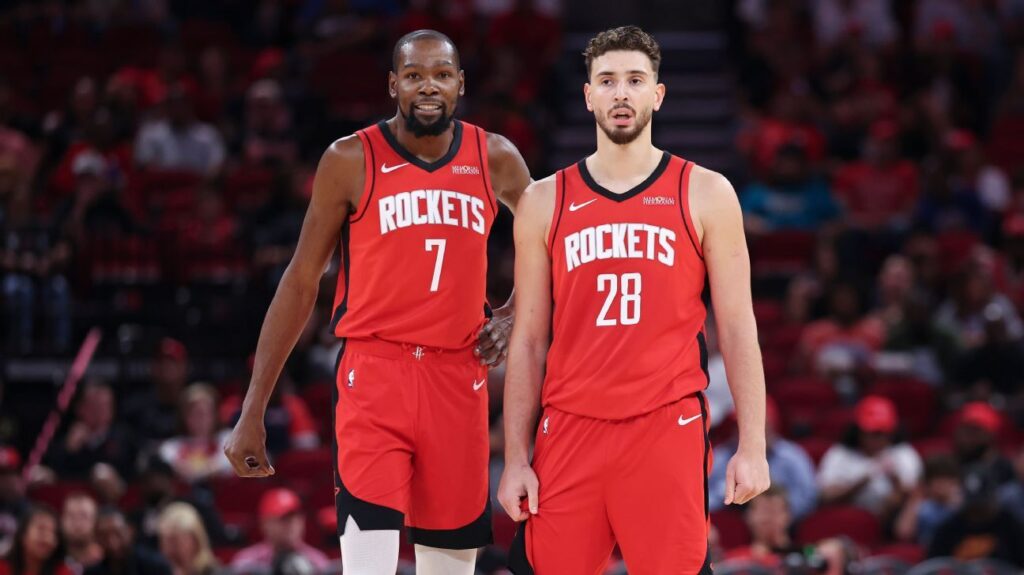
IT’S 9:20 PM ON Jan. 15, as a hooded Kevin Durant presses his palm against his forehead, intently examining a stat sheet to analyze the 20-point defeat to the defending champion Oklahoma City Thunder.
“Honestly, I feel like I’m missing good shots,” he reflected. “We fired up 104 attempts. Our turnovers weren’t excessive. My ability to make shots should uplift the team.”
Unfortunately, that wasn’t the case this evening.
Durant shot 7 of 23 from the floor, including a dismal 0 for 5 from beyond the arc. For the Houston Rockets, this rematch against OKC, following a double-overtime defeat in their season opener, was an opportunity to measure their skill against the best. Instead, they concluded one of the worst seven-game stretches in NBA history for 3-point shooting (58 of 236) as recorded by ESPN Research, marking their fifth loss in seven games.
Less than a day later, Houston coach Ime Udoka affirmed his belief in the team’s unique offensive style and its potential for lasting success.
“This formula can succeed,” he stated in an interview with ESPN.
By adopting a committee approach at point guard, forced by Fred VanVleet’s season-ending knee injury before training camp, the Rockets surprisingly sit at No. 3 in the NBA for offensive rating (118.9). They’ve employed a physical, albeit methodical strategy (Houston ranks 28th in pace), relying on contributions from various players within their sizeable rotations, primarily Durant and center Alperen Sengun.
but, this unorthodox style has led to inconsistency for the Rockets.
Udoka anticipates progress as the season continues.
“We prioritize hunting quality shots,” Udoka noted about 90 minutes prior to the late game against the Minnesota Timberwolves on Jan. 16. “Our untraditional approach this year, lacking a designated setup point guard like Fred [VanVleet], is different.
“Kevin and Alpi [Alperen Sengun] attract significant attention and create open opportunities. Many teams are doubling and scrambling, which allows us to dominate rebounds. The strategy hinges on those players drawing defenses in, creating advantageous situations for us.”
Durant and Sengun embodied Udoka’s confidence later that evening against the Timberwolves, who were missing their star guard Anthony Edwards (for foot maintenance). Together, they accounted for 77 points in a 110-105 win, with Durant achieving a season-high 39 points on 11 of 18 shooting, including 6 of 8 from 3-point range. His performance marked the second-highest scoring performance by a Rockets player over 35 years old (trailing Clyde Drexler’s 43 points against the LA Clippers in 1997), according to ESPN Research.
Sengun chipped in with 25 points and 14 rebounds before fouling out, marking his ninth game this season with at least 25 points and 10 rebounds.
Houston’s “bully ball” was back in action.
“We have the talent,” forward Jabari Smith Jr. stated to ESPN. “We just need to understand how to make it work. It may not be traditional, but we see glimpses of its potential. When the ball moves and has rhythm, that’s when we can build leads.”
UDOKA AND THE Rockets coaching staff spent last season experimenting with big lineups, finishing the 2024-25 campaign leading the NBA in offensive rebounds per game (14.6). Houston’s size also translated into aggressive offensive glass play, yielding more second-chance points, another category they dominated last season (18.1) while achieving a 52-30 record.
This strategy almost proved effective in the playoffs against the aging, undersized Golden State Warriors, pushing them to seven games. but, the Rockets recognized the need for a primary offensive contributor. though Jalen Green led the team with 21.0 points per game, the then-22-year-old lacked the consistency to elevate the team to its goals.
Meanwhile, a discontented Durant was stagnant in Phoenix, where the team had explored trade options around the February deadline without his awareness.
Houston observed patiently, waiting for Phoenix’s asking price to decrease, which it ultimately did during the summer.
Green struggled to step into a major offensive role during the playoffs. Aside from scoring 38 points in a Game 2 win, he averaged only 9.2 points on 31.1% shooting in the remaining six games as the Rockets fell 4-3 to the Warriors.
“Even when you’re pleased with your roster, which we were, it’s still my responsibility to evaluate potential opportunities,” Rockets general manager Rafael Stone noted. “except if you’ve just won a championship, improvement is necessary.”
To accomplish that, Houston executed the largest trade in NBA history in July, involving seven teams and numerous picks and players—including former Rockets Green and Dillon Brooks—to acquire Durant, a leading scorer in the league.
“When it’s time to score, there’s little deliberation; we simply aim to get KD the ball,” Rockets guard Amen Thompson remarked. “If you want to double Alpi and leave KD exposed, or double KD and let me, Jabari, and Reed roam, he’s a definite threat.”
At 6-foot-11, the 15-time All-Star Durant enhances Houston’s already considerable size.
“We recognized what worked last year and decided to invest heavily in that approach,” Udoka stated. “We became a bigger team… We’re capitalizing on our size and the natural offensive rebounding strengths of certain players. Amen is excellent at it, Tari excels, and Steven as well. Jabari and others have developed those skills, including Alpi. This became a theme last year, and we’ve amplified it this season.”
REED SHEPPARD SQUEEZED into some tan suede cowboy boots and donned a mauve hoodie while enjoying a laugh with veteran Jeff Green in the locker room after Houston’s victory over the San Antonio Spurs, the Western Conference’s second seed, where he led the team with 21 points.
As Houston trailed by eight points early in the fourth quarter, having fallen behind by as much as 16, Sheppard launched a 33-footer from the Toyota Center logo just as Victor Wembanyama closed in. The shot hit nothing but the floor, provoking laughter from the significant Spurs contingent in the crowd of 18,055.
Sheppard braced himself for Udoka’s feedback during the subsequent timeout.
“He approached me and said, ‘Dude, I love that shot. Don’t worry,'” Sheppard recounted. “He could have reacted differently. It was an airball, but it was about having confidence to take that shot without overthinking.”
Sheppard quickly scored eight points in just 1:19, giving Houston its first lead of the second half with a 26-foot pull-up jumper with 4:45 remaining. He finished the final quarter with a team-high 12 points, hitting 3 of 5 from downtown.
“I appreciate the confidence to take that deep shot, even if it didn’t connect,” Udoka commented. “It reflects his belief in himself. We’ll require that kind of mentality from several players on our roster.”
The average height across the NBA this season stands at 6-foot-7. but, Houston’s most utilized lineup—Durant, Sengun, Smith, Josh Okogie, and Thompson—averages nearly 6-9. When deploying their towering double-big lineup, four of the five players (Steven Adams, Durant, Sengun, and Smith) stand at 6-11, while the 6-7 Thompson plays point guard.
“When you have Alpi [Sengun], Steven, and Jabari crashing the boards, we’re generating numerous extra offensive possessions with KD shooting alongside me, Reed [Sheppard], and Jabari,” Thompson explained.
Udoka believes Sheppard and rising star Thompson play vital roles in stabilizing Houston’s dynamic offense. Sheppard can aggressively attack defenses from beyond the arc, while Thompson thrives on driving to the basket for dunks or directing open shots to teammates.
“When he can rebound and make spectacular plays above the rim, especially at home, the crowd energizes,” Durant emphasized regarding Thompson’s contributions. “It invigorates our entire team.”
Udoka agreed, but he’s eager for further development from Houston’s young guards.
“The formula has potential as we get Reed and Amen acclimated to the point guard role,” Udoka stated. “That’s our goal for this season. They’ve made progress in that aspect… They need to balance being aggressive, particularly Amen, who must find ways to penetrate or set up teammates for scoring. While it won’t happen instantly, by the end of the season, we want them operating smoothly and making fewer mistakes in the areas we’ve discussed.”
HELP AT POINT guard doesn’t seem imminent, according to Udoka, who informed ESPN that the organization has not considered adding players at that position as the trade deadline nears.
Houston is currently hard-capped, sitting $1.25 million below the first apron.
“We’ve always had faith in our depth, relying on players like Aaron [Holiday], Jae’Sean [Tate], and others who aren’t logging significant minutes. We feel we can rotate three deep at every position with Clint [Capela] available as the backup center. So, adding help at the trade deadline isn’t something we’re pursuing.
“We want to evaluate what [Thompson and Sheppard] look like with a year of experience at point guard and hope for Fred’s eventual return. For the time being, we want those players to grow into that role.”
Currently, Houston ranks 29th in 3-point attempts (30.7 per game) and 25th in successful 3-pointers (11.3), but they sit sixth in 3-point shooting percentage (37.0). This indicates that players such as Sheppard (40.9% from beyond the arc), Durant (39.5%), Okogie (38.1%), and Eason (46.1%) are making the most of the few opportunities they have. Smith and newcomer Dorian Finney-Smith are also capable threats from long-range, but the latter is still working his way back into the rotation after missing the first 27 games due to offseason left ankle surgery.
even with this, only 29.1% of the Rockets’ scoring derives from 3-pointers.
Udoka expects Houston’s shooters to capitalize when the ball reaches them, but the potential for second-chance scoring risks declining due to Adams’ recent injury presenting another hurdle for Houston’s unconventional offensive strategy. Ranked No. 6 all-time in offensive rebounding percentage (15.33) just behind Houston’s No. 3 center Capela (15.38), Adams sustained “a severely sprained ankle” during a Sunday game against New Orleans and is now out indefinitely.
Capela will step up as the primary backup center behind Sengun and may play alongside him in dual-big lineups. Smith may also be utilized at center in certain configurations until Adams is back.
It’s crucial to note that the Rockets score 45.6% of their points in the paint, placing them seventh in the NBA. That figure may decline if Adams is sidelined for an extended period and Sengun and Capela struggle to fill that role.
still, the Rockets are currently positioned at No. 4 in the Western Conference, poised to surpass last year’s early playoff exit with Durant leading the charge.
Utah Jazz coach Will Hardy collaborated with Udoka during their three seasons on Gregg Popovich’s staff in San Antonio (2016-17 to 2018-19) before reuniting with Udoka in Boston as an assistant during their march to the 2022 NBA Finals.
Hardy recognizes a Rockets team and style of play reflective of his steadfast, no-frills ally.
During their assistant coaching days under Popovich, Hardy reminisced about how the Hall of Fame coach encouraged debate and discussion in staff meetings. Popovich disliked “yes men,” while Udoka never fit that mold. In those days, Udoka stood firm, and his dedication to that principle has only intensified, believing his unconventional tactics could produce rewards for Houston that have been absent since the 1990s, the last time they reached the NBA Finals.
“That has been their style since he arrived,” Hardy observed. “That’s the identity Ime and this roster have established. It can certainly be sustainable. It must be blended with other strategies. but, you wouldn’t want to abandon your team’s identity at any point. While there are tactical adjustments to navigate in playoff series, the overarching identity of your team is something to maintain as consistently as possible.”