








Ever since Ryusuke Hamaguchi’s luxuriantly lengthy “Drive My Car” waited until after a 40-minute prologue to announce itself on screen, the late title-card drop has become a mark of the sophisticated, cine-literate art film that works to its own schedule and rulebook. But Isabel Sandoval‘s new film “Moonglow” may be going for a new record, at least proportionally. The title floods the screen, in lavishly flowing script, a whopping 49 minutes into this 108-minute neo-noir, not far off the halfway mark. Such an affectation can signal a structural pivot or tonal shift, though in Sandoval’s film, it rather underlines what audiences may already be feeling: With nearly an hour on the clock, this elegantly appointed story of police skulduggery and rekindled romance in 1970s Manila doesn’t really feel like it’s got started.
Early expectations were high for “Moonglow,” the fourth feature from U.S.-based Filipino actor-writer-director Sandoval, and her first since 2019’s “Lingua Franca” — an empathetic portrait of an undocumented trans woman in contemporary Brooklyn that premiered in Venice and was acquired by Ava DuVernay’s ARRAY distribution company, netting Sandoval a substantial following. A period-set genre film steeped in cinephile reference points, “Moonglow” is the formal reach one might expect after a modestly scaled breakthrough. But while it looks and sounds the part — all muzzy, hazy layers of humid tropical-nights atmosphere, blurred through distance and memory — the film is a letdown, indifferently plotted as a thriller and only intermittently convincing as a character piece.
Assisted by the high public profile of co-star Arjo Atayde — both a well-known TV actor and a Nacionalista Party congressman in the Philippines — the film will generate interest on home turf, while internationally, Sandoval’s reputation should score it limited arthouse distribution (and, of course, many further festival bookings) following a world premiere in Rotterdam’s Big Screen competition. But it’s unlikely to win her many new admirers, while those converted by “Lingua Franca” may wait for a new work a little closer to that film’s quiet humanism.
It opens with a James Baldwin quote (“People are trapped in history, and history is trapped in them”) that implies intellectual and political intentions beyond mere genre thrills — though in its taciturn opening minutes, “Moonglow” feels like it’s going places in brisk, hard-boiled style. Sandoval, again taking leading-lady duties, plays Dahlia, a cop reporting to Bernal (Dennis Marasigan), a shady police chief with friends in both high and low places in Manila, a city still under martial law in 1979. She’s assigned to investigate a robbery that we’ve already seen her commit, stashing vast wads of cash in her dingy apartment. Assisting her investigations is Bernal’s nephew Charlie (Arjo Atayde), a straight-arrow lawyer who, as fate would have it, was Dahlia’s lover 12 years ago.
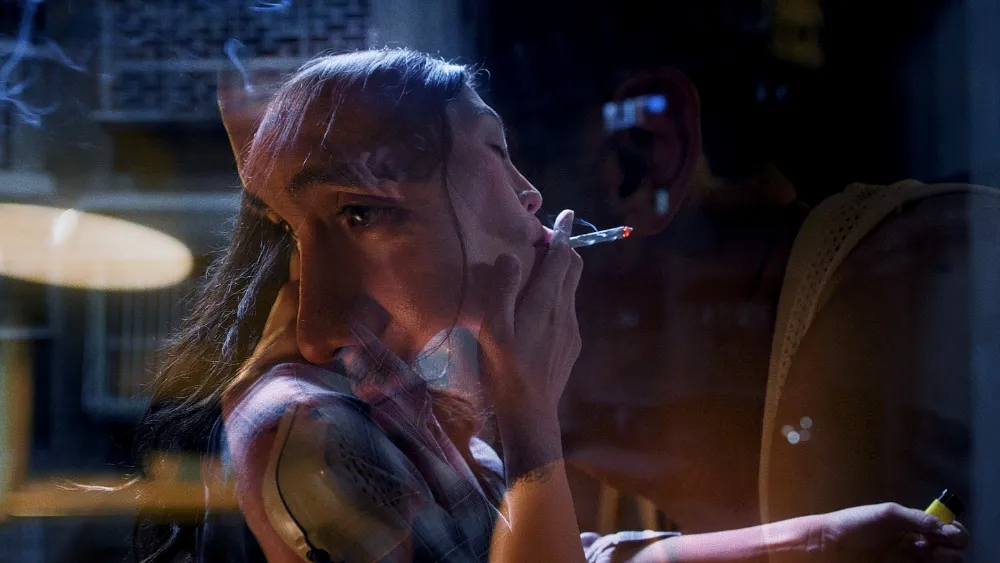
Yet after gesturing toward a promising thriller setup, the film soon begins to spin its wheels — doing little to complicate or tighten the melodrama, while only superficially probing its two principal characters as their romance is inevitably reignited. Dahlia’s crime, it turns out, was motivated by social justice rather than personal avarice, to benefit those living on Manila’s economic margins. But she remains something of a cipher, posing and smoking with immaculate, heavy-lidded elan under the devoted gaze of DP Isaac Banks’ camera, while revealing few specific human foibles or urges.
Charlie, home to care for his ailing father after having emigrated to the States some years before, is likewise underdeveloped beyond that circumstantial detail. We’re mostly left to guess at any internal conflicts he might be feeling as he comes closer to the truth about Dahlia. Recurring flashbacks to the couple’s courtship in 1967 illuminate little, though we do at least get to admire the younger, happier Dahlia and Charlie looking luscious in pristine, summery formalwear — a far cry, in both cases, from their current, wearier demeanor. (On the baby-faced Atayde, an unflattering pair of glasses is counted on to mark the ravages of time.)
They’re an attractive pairing onscreen, though the chemistry between them murmurs more than it crackles, not helped by Sandoval’s sometimes ungainly writing. (Sample exchange: “We’re different people now.” “What are we now?” “Grownups.”) Still, “Moonglow” is more comfortable in this intimate register than when it tries to kick into a higher genre gear: Shootout scenes are awkwardly staged, while the more tough-talking the dialogue gets, the harder it is to ignore a faint air of play-acting to proceedings.
There’s more conviction to the atmospherics. Banks shoots the film in soft, velvety dusk tones, like a languid, fevered vision a few beats behind reality — the same impression given by composer Keegan DeWitt’s faded, floating-on-the-night-breeze jazz compositions. “Moonglow” revels in the chic Hollywood trappings of noir, married to its very particular choice of time and place: whirring fans, single shafts of light in dank offices, extravagant wraiths of cigarette smoke, all enhanced by its own specific sense of Southeast Asian torpor.
Source: variety.com