








-

Andrea Adelson
MIAMI GARDENS, Fla. — A few days after a disheartening defeat to rival Florida State, Mario Cristobal found himself in his office, nine games into his role as the head coach at Miami in 2022. The bare walls around him reflected the urgency of his commitment—who has time for decor when there’s so much rebuilding to be done?
This season, the Hurricanes had already faced unexpected losses to Middle Tennessee and Duke, and more defeats loomed ahead.
“These setbacks fuel my determination. Instead of feeling down, I get angry and channel that into productive energy,” Cristobal remarked back then. “I have a duty to set Miami right. This is my passion, and I’ll work tirelessly to make it happen.”
Fast forward three years and two months, and Cristobal is on the brink of realizing the vision he articulated when he stepped into the program: to resurrect the Hurricanes to their former glory, guided by the strategy laid down by Jimmy Johnson during Cristobal’s own time as a player at Miami in the late ’80s, and later reinforced throughout his coaching career.
No tricks. No “hocus-pocus,” as Cristobal puts it.
“From day one, we knew there was no doubt,” said Luis, Cristobal’s older brother and fellow Miami alumnus. “It was just a matter of time before Mario was chasing a national championship. Everyone knows when he sets his mind to something, it will happen.”
yet, the journey has been anything but straightforward. Throughout his tenure, Cristobal has faced considerable scrutiny. During his four years leading the Hurricanes, the team has lost six times as heavy favorites. The burden grew even heavier when Miami fell to SMU in November, their second defeat this season against an unranked opponent.
Following that disappointing game, Jessica, Cristobal’s wife, received troubling text messages criticizing her husband, as the loss threatened Miami’s hopes for the College Football Playoff. But Cristobal turned the loss and ensuing criticism into a rallying cry for his team. He invoked the wisdom of football legends, telling his players that nobody wanted Miami to succeed, and that they had a chance to prove their detractors wrong. This sparked a remarkable seven-game winning streak, including two victories in the CFP as an underdog, leading to a home showdown for a chance to claim the sixth national title in school history against Indiana on Monday night (7:30 p.m. ET, ESPN).
The journey of this season may have ignited in January, but the narrative of the Miami Hurricanes dates back five decades, beginning in a home off Southwest 67th Street, just under four miles from the University of Miami campus.
LUIS AND MARIO Cristobal were raised in Miami by immigrant parents from Cuba who instilled strong work ethics in their sons. Their father, Luis Sr., owned a car battery shop in Hialeah, while their mother, Clara, dedicated over 30 years to Kendall Toyota. Luis reminisces about how both parents worked tirelessly to provide for their family. Their maternal grandfather, a Cuban exile, learned construction upon arriving in the U.S. and built the Cristobal family home in the ’70s.
As teenagers, if the boys wanted some extra cash, they had to earn it by selling scrap metal from their father’s shop.
although their love for football—Cristobal was a devoted Pittsburgh Steelers fan—the boys weren’t allowed to play for fear of injuries. Instead, their parents enrolled them in judo and baseball, sports that are popular in Cuba.
When Luis became a sophomore at Columbus High, the coaching staff quickly identified his potential as an offensive lineman. Relenting, their parents finally let both sons join the football team. It soon became evident that the Cristobal brothers had a natural affinity for football, and securing scholarships to the University of Miami became their primary aspiration. They had been captivated by the Hurricanes as kids, using free tickets from the parks and recreation department in Miami-Dade to attend games at the Orange Bowl in the late ’70s and early ’80s—just before Howard Schnellenberger revived the program, leading to Miami’s first national title in 1983.
Mario vividly remembers the game that clinched the championship, a thrilling 31-30 victory over No. 1 Nebraska in the 1984 Orange Bowl.
“I can recall my grandfather’s TV flickering—a wire antenna struggling for reception, black and white and unclear,” Cristobal reflected. “With Nebraska going for two at the end and Miami triumphing, next thing I knew, the streets were alive with honking cars and clanging pots and pans throughout Miami.”
From that day, the brothers would often sneak out to ride their bikes or even hitchhike to attend Miami practices. “I thought, ‘I want to be one of those guys. I want to be a University of Miami Hurricane,'” Mario expressed.
Luis, two years older, narrates the moment coach Jimmy Johnson sat in their living room with offensive coordinator Gary Stevens. “When they offered, I accepted immediately,” Luis recounted. “I could have considered Ivy League offers, but my parents just looked at me, asking, ‘Do you want to think it over?’ I said, ‘Nope.’ The same goes for Mario. When that dream became real for us both, it was unforgettable.”
Johnson courted Mario, though he ended up playing for Dennis Erickson after Johnson’s departure to the Dallas Cowboys. Their time on the offensive line would shape both of their careers, with Mario emerging as the more renowned player.
“I felt insignificant among an awe-inspiring team filled with Hall of Fame talent,” Mario said. “But that experience was transformative for my mindset; it shaped my DNA and everything I believe in.”
Cristobal secured two national titles at Miami in 1989 and 1991 and was recognized as an All-Big East player in 1992—a period that dramatically redefined his future.
He understood he had a debt to repay to Miami.
CRISTOBAL LAUNCHED HIS coaching career as a graduate assistant at Miami in 1998, famously telling then-coach Butch Davis that he aspired to become the head coach one day. Back then, the Hurricanes were struggling after NCAA sanctions had reduced 24 scholarships over two years. Following a dismal 5-7 season in 1997, Cristobal had a close-up view of Davis’ efforts to rebuild the program. While Cristobal dreamed of a grand coaching career, he also applied to join the Secret Service, receiving an acceptance message while Miami was at the Gator Bowl in 1999. He bid farewell and packed up his minimal belongings.
That night, he awoke in a panic at 4 a.m., questioning his choice. Why was he leaving the sport he loved?
“Being cut as an undrafted free agent was heart-wrenching,” Cristobal admitted. “I had discovered another avenue to remain in football, and I loved every moment of it—teaching, coaching, being involved. I couldn’t imagine life without it, so I returned and pleaded for my $2-an-hour job back, and they welcomed me again.”
His path eventually led him to another Miami institution—Florida International, just as it began transitioning to an FBS program. During Cristobal’s time at Miami, FIU was mainly known as a commuter school with little interest in football. yet, the appeal for a football program increased, and under former Dolphins quarterback Don Strock, FIU started its football program in 2004.
By the time Cristobal took over as head coach in 2007, he inherited a team that had gone winless (0-12) the previous year and was also recovering from NCAA sanctions, compounded by facilities that were still under development, forcing staff to operate from trailers. He reminisces about times when bills went unpaid, leaving the team stranded without transportation—on one occasion, the coaching staff and players carpooled to the Orange Bowl, where FIU played its home games.
Cristobal rolled up his sleeves and got to work. It was a rough start; in Year 1, FIU opened the season 0-11. In the season finale against North Texas at the Orange Bowl—the last football game before the stadium’s demolition—they improbably won 38-19. Though at a different school, he felt that last victory within the stadium that had provided some of his greatest moments was a powerful sign.
He still keeps pieces of turf from that game.
“It felt like a Super Bowl celebration with the university president popping champagne bottles,” he said. “You can never say you’ve seen it all, but we’ve experienced so much.”
Cristobal turned the program around, guiding it to its first two bowl appearances, including the first bowl win in 2010. After six seasons at FIU, he was let go following a 3-9 record in 2012. That became a pivotal moment.
“I vowed to myself that I would never let that happen again, no matter the hours I had to put in or what I had to endure; I was determined to prevent that from recurring,” Cristobal stated.
Shortly after, he took a position with Nick Saban at Alabama. The four years he spent there as assistant head coach, offensive line coach, and recruiting coordinator solidified his core beliefs: Work hard, refuse to make excuses, and construct teams based on toughness and competition, starting with the offensive and defensive lines.
“That tenure with Nick Saban reaffirmed the principles established by Jimmy Johnson: discipline, effort, and toughness,” Cristobal said.
These experiences prepared him well for the head coach position at Oregon, where he transformed a struggling program into a Rose Bowl champion within two seasons. But they also set him up for the most significant role of his life.
MIAMI SLIPPED INTO mediocrity following its years of triumph, cycling through four head coaches in 15 years after Larry Coker—with the last national title in 2001—was let go in 2006. Finally, in 2021, school officials became serious about a financial commitment to football, allowing them to pursue the one coach that alumni and fans had always wanted.
though Cristobal held a dream job at Oregon, witnessing Miami’s decline weighed heavily on him. The sense of obligation he felt towards the program? His heart urged him to return. Before making that leap, he had a crucial conversation with his wife, beginning with a straightforward question.
“Do you realize that this will consume my entire life?” Cristobal asked her. “Miami needs direction, and we are the ones to help guide it back. Miami will once again hoist that trophy.”
Reflecting on that conversation after the CFP semifinal victory over Ole Miss, Jessica Cristobal stated, “This has been his lifelong dream to reach this point. He was right—it has required every ounce of his energy and time. I am willing to support whatever it takes to achieve our dreams, and here we are. It’s truly remarkable.”
Cristobal was aware of the early challenges ahead, but he also affirmed, “We will endure the painful process of establishing a solid foundation.”
Five players remain from his initial recruiting class in 2022, a group that experienced a 5-7 record in their inaugural year.
“After that 5-7 season, I was in the locker room in tears, and I approached Mario, saying, ‘All I want to do is win, coach,'” shared senior linebacker Wesley Bissainthe, who was part of that 2022 class. “Over the next few years, we committed to bringing in individuals who embodied the culture. Everything else fell into place.”
Cristobal’s 2023 recruiting class included Francis Mauigoa and Samson Okunlola—the two top-rated offensive linemen in the nation. They were essential to his strategy for bolstering the trenches. When recruiting running back Mark Fletcher from Fort Lauderdale, Cristobal provided an enticing message.
“He promised that he’d have big guys making way for me, which was music to my ears as a running back,” Fletcher recalled.
Yet, Fletcher hesitated, initially committing to Ohio State. “I think I sent him 247 unanswered texts while he was committed elsewhere. So I’m thrilled we remained persistent,” Cristobal remarked.
Hard work, toughness, resilience—the core principles never wavered. Not even after the bitter 23-20 defeat against Georgia Tech in 2023, when Miami chose not to kneel down to secure a win, resulting in a fumble by running back Don Chaney that led to a cascading series of events ending in a loss.
Nor did it change after two losses in their final three outings in 2024, when Miami could have locked in an ACC championship and a potential CFP appearance with a victory at Syracuse. Instead, they squandered a 21-0 lead, losing despite having 2025’s eventual No. 1 NFL draft pick, Cam Ward, at quarterback.
Such losses fueled a narrative that followed Cristobal from Oregon, criticizing him for struggling in crucial game situations and finding ways to lose to inferior teams. Fair or unfair, this narrative resurfaced every time Miami faltered as a favorite.
“Leadership involves continuous growth in the quest for excellence,” stated University of Miami president Joe Echevarria post-Fiesta Bowl. “We make mistakes; everyone does, including me. But the goal is to avoid repeating them. Mario has cut no corners, and he’s learned from every experience. When you lead a football program, learning comes from mistakes made. If you succeed more often than you fail, you’re on the right track.”
IN THE AFTERMATH of a thrilling 10-3 victory against Texas A&M in the playoff’s opening round, Michael Irvin did something quite unexpected. And given his unpredictable nature as a former Miami wide receiver, that’s saying a lot, considering the drama he has brought to the Hurricanes’ sideline over the last two years.
As Cristobal began his postgame interview, Irvin approached the coach and planted a kiss on his cheek. Alumni across Miami might have felt inclined to do the same, given the challenges the team had faced over the past 12 weeks. Losses to unranked Louisville and SMU reignited the same negativity that had often doomed Miami’s seasons. To compound matters, former Miami head coach Manny Diaz had led Duke to the ACC title following a tiebreaker win over Miami to secure a spot in the championship.
yet, Selection Sunday brought Miami the news that they were the final team to claim a spot in the 12-team CFP field. Cristobal communicated to his team that now they were the underdogs, a narrative they embraced eagerly.
“Everyone was ready to criticize my coach if he had lost that game after Manny had triumphed,” noted Irvin. “They would have metaphorically doused him in gasoline and set him on fire. Facing 110,000 opposing fans, you must be prepared to endure significant pressure, and he ensured the team was ready for that. Many squads would have folded, but this team held strong.”
“That kiss was a gesture of appreciation for all the sacrifices he’s made. He could have taken other opportunities, but this is home, and he recognized its significance to all of us. It was a godfather kiss. I was essentially saying, ‘Yes, godfather,’ to coach.”
The profound bond that former Miami football players share with the program has deepened with Cristobal at the helm. This past spring saw nearly 400 former players gather for a reunion. Their presence during the playoffs has been unwavering, from icons like Irvin, Lamar Thomas, and Gino Torretta to legends such as Ray Lewis, Andre Johnson, Reggie Wayne, and Edgerrin James.
All of them believe Miami needed someone from within to truly understand the meaning of coaching, building, and winning at the University of Miami.
“I often say Miami is almost like its own nation,” expressed Darryl Jones, a receiver from the 2001 national championship team, now serving as the team chaplain. “It required someone like Mario, who comprehends those dynamics. He’s a resilient guy, instilling toughness, but also knows how to assemble the right staff and culture—it’s been remarkable to observe.”
Playing and coaching at Miami isn’t for everyone. Cristobal demands a lot—self-identifying as a “tough son of a b—-“—and his intensity remains consistent both on the practice field and during games. Akheem Mesidor, who transferred to Miami in 2022 from West Virginia, was asked to characterize Cristobal’s intensity.
“I can’t encapsulate it in a single word; I can provide you with a numerical scale,” he replied.
And that scale?
“Ten out of ten.”
This week, Cristobal has been circumspect about the opportunity to win a national championship at his alma mater—Miami, the only place that feels like home. He understands there is a process to enact, and dwelling on the future could detract from what must happen Monday night: winning the next game. That next game, as fate would have it, is against No. 1 and undefeated Indiana, at Hard Rock Stadium, bearing the weight of Miami Hurricanes football on his shoulders.
As a former lineman, Cristobal knows what it takes to carry a heavy burden—but now, there’s a potential reprieve—if only for a moment—to reclaim his status as a champion in the place that made him one nearly four decades ago.
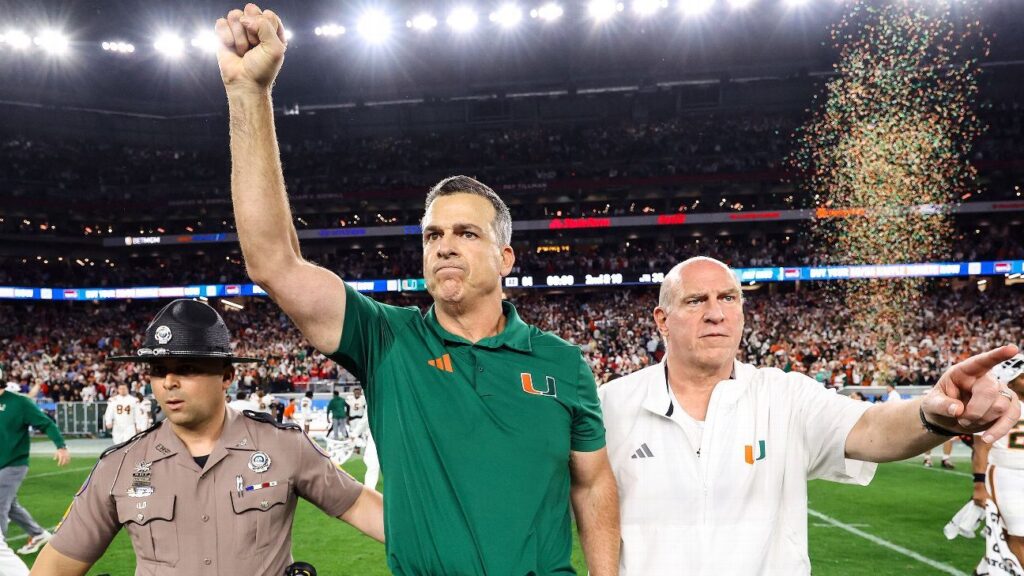
“This is long overdue, isn’t it?” Reggie Wayne remarked, as confetti rained down in Arizona. “It’s way beyond due for a storybook conclusion, especially with the chance to win at home. You couldn’t ask for anything more impressive than that.”