








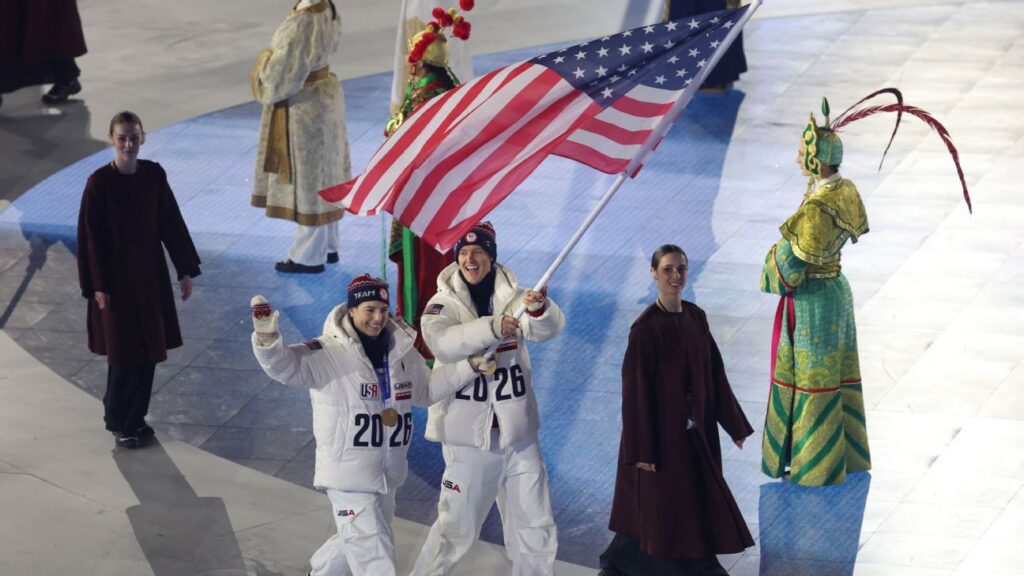
VERONA, Italy — The closing of the Milan Cortina Olympics took place on Sunday, with the flames in the co-hosts Milan and Cortina d’Ampezzo being extinguished during a farewell ceremony held at the historic Verona Arena. This venue sits centrally among the widely distributed mountain, valley, and city locations that characterized the most expansive Winter Games in history.
In her closing remarks, International Olympic Committee president Kirsty Coventry praised local organizers for “delivering a unique winter Games and establishing a new, very high standard for the future.”
The next Winter Games are set to take place in neighboring France, where the Olympic flag was officially handed over during the ceremony. Maintaining a similar widespread format, the 2030 Winter Games will host events in the Alps and Nice by the Mediterranean, with speedskating competitions planned in either Italy or the Netherlands.
Over 17 days of competition, 116 medal events in eight Olympic sports across 16 disciplines, including the introduction of ski mountaineering, took place. The final events concluded just hours before the ceremony, with Coventry presenting the medals for the men’s and women’s 50-kilometer mass start cross-country races inside the Arena.
Italy achieved its highest medal count at a Winter Olympics, securing 30 medals — comprising 10 gold, six silver, and 14 bronze, surpassing its previous record of 20 medals from the 1994 Lillehammer Olympics.
“Your remarkable achievements inspired Italians everywhere and significantly contributed to the success of the Games,” said Giovanni Malagò, president of the Milan Cortina Foundation, to the Italian athletes behind him wearing headbands that read ”Italia.”
The farewell ceremony celebrated Italian culture through dance and music, ranging from lyrical opera to 20th-century pop and the contemporary beats of DJ Gabry Ponte, who energized the 1,500 athletes with an invitation to dance while colorful confetti filled the air. The event concluded with the song “Incoscienti Giovani,” performed by Achille Lauro, as the athletes, embodying youthful energy, exited.
The 2½-hour ceremony commenced with a charming tribute to Italian lyric opera, where the stage director animated both the closing ceremony cast, including Achille Lauro, and long-hidden opera characters from crates in the amphitheater’s tunnels.
On stage, iconic figures like Madama Butterfly in vibrant pink and green, and Aida in golden layers, emerged from mirrored boxes as 17th-century musicians played the jubilant “Libiamo ne’ lieti calici” from “La Traviata,” a nod to the Arena’s historic role as a summer opera festival venue.
The opera characters, led by Rigoletto the jester, spilled into the piazza, mingling with athletes representing their nations, some of whom were seen filming the moment with their phones.
In a standout moment, acclaimed ballet dancer Roberto Bolle performed aerial maneuvers within a fiery ring symbolizing the sun. He descended onto a stage that resembled the Venetian lagoon, complete with gondolas, dancing to an evocative piece by Italian singer Joan Thiele.
A key highlight saw the Olympic flame, encased in a Venetian glass vessel, brought into the Arena by Italian gold medalists from the 1994 Lillehammer Games. The Olympic rings shone brightly on the stone stairs behind the stage, surrounded by national flags, as one of the gold medalists raised the flame at the center of the stage.
For Coventry, this was her inaugural Olympics experience, having previously been a two-time Olympic swimming champion, and she shared much of the ceremony alongside Italian Prime Minister Giorgia Meloni.
About 12,000 attendees, including athletes and officials, were present for the more intimate closing ceremony, which contrasted sharply with the grand opening in Milan’s San Siro stadium, which hosted over 60,000 guests, featuring performances by Mariah Carey and Andrea Bocelli.
The Milan Cortina Games spanned an impressive area of 22,000 square kilometers (8,500 square miles), encompassing ice sports in Milan to biathlon in Anterselva near the Austrian border, snowboarding and men’s downhill in Valtellina close to the Swiss border, along with cross-country skiing in Val di Fiemme north of Verona and women’s downhill, curling, and sliding sports in co-host Cortina d’Ampezzo.
The ceremony concluded as the Olympic flames were extinguished in the two caldrons located in Milan and Cortina, visible in Verona via video link. A spectacular light show replaced fireworks, which were prohibited in Verona to avoid disturbing local wildlife.
The opening ceremony for the Milan Cortina Paralympics is scheduled for March 6 at the Verona Arena, with the Games lasting until March 15.