








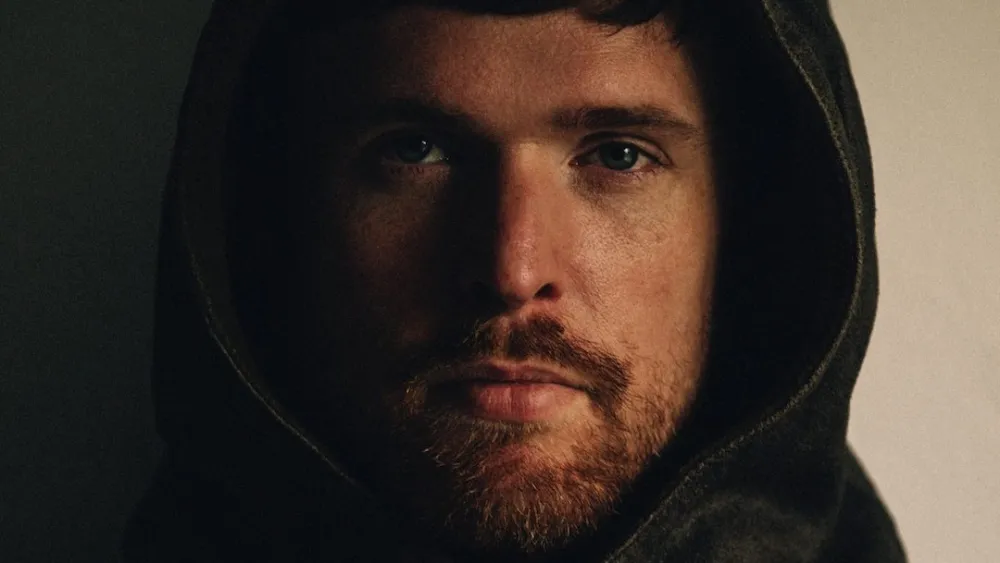
There are very few artists who sound like British singer-songwriter James Blake, and even fewer who have had a career like his.
Blake’s rare ability to combine electronic innovation (sometimes dance oriented, sometimes not) with folk-inspired songwriting and his high, unmistakable voice, led him to release not only several influential albums but, for several years, become a collaborator of choice for a wide range of top artists, from rappers Kendrick Lamar, Travis Scott, Jay-Z and Lil Yachty to Beyonce, Frank Ocean and Rosalia. It’s added up to two Grammy wins (from nine nominations), four U.K. top ten albums, a song on the soundtrack for the Oscar favorite “Sinners,” and a vast influence in the 17 years since he dropped his first single.
For his eighth full-length, “Trying Times” (out today), Blake basically works all of the above into a sound that is unified and, surprisingly, a bit more relaxed than his last couple of albums. “Death of Love” finds him altering his voice almost beyond recognition and rides on a Leonard Cohen sample; “I Had a Dream” has an oddly ‘50s vibe; the title track is one of his loveliest ballads; the closing “Just a Little Higher” is bedecked with a gorgeous orchestral arrangement. It’s a fusion of all of his musical moods that is probably his most fully realized album to date.
Not coincidentally, it’s also Blake’s first album as a fully independent artist, an experience reflected in the cover, which features a photo of him literally spinning plates. As he told Variety in an in-depth interview just over a year ago, “I’ve been financially up and down since I started — a recurring cycle of doing really well and then almost broke,” he said. “And multiple times I thought, ‘Am I going to be the classic story of the artist who did well and then can’t work out why they don’t have any money?’”
So he literally took his career into his own hands, changing up his team, getting out of his major-label deal and going full DIY, down to booking his own tours. Four companies in particular have been partners in this enterprise: Vault, a subscription platform where he can release music any time he wants; Good Boy Records to distribute his more-conventional releases like the new album; Bside to assist with ticketing for his concerts; and Indify, to connect with investors, marketing and other partners. And rather than relying on social media to promote his work, he’s developed a vast email and phone list that allows him to communicate directly with fans. (Head here for Blake breaking down how it all works.)
So how’s it all going? Variety caught up with Blake via Zoom from his home in England last week.
Your new album is called “Trying Times.” Discuss!
I’m not sure if it’s the best or worst time to release an album called that, but here we are. I think the meaning of the title flips between a very English understatement of how terrible everything is in a sort of tongue-in-cheek way, and then very serious, earnest interpretation. Either way, it’s something.
Ironically, this album feels a bit looser musically than your last few. Where is that coming from?
The sound of a record is never a conscious decision for me. I guess I’ve been through a fair amount of changes, but in terms of being loose, I was very careful about where I recorded this record, I really tried to work in studios that made me feel sort of like an open channel, like I’m tuning in spiritually with the place. Over the years, if I’ve written or made music in the wrong place, those pieces of music just sit on the hard drive forever. I’d rather record less often, but in quality places.
What makes those places so conducive?
Certain studios have something energetic about them. The West Country [in England] is famously underpinned by ley lines, these sort of spiritual lines that run under the under the ground [and pass beneath such famously mythic British sites as Stonehenge and Glastonbury]. Whether you believe in that or not, whenever I went to the place I recorded in the West Country, I just felt open, ideas came easily, and I was able to unlock, in a matter of hours, songs that previously I’d found difficult to figure out.
You’ve been back in England for a while. Have you gone off L.A.?
No, L.A. is great and it’ll always have my heart. But there’s definitely… (he pauses). I feel like I’m floating when I’m there. It’s odd. I don’t feel fully tethered and sometimes that’s nice, but eventually it starts to get to me.
On this album you seem a bit less reluctant to alter your voice by speeding it up or just sounding like somebody different. Is there any particular reason for that?
When I first started doing that, I’m not sure if it was because I was so confident in myself, or because I wasn’t confident in my voice and wanted to hide it. But now I think I’ve established what my voice is so much that I don’t have any problem deviating from that. It did take me a while to feel that way, but now I love playing with effects on my voice.
What were some of the moods and emotions that went into the record beyond the ones you’ve already discussed?
To be honest, I don’t think this album generally is about the state of the world — it’s not that overtly political, although it deals with a little bit of that. I think the theme that persists through it is reconciling your private life — your hopes, your dreams, your relationship, your love, your friendships — with what’s happening outside and how much you allow it into your own world. So I when I talk about “love in a time of chaos,” the reason I keep saying that phrase is because I think we can’t really imagine the future — what does it even look like? We can’t imagine it. The hope is that we ride it out, nature heals, and love and empathy persevere as we go through it.
How did “Seance,” your song on the “Sinners” soundtrack come about?
I love Ludwig [Goransson, Oscar-winning film composer and Childish Gambino/ Adele/ Kendrick Lamar collaborator who wrote the film’s score] and any chance I get to work with him, I’m going to take it — in fact, we’re working on something at the moment. He’s like a long-lost brother in music, and when we work together, what’s great is that we don’t really step on each other’s toes, we each do something so different. I love his outlook on music, and he’s got that pure confidence to just allow whoever he’s working with to be their full selves. It’s not actually a lack of ego — it’s strength of character, the self-confidence of, like, “I’m the fucking man and I can let anyone come to the studio and be their best selves.”
The “Sinners” thing was really cool and I felt very honored to be asked by him, and it feels like we’ve started on a journey of discovery. It’s a type of music making that I’m just not used to, so it’s exciting for me. Like the last thing we did, I was doing all sorts of random singing styles and trying to get these crazy tones out of my voice. That’s not how I normally work!
How are things in your business world? Are you still as excited and exhilarated by it as you were a year ago, or have you been beaten down? (Laughter)
You know what? I am. And I haven’t been beaten down — to be honest, I’m more excited now, in a way. I think last time we talked, I may have been feeling more anxiety than excitement. There was a sense of everything shifting — the last time that happened was the [beginning of the] streaming era. Back then, I wasn’t in a position to do anything about it, so this time was a bit scary because I felt like I could actually affect something.
I became close to people who I felt like had the right ideas and were developing real alternatives in the music business that have a strong chance. Vault, Bside, Indify — these were bets that I placed, and I took huge risks. I left my label, I left my management, I left the whole system and just took a big risk by setting up a new team with an indie label [Good Boy Records] who hadn’t previously worked with an artist like myself, and then I started to assemble the rest of the team. Even understanding what a team looked like was something outside of my reality, initially. And leaving the standard ticketing system to use direct-to-fan methods — I mean, there’s so many strands to this, and it was a huge gamble, not knowing whether those things were going to pan out.
I knew the fundamentals were good, and I knew the fundamental reasoning for doing it, the ethical side, felt great. But yeah, it was a big gamble. And as we’ve seen since then, labels are turning to distribution rather than [conventional signings], there’s less of those crazy 360 deals being signed. I’m not saying I did that —the industry was changing anyway. I was just pointing out cracks that were already showing, and we have to make sure that artists have a voice in this. And there are many artists who are a voice in this, and there are some great tech companies and labels who are doing something different. They are the people who are actually affecting change and changing the way deals are signed.
Are there things that haven’t quite worked out?
Well, the monopoly on venues means that I can’t actually do a certain level of touring — I can do direct-to-fan ticketing, but it’s very, very difficult to do an entirely independent tour. So that, I think, is going to take a while. But I know a lot of artists who don’t [have big streaming numbers] but sell out venues and sell directly to their fans and build amazing communities of people who love their music. I think they are the artists who actually stand a chance to survive much more than people relying on streaming, because as we know, [the streaming model] doesn’t weigh in our favor, right?
But overall, I don’t think anything hasn’t worked out, to be honest — I think it’s been a massive success. The last time we spoke, I was starting to build a community within Vault and building my mailing list, which is our pathway out [of the traditional industry models]. It’s been wonderful because I’m recognizing people at the shows and I actually sort of have a rapport with them. We did Vault listening parties in L.A. and we’ve done them all around Europe, and they’re the things I look forward to the most, because I’m doing Q&As afterwards and chatting about the record and all sorts of things. If I was left to Instagram and TikTok, I wouldn’t really know them.
And the tour that we just announced sold out in under a minute because so many people [on his mailing list] were already plugged in, and when we put up the U.S. tour, most of the main shows were sold out in pre-sale. Even when I was within the major system, we didn’t have that level of engagement at all.
So instead of reaching 7% or whatever of my audience through Instagram or TikTok, or having to pay a crazy amount to access people, we just collected e-mail addresses or phone numbers instead of followers — and that’s what leads to actual awareness of what you’re doing. I think that breaks the illusion that we have to be connected by social media.
People ask, Could I have done this before? Probably. But was I encouraged to do virtually everything else but this, to make sure that I didn’t have full control of it? Definitely.
Source: variety.com