









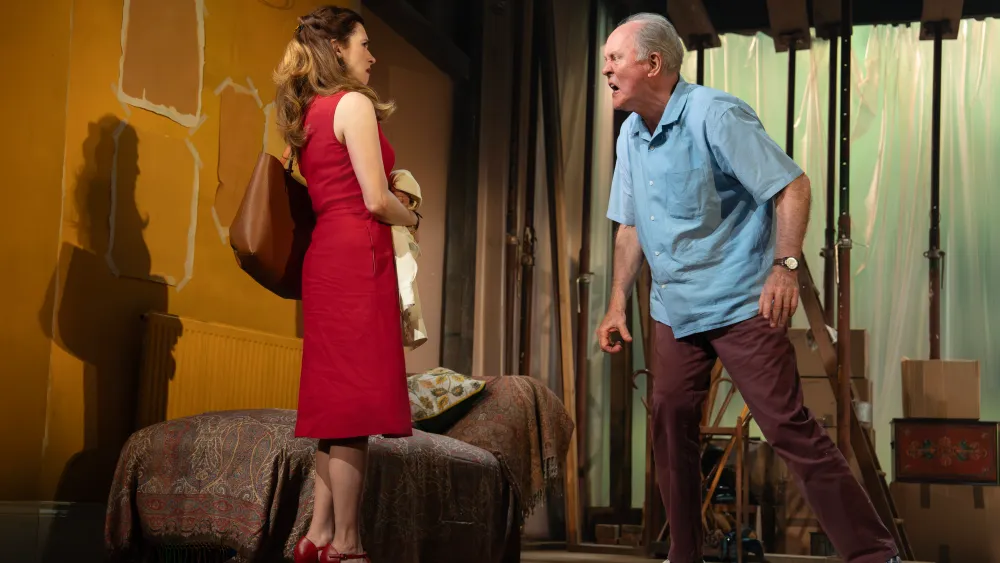
Watching “Giant,” opening March 23 on Broadway after a much-hailed run on London’s West End, one is left with little wonder how its protagonist, Roald Dahl, achieved such success as a writer for children. The child within him is ever-present — in control of what is perhaps only technically an adult man.
As played by John Lithgow, Dahl is an intimidating physical presence, and, as if on the playground, uses this looming quality, along with a facility for language, to intimidate anyone around him. He’s being questioned, over a turbulent afternoon, about a book review he wrote about an account of Israel’s 1982 invasion of Lebanon; his language, conflating Judaism with Zionism, was intemperate at best, and seems to both his British publisher Tom Maschler (Elliot Levey) and to Jessie Stone (Aya Cash), a representative from his American publisher, to tip into antisemitism.
Asked to apologize — not least because his forthcoming book, the international-cabal-of-child-snatchers thriller “The Witches,” might now be read as a hateful blood libel allegory. Dahl (given his stature, in all senses of the word, it feels wrong to call him Roald) takes their concern, cajoling and eventual anger as grist for alternating mockery and doubling-down. This is all the more fun for him given that Tom and Jessie, both Jewish, appear to him hopelessly compromised. Navigating his moods is, for the other characters on stage (including his pained fiancée Liccy, played by Rachael Stirling) a challenge; for the audience, it is a thought-provoking pleasure.
First-time playwright Mark Rosenblatt, previously a theater director and filmmaker, does not hold the audience’s hand when it comes to Dahl. References to the man’s life and work whiz by — illustrator Quentin Blake, a longtime collaborator, mentioned by first name only; ex-wife Patricia Neal, the Oscar-winning actress, alluded to passingly. But the insights this approach lends, for those who grew up holding Dahl’s work close, are immense: Dahl’s swizzing, swozzling way with language as tool and as intoxicant comes first as a delight, until one sees that Dahl is using his swashbuckling verbosity as a weapon, too.
Lithgow, who has long excelled at conveying erudition, shows us how, confronted with demands, Dahl conceals shivs within gossamer webs of words. He won’t apologize or retract in part because he’s stubborn — a death threat over the review hasn’t changed his mind, so what good do publishing-industry functionaries have? There’s also the fact that he was, if anything, pulling punches as to his true beliefs. The insinuating, clubby way he verbally nods to “your people” casts Jessie and Tom not as publishing professionals trying to protect Dahl from himself but as combatants in a global struggle they didn’t know they were fighting.
Tom, long accustomed to Dahl’s beliefs and his manner of expressing them, attempts a sort of soft diplomacy. (It helps that, in this play’s depiction of the real-life publisher, Tom cares little for global politics, especially where Israel is concerned.) Jessie, out of her depth and increasingly aware of it, is heartbroken: Unlike Tom and Liccy, she’s never known the man behind the pen, and, until today, she’d considered him a hero of humanism. How could the man behind such works of impish, mischievous sweetness be so very bitter?
It’s a credit to the direction of Nicholas Hytner — of “War Horse,” “The History Boys” and other magisterial slices of Brittania — that Lithgow’s titanic performance doesn’t unbalance the show. The actor relishes all aspects of Dahl’s childishness, and the humanity within the beast emerges in small moments. Disclosing to the gamekeeper of his estate (David Manis) that he’s been put forward for a knighthood — an honor he’d previously blustered about not much wanting — Dahl’s face turns schoolboy moony. To meet the Queen! And all because of stories this very best lad had written! Elsewhere, though, Levey and Stirling, both reprising their roles from London, are adept counterpunchers, and lend the sense that — until the moment Dahl’s beliefs threaten to do harm — they take a kind of pleasure in the rhetorical dance.
But it’s Cash, joining the production and making her Broadway debut, who catalyzes Lithgow most effectively. Familiar as I was with Cash from her work in TV comedy, including “You’re the Worst” and “The Boys,” I was surprised at first by the blunt-force nature of her performance, until it became clear how Cash and Lithgow were working together. She, an emissary from the States, is everything Dahl cannot abide: American plainspokenness as opposed to Commonwealth allusiveness, emotional appeal running up against stiff-upper-lip carrying on. (Both Jessie and Dahl have grief around their children, which Dahl uses as a cudgel against her only briefly. Some things are too barbarous even for the author of “The Twits.”)
Jessie leaves the scene for a while, ushered out in the manner of a British drawing-room comedy, with higher stakes and deconstructed room. Dahl’s manor is in what we may come to belief in a perpetual state of renovation, and, while the clutter feels like occupying space in Dahl’s mind, the sheer plastic painter’s sheet through which characters entering and exiting get obscured and distorted does something still more effective. To Dahl, locked into a set of beliefs no appeal to emotion or reason can dislodge, entrants from the outside world look more like monsters than like people.
“Giant” is not without flaws; I would note without spoiling that, after a barnburning next-to-last sequence, it did not entirely stick its landing. (We’re meant to think that the bill is coming due for Dahl and his reputation is about to be torched, but his antisemitism, while known to this day, has seemed not to stick much to his legacy, and a few years after the events of this play, he did get offered an OBE by the Queen — which he turned down.) Rosenblatt, too, nails the back-and-forth of dialogue but, in his first attempt, can land, for fleeting but unwelcome moments, in a schematic place. The audience, for instance, will realize that Dahl is, yes, a child in an adult’s body about an hour before Cash’s character announces it. But its working through a series of debates that many potential viewers likely will have grown weary of — “separating the art from the artist” being only the first — is by and large done elegantly. “Giant” was conceived of years before the events of Oct. 7, 2023, a recent salvo in an age-old conflict, and yet its approach to geopolitical conversations feels up to the minute.
Dahl’s revulsion at the violence committed in Israel’s name is at once comprehensible, in and of itself, and rooted in Dahl’s set of antisemitic beliefs. Tom and Liccy have been able to hold all of that in their mind up until the day of this play; Liccy, in the end, seems still able to. But it’s Jessie who must traverse the farthest, from disillusioned optimism to despair. And even viewers schooled enough in Dahl Studies to have known that his beliefs extended into prejudice may find themselves joining her.
Source: variety.com