








Bill Mazeroski, the legendary Hall of Fame second baseman who garnered eight Gold Glove awards for his reliable defensive play and captured the hearts of countless Pittsburgh Pirates fans with his unforgettable walk-off home run in Game 7 of the 1960 World Series, has passed away at the age of 89.
Pirates chairman Bob Nutting remarked: “Maz was incomparable, a true legend of the Pirates … His name will forever be linked to the most significant home run in baseball history and the 1960 World Series championship, but what I will cherish most is the person he was: humble, gracious, and proud to be a Pirate.”
Mazeroski died on Friday, as confirmed by the Pirates. The cause of death has not been disclosed.
‘Defensive mastermind’
Inducted into the Hall by the Veterans Committee in 2001, his statistics may not paint him as a superstar. Mazeroski holds the record for the lowest batting average, on-base percentage, and stolen bases amongst second basemen in Cooperstown. Over 17 years, he maintained a lifetime batting average of .260, hitting 138 home runs and stealing 27 bases, with an on-base percentage of .299. He never achieved a .300 batting average, reached 100 RBIs or runs scored, and finished in the top 10 for Most Valuable Player only once.
His most remarkable traits extended beyond the scorecard. His Hall of Fame plaque describes him as a “defensive mastermind” with “hard-nosed hustle” and a “quiet work ethic.” A 10-time All-Star, he established a major league record with 1,706 double plays, earning the nickname “No Hands” for his lightning-fast ground ball fielding and relays. He led the National League in assists for second basemen nine times and has been acknowledged by statistician Bill James as the game’s greatest defensive player at his position by a considerable margin.
“I believe defense has a rightful place in the Hall of Fame,” Mazeroski stated during his induction speech. “Defense deserves as much recognition as pitching, and I take pride in being recognized as a defensive player.”
A historic home run
yet, the defining moment of his career came at the plate, as the square-jawed, tobacco-chewer Mazeroski, a coal miner’s son from West Virginia, fulfilled the dream of countless kids who aspired to play professional baseball.
The Pirates had not been to the World Series since 1927, when they were defeated by the New York Yankees, and in 1960 they again faced the Yankees. While New York boasted stars like Mickey Mantle and Roger Maris, Pittsburgh lacked big-name players besides a young Roberto Clemente. The team relied on contributors like shortstop Dick Groat, outfielder Bob Skinner, and starting pitchers Vernon Law and Bob Friend. Mazeroski, who turned 24 that September, finished the season with a .273 average and typically batted eighth.
The series revealed stark contrasts in scoring versus wins. The Yankees outscored the Pirates 55-27, including 38-3 in the three games they won. Bobby Richardson, Mazeroski’s counterpart for New York, drove in a record 12 runs and was declared the Series MVP, despite being on the losing team. Yankees ace Whitey Ford recorded two shutouts against the Pirates, setting a record with 33⅔ consecutive scoreless World Series innings.
The Pirates’ initial three wins were far from spectacular, yet they counted—Mazeroski played a pivotal role. He hit a two-run homer in the fourth inning off Jim Coates in Game 1, propelling the Pirates to a 6-4 victory, and added a two-run double in Game 5, leading to a 5-2 win. But he saved his most significant contribution for Game 7.
Approximately 36,000 fans at Pittsburgh’s Forbes Field, along with many more listening in from afar, witnessed one of the most thrilling and emotional conclusions to a World Series. The lead fluctuated back and forth; Pittsburgh initially scored four runs, only to fall behind when the Yankees rallied to lead 7-4 in the eighth inning. yet, the Pirates retaliated with five runs in the bottom of the eighth, aided by a double-play ball that unexpectedly hit Yankees shortstop Tony Kubek in the throat. The Yankees quickly equalized, leaving the score at 9-9 in the ninth.
The final inning has been replayed countless times by fans of both teams and generations of spectators. New York’s pitcher Ralph Terry, who had been brought in during the previous inning, was later acknowledged by manager Casey Stengel as having a fatigued arm. The right-handed hitting Mazeroski came to the plate first, having previously grounded into a double play.
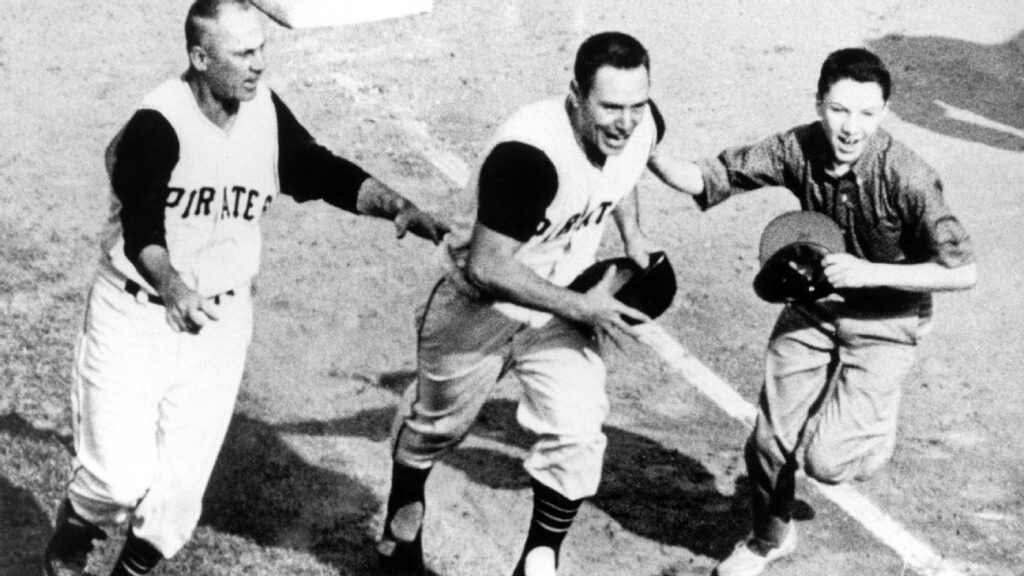
Terry began with a fastball that was called a ball, then consulted briefly with catcher Johnny Blanchard, who advised him to keep his pitches down. He delivered what Mazeroski later referred to as a slider that simply didn’t slide. Mazeroski connected, sending the ball soaring to left field, rising and clearing the ivy-covered brick wall, as Yankees left fielder Yogi Berra turned away in defeat. The entire city erupted, as if everyone had swung the bat alongside him, fulfilling the dreams of all underdogs who longed to overcome the famed Yankees. Mazeroski rounded the bases, grinning and waving his cap, joined by jubilant fans who surged onto the field to celebrate at home plate with him.
“I was just hoping to reach base,″ he later told The New York Times in 1985. ″Nothing fancy, just waiting for a fastball until I was behind in the count. I thought it might bounce off the wall and wanted to reach third if it ricocheted away from Berra. But when I got around first and saw the umpire waving his arms, I knew it was over.”
ESPN has called it the greatest home run in major league history. It was the first instance a World Series concluded with a home run, spawning waves of celebration and despair. Pirates fans etched the date, Saturday, Oct. 13, 1960, and the exact moment of Mazeroski’s hit, 3:36 p.m., into their memories. Forbes Field was demolished in the 1970s, but a decade later, fans began gathering annually on Oct. 13 at the park’s last remnant, the center-field wall, to relive the original broadcast.
Meanwhile, Mantle cried on the plane ride home, convinced the superior team had lost. Ford harbored resentment toward Stengel—who was fired five days after the Series—for using him in Games 3 and 6, thus preventing him from starting a third time. Bing Crosby, the singer and co-owner of the Pirates, was so superstitious about jinxing his team that he listened to the game with friends in Paris.
“We were in this lovely apartment, listening on a shortwave radio, and as it became tense, Bing opened a bottle of scotch and began tapping it against the mantel,” his widow, Kathryn Crosby, recounted to the Times in 2010. “When Mazeroski hit the home run, he tapped it so hard that the scotch flew into the fireplace and started a fire.”
A loyal team player
Mazeroski played his entire major league career with the Pirates and was a dedicated team member off the field as well. He met his wife, Milene Nicholson, a front office staff member, through Pittsburgh manager Danny Murtaugh. They married in 1958, had two sons, and remained together until her passing in 2024.
William Stanley Mazeroski was born in Wheeling, West Virginia, during the Great Depression, grew up in eastern Ohio, and lived for a period in a one-room home lacking electricity or indoor plumbing. His father, Louis Mazeroski, harbored aspirations to be a ballplayer himself and encouraged Bill’s love for sports, often practicing with him by throwing tennis balls against a brick wall.
even if he excelled in basketball and football, Mazeroski’s passion lay in baseball, leading to his drafting by the Pirates at just 17 in 1954. Initially a shortstop in a stacked position, he transitioned to second base by his rookie year in 1956. Even as a part-time player towards the end of his career, he remained a respected leader on the 1971 team featuring Clemente and Willie Stargell that triumphed over the Baltimore Orioles in the World Series.
After retiring in 1972, Mazeroski briefly coached for the Pirates and the Seattle Mariners and served as an infield instructor for Pittsburgh during spring training. In 1987, the Pirates retired his jersey number, 9. The 50th anniversary of his Game 7 heroics was commemorated in 2010 with a 14-foot, 2,000-pound statue of one of Pittsburgh’s most beloved figures rounding the bases, installed on Bill Mazeroski Way.