







MIAMI — Indiana is on the brink of achieving one of the most remarkable turnarounds in college football history.
Miami, meanwhile, is nearing a generational comeback, having struggled through its time in the ACC since joining in 2004.
The No. 1 Hoosiers (15-0) have exemplified perfection all season — they remain undefeated, play cleaner football than any team in the major conferences, and represent a fresh wave of triumph in this evolving landscape of college football. The program is on the hunt for its first national title since 1967 and hasn’t finished in the top five in over five decades.
The No. 10 Hurricanes offer a more talented roster, having advanced from bubble contention for the College Football Playoff to securing home-field advantage in pursuit of their first national title since 2001. (The unique combination of venue and the novelty of the Hoosiers have driven the average ticket price to around $4,000 on the secondary market.)
Who will emerge victorious? We surveyed 25 coaches, scouts, and front office personnel familiar with the teams. The overwhelming majority, 21 out of 25, chose Indiana.
What makes the Hoosiers the favorite? And what must Miami do to win as nearly a seven-point underdog? NFL scouts and opposing coaches dissect the pivotal elements surrounding the game.
Who has the talent advantage?
One of the highest praises for the instant powerhouse Curt Cignetti has built at Indiana?
The same scouts that predominantly favor Indiana also recognize that Miami boasts a roster with more NFL-caliber talent.
How significant is this advantage from a talent standpoint? Relying on NFL draft prospects isn’t a flawless measure.
This variable is complicated, as some players may opt to return to school instead of entering the draft. yet, Miami is estimated to have 12 draftable players if the likes of tailback Mark Fletcher, left tackle Markel Bell, and Ahmad Moten Sr. return, as the school has indicated to scouts. compared to, Indiana anticipates closer to six drafted this year.
(Ohio State had 14 players drafted last year, and consistently producing double-digit draft picks is a hallmark of title contenders.)
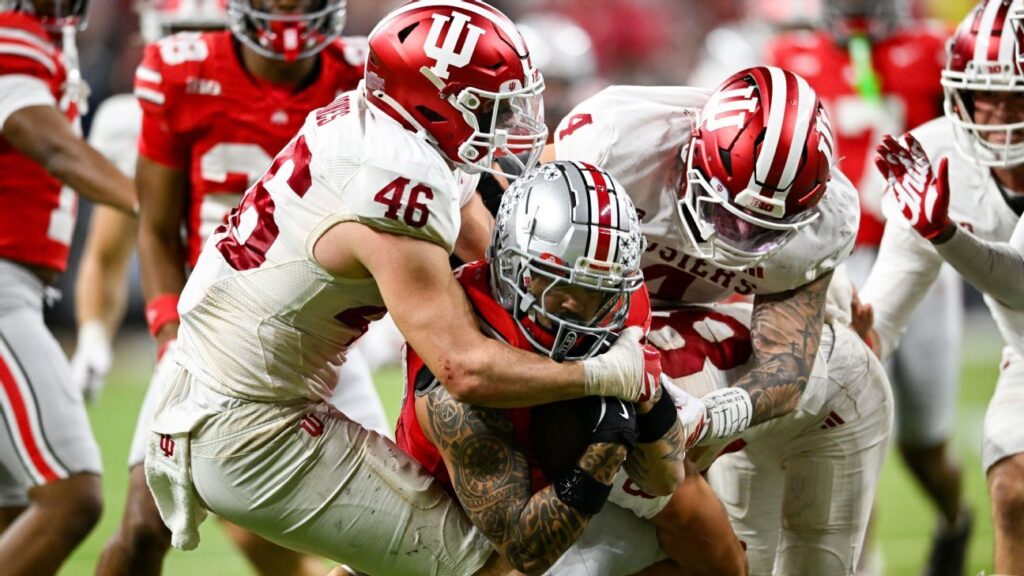
Coaches and scouts highlight the trenches as Miami’s strong suit and a potential advantage, with four of its five offensive linemen projected as draft picks. Yet those same coaches note that Indiana has consistently overpowered lines with superior talent throughout the season and wouldn’t be surprised to see that trend continue on Monday night.
Carson Beck is projected as a third- or fourth-round pick, and scouts speculate that an impactful performance in the title game could elevate his status. Several NFL teams, including Miami, New York Jets, Pittsburgh, Cleveland, Vegas, and Arizona, have clear needs at quarterback, and Beck or Penn State’s Drew Allar is expected to be the third QB chosen in the draft.
Indiana quarterback Fernando Mendoza is the probable No. 1 pick and by far the best prospect on the field. Other Hoosiers likely to hear their names called include standout receiver Elijah Sarratt, corner D’Angelo Ponds, and linebacker Aiden Fisher, though none are expected to be top 50 picks.
“Miami has better personnel,” stated an opposing coach. “But given Miami’s schematic limitations, I expect Mendoza to have a solid performance. They just need to protect him.”
What is Miami’s path to victory?
The inside joke among coaches is that if Miami is going to win, it will result in the shortest title game in history. Miami tends to huddle and often approaches the line of scrimmage with about 15 seconds left on the play clock.
Miami controlled time of possession against Ole Miss, holding the ball for 41:22. They had four drives exceeding 13 plays. While such time management partly stemmed from Ole Miss’ high tempo, the Hurricanes will need a similar game flow to succeed.
A glimpse of how this might look came during Oregon’s second drive against Indiana last round. After Dante Moore threw a pick-six on the opening drive, he executed a 14-play, 75-yard drive to tie the game, consuming nearly eight minutes. Miami offensive coordinator Shannon Dawson — a proponent of the Air Raid offense — must remain patient, run the ball, and capitalize on available opportunities.
Early success will hinge on Miami’s running game. Fletcher has amassed 58 carries for 395 yards in the playoff, averaging 6.8 yards per carry and consistently pushing defenders back, almost as if aiming for a Caterpillar NIL deal.
“I believe Miami will shorten the game and emphasize the run,” remarked a veteran NFL scout. “I do think it will be a tight contest. finally, Indiana’s quarterback will make more key throws on third down.”
Right tackle Francis Mauigoa is the cornerstone of Miami’s offensive line, projecting as the highest draft pick on their offense. (Freshman Malachi Toney is the most talented player but isn’t draft-eligible yet.)
Standing at 6-foot-6 and weighing 335 pounds, Mauigoa could transition to guard in the NFL. He’s a formidable presence who needs to dominate an Indiana defensive line that has lost key players, Kellan Wyatt and Stephen Daley, to injury.
A scout points out that Mauigoa possesses the raw strength and foundation for a “high ceiling” in the NFL. He must control the line of scrimmage to help manage the clock and maintain a low-scoring game.
Can Miami replicate its Ohio State success?
A significant statistical oddity this postseason was Miami’s win over Ohio State in the quarterfinals, where they finished the game with zero penalties—making them the first team in CFP history to achieve this.
Indiana prides itself on disciplined, mistake-free football. Miami, however, has struggled with penalties throughout the season, excluding the Ohio State game. In total, they accrued 21 penalties costing them 163 yards in defeats against SMU and Louisville.
The disparity in penalties serves as one of the game’s most glaring statistics. Indiana ranks No. 2 nationally in fewest penalty yards, with an average of 26.9 per game, whereas Miami stands at No. 85 with 57.1 yards. According to ESPN Research, in four of Miami’s six one-score games this season, they committed at least nine penalties.
No penalty loomed larger than a costly unnecessary roughness call against defensive lineman Marquise Lightfoot, extending SMU’s game-tying drive that resulted in overtime during Miami’s loss in Dallas.
Indiana’s defense has been remarkably efficient, with only 13 penalties called against it all year. Army leads the nation with just seven penalties.
A focal point to watch during Monday night’s game will be the offensive line.
While Indiana isn’t perfect in this area, they had seven pre-snap penalties in their victory against Oregon—six of which were false starts, and another was due to a delay of game. Could similar issues arise if Miami fans create noise disruptions? (The crowd is expected to be roughly a 50-50 split based on ticket distribution.)
Miami’s offensive line has been a strength but is not without mistakes, accruing 37 penalties this season—the fourth most in FBS according to ESPN Research. They’ve incurred 24 false starts, second most in the FBS, including three against Ole Miss.
Miami must perform as they did against Ohio State to pull off the upset.
The difference-maker on Indiana’s defense
A standout player identified by coaches and scouts as a crucial contributor is Indiana linebacker Aiden Fisher. He admires former Carolina Panthers linebacker Luke Kuechly, particularly Kuechly’s ability to read and anticipate plays pre-snap on ESPN’s “MNF Playbook with Next Gen Stats.”
“His foresight in the game is exceptional,” Fisher shared with ESPN. “I’ve integrated some of his strategies into my notes this offseason regarding film analysis and overall understanding of the game.”
Fisher has developed a reputation within the Big Ten for deciphering the opposition’s plays through their formations and movements. He often moves close to the line of scrimmage to capture the quarterback’s pre-snap terminology, retaining that information for later use to recognize plays.
While he didn’t want to “reveal his secrets” about his observations against Miami, he recounted a favorite play this season when he anticipated a tight end screen for Iowa based on their motion.
He alerted linebacker Rolijah Hardy, who then tackled Iowa’s DJ Vonnahme for a 1-yard loss.
“That’s one of my favorite plays of the season, even though I didn’t directly execute it,” he recalled. “[Hardy] made the big play, and you can see me on film pointing to my head. That’s what excites me during games. I can call out the bluff.”
Fisher, who was a high school quarterback, leverages his understanding of that position to comprehend the quarterback’s signaling—”various protections, audibles, and checks”—and use this intel to foresee plays as the game progresses.
Indiana’s defensive coordinator, Bryant Haines, terms Fisher “an elite mind.”
“What’s notable about a quarterback as he approaches the line of scrimmage is that he’s communicating real concepts,” Haines explained to ESPN. “The terminology works on right and left (like East Coast and West Coast). Any team has underlying concepts behind their language, and he’s adept at pinpointing some of those nuances.
“When you combine that with formational tendencies, he gains significant insight into the opposing team’s strategy.”
The Heisman winner vs. a banged-up Miami secondary
The looming uncertainty surrounding Miami’s secondary is a critical factor in this game, particularly in the first half.
Miami defensive back Xavier Lucas will miss the first half due to a targeting call. Another corner, Damari Brown, has been sidelined since November 29 and is listed as “day-to-day,” according to Mario Cristobal.
Both players are essential members of the secondary, with Lucas notching 11 starts and Brown five this season, playing key roles in Miami’s corner rotation.
Add to that a critical corner, OJ Frederique, who played just seven snaps against Ole Miss in the Fiesta Bowl. He assured ESPN that he’s “fully healthy” and ready to contribute, having returned for the playoff following a nearly two-month absence.
This situation is likely to force Miami to depend on less experienced defensive backs, particularly until Lucas can return in the second half.
True freshman corner Ja’Boree Antoine played 24 snaps against Ole Miss, 14 of which were defensive—third most for him in a game this year and the highest in a consequential match.
As Ole Miss targeted Antoine last week, expect Indiana to similarly seek to exploit the vulnerabilities in Miami’s secondary early in the matchup.
Freshman Chris Ewald, who has appeared in four games for a total of 27 snaps, and Jadais Richard, a transfer from Vanderbilt who has played in four games and logged 21 defensive snaps this season, are names to watch. Miami may also shuffle experienced players from nickel or safety positions to provide additional support.
Don’t be surprised to see Mendoza and Indiana’s deep receiving corps searching for weaknesses in Miami’s defensive backend. Opposing coaches have cited this as Miami’s most significant vulnerability all season.
“Both offenses will have a grasp of each other’s schemes as their defenses share the same principles,” indicated an opposing coach. “If the teams are aware of their opponent’s intentions, who poses more of a threat? I believe Indiana, when aware, can turn this into a high-scoring affair, while Miami isn’t constructed for such a style.”
ESPN research producers Marisa Dowling and Sopan Shah contributed to this story.