








When prestige hair care brand Olaplex first debuted on the Nasdaq in late 2021, it surpassed pricing predictions and gained momentum fast.
The company opened at $25 per share, an increase from its initial public offering pricing estimates. It was part of a broader group of retailers that went public that year amid an IPO boom. Olaplex hit its all-time high just a few months after its public debut, reaching a price of $29.41 on Jan. 3, 2022.
But that run didn’t last long.
Since its IPO, Olaplex’s stock performance has plunged drastically, losing nearly 95% of its value. The S&P 500, meanwhile, has gained more than 50% over the same period. Now, the company is hoping to turn its performance around.
“We are encouraged by the momentum we are seeing as we work to build a business that lives up to our breakthrough science, and we look forward to the journey ahead,” CEO Amanda Baldwin told CNBC in an exclusive statement.
Olaplex declined to comment to CNBC beyond that statement.
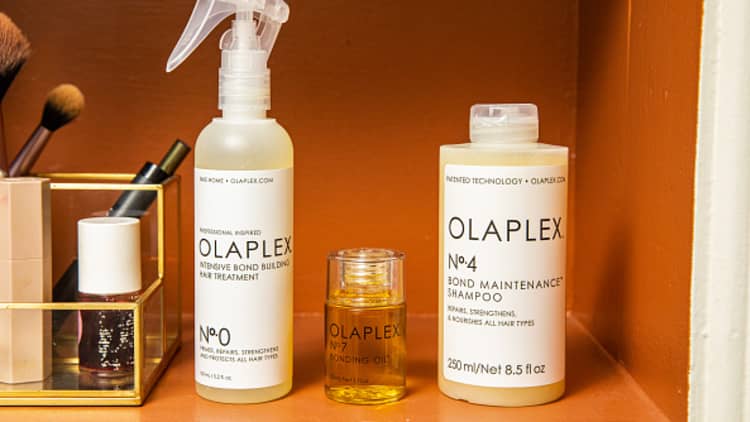
The company has a range of products, sold directly to consumers and to professional salons, that use a bond-building technology to strengthen and restore hair.
Its stock began sinking due to weakened demand and regulatory challenges in 2022, but some of Olaplex’s main issues were borne out of an early 2023 lawsuit filed against the company that accused the brand of using harmful ingredients. It involved nearly 30 women who alleged that the products caused hair loss and hair damage, citing an ingredient called lilial.
The company aggressively denied those claims and said it had removed the lilial ingredient from all of its products, but consumers on social media continued to attack the brand, its formulations and the alleged side effects.
Though the case was dismissed later that year, the allegations left lasting damage on the brand’s reputation. Over the course of that year, its stock sank more than 50% – and it never recovered. Shares of Olaplex are now trading at less than $1.50, with a market cap of roughly $1 billion.
In fiscal year 2023, Olaplex said its net sales decreased 47.8% in the U.S. compared with the previous year, while its net income sank 74.8%.
In the meantime, the hair care industry added new players that fought for Olaplex’s falling market share. Companies like K18, Ouai and Redken have crowded the playing field, gaining popularity while Olaplex battled social media backlash.
In late 2023, Olaplex recruited Baldwin, the former CEO of beauty brand Supergoop, to helm the company and turn around its brand strategy.
At the time, Baldwin said she saw “tremendous opportunity” to help the brand by deepening engagement with its customer base, innovating new products and sharpening its press strategy.
“Olaplex stands apart as a category creator redefining what is possible through the combination of beauty and science,” Baldwin said in a statement in late 2023.
Late last month, the company launched a new product, a pre-shampoo treatment intended to revitalize hair that marked the company’s next foray into advancing its bond-building technology.
In its fourth-quarter earnings report last week, Olaplex reported a 4.3% increase in net sales compared with the fourth quarter of 2024, to $105.1 million. But for the full 2025 fiscal year, net sales increased just 0.1%. Shares of the company sank more than 20% after the report.
Reviving the brand
Olaplex didn’t always have so many challenges.
Celebrity hair stylist Tracey Cunningham has been with the brand since before it officially launched, first connecting with Olaplex founder Dean Christal in 2013 to begin testing products.
Cunningham, who specializes in hair coloring, said she began with testing the product on one red-haired client. By the end of the day, her opinion was clear.
“I called Dean Christal at the end of the day, and I said, ‘Dean, I just want to tell you something — you just gave hair colorists super powers. You are going to change the game with hair color,'” she said.
Cunningham began using Olaplex on practically all of her customers at her Los Angeles salon, finding that it strengthened the hair and held color well. Over the course of the evolution of the brand, she said she’s seen its technology and formula improve.
Still, not all consumers have had the same experience with the brand, and it remains unclear whether Olaplex will be able to bounce back from its fall from grace.
Analysts from JPMorgan Chase aren’t sure that Olaplex is reaching an inflection point. In a January note, the analysts wrote that they’re holding a bearish outlook for the brand.
“We believe the company will face a challenging few quarters ahead working off a significantly lower normalized base with sales performance in FY25,” they wrote. “The increased competition, generally stressed consumers and a challenging operating backdrop will likely remain significant headwinds over the next several months.”
A bottle of Olaplex N.4 Bond Maintenance Shampoo arranged in Denver, Colorado, US, on Thursday, Dec. 8, 2022.
David Williams | Bloomberg | Getty Images
But Olaplex is singing a different tune.
On a third-quarter earnings call in November, Baldwin said research conducted when she first joined the company indicated that the brand was seen by consumers as “effective, yet cold and clinical.”
“According to the latest brand health tracker, which we fielded at the end of the quarter versus a baseline taken before we relaunched the brand, Olaplex is now perceived as more approachable and alluring while retaining its core identity as a scientific and iconic brand,” she said.
Susan Anderson, an analyst at Canaccord Genuity Global Capital Markets who has covered Olaplex for nearly all of its public history, said stabilizing sales, product innovation and distance from the lawsuit fallout are showing encouraging signs for the company’s progress.
“The negatives are just getting much less,” Anderson told CNBC.
She noted that the company’s challenges have been compounded by negative perception and increasing competitors, but she believes customers have largely “moved beyond” the hair loss allegations.
And hair and scalp health continues to be a buzzy category within hair care, she added.
“It’s one of the hotter areas of beauty,” Anderson said. “We don’t really see that going away anytime soon, and I do think it presents opportunities for Olaplex to continue to roll out new products.”
In a December survey, Canaccord found that Olaplex was the top prestige hair brand for consumers ages 18 to 29.
There have been recent green shoots for the company, too. In January, reports that Olaplex attracted a takeover offer from Germany-based company Henkel sent the stock surging more than 30%.
Olaplex declined to respond to the report.
“I’ve always thought this is definitely a takeout candidate, the valuation is attractive here,” Anderson said. “Obviously, it’s still a great brand that has a loyal following, so I guess I was not surprised at all.”
Source: www.cnbc.com