









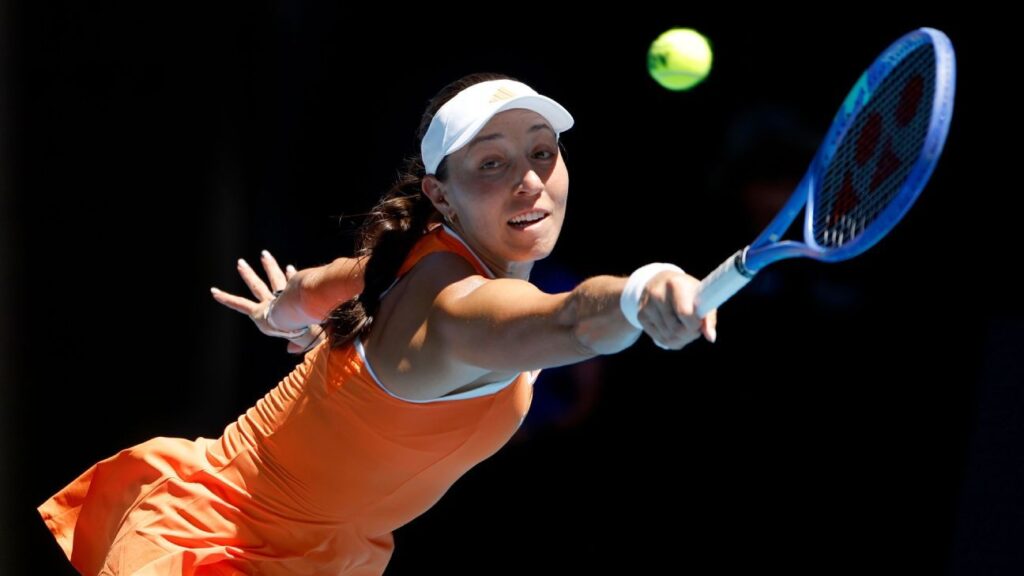
MELBOURNE, Australia — Jessica Pegula’s journey at the Australian Open so far has showcased her exceptional composure and tactical play. On Monday, she elevated her performance by making a bold statement.
The world No. 6 not only bested defending champion and close friend Madison Keys at Rod Laver Arena, but she also thoroughly outplayed her, demonstrating a level of strategy indicative of a player poised to claim a Grand Slam title.
With a 6-3, 6-4 win over ninth-seeded Keys, the 31-year-old moved into the quarterfinals, continuing her flawless campaign without dropping a set.
This highly anticipated match was framed as a showdown between Keys’ powerful shotmaking and Pegula’s strategic efficiency. What transpired was not just that, but also a lesson in exploiting an opponent’s strengths through shape, variety, and pressure.
“[I’m] happy with the way I served during key moments and executed my strategy,” Pegula remarked after the match.
“I’ve been seeing the court, hitting, and moving really well throughout this tournament, and maintaining that level against a formidable player like Madi, especially the defending champion, was a tough task, but I think I did it effectively.”
From the outset of the first set, Pegula’s intentions were unmistakable. Always on the offense, she broke Keys’ serve early and showcased service games characterized by precise placement, forcing her opponent to move rather than allowing her to gain dominance with aggressive returns.
Pegula employed wide serves, angled groundstrokes, looping forehands, slices, and flat cross-court shots. Anything to disrupt the rhythm of the 2025 champion was on her agenda.
yet, Keys still delivered moments of brilliance, showcasing powerful serves and impressive backhand winners that reminded spectators of her high potential on the tour, while also reminding Pegula of the need to maintain her performance level to avert a Keys comeback.
Yet, the challenge for Keys lay in her own inconsistency. Frequently, she would finish points with winners, yet Pegula’s variety and depth often forced her into errors.
The statistics illustrated a stark reality.
After 10 games, with Pegula leading 6-3, 1-0, Keys had recorded 14 winners, but also made 20 unforced errors. Pegula? Just five winners and five errors. By the end, Keys boasted 26 winners along with 28 unforced errors, while Pegula’s tally was 12 winners to 13 errors.
This encounter revealed the clash between high-risk, potent ball striking and a smart, steady game, with the latter emerging victorious.
The second set unfolded in a similar manner, with Pegula maintaining a slight lead throughout. She not only had the physical edge, but also a psychological one, consistently absorbing Keys’ serve without faltering, forcing longer rallies and delivering meticulously under the fourth-round pressure.
Even in serving situations where Pegula could be perceived as weak, the contrast was stark—just one double fault compared to Keys’ six.
“Focusing on my serve was crucial,” Pegula said. “Serving into the sun on one side was challenging, and I dropped that game. But I thought, you know what … she hit a couple of good shots, whatever. Just don’t dwell on it too much.”
“I needed to remain focused. Keeping my feet moving and my body weight directed forward was essential. When nerves kick in, especially while playing well, it’s easy to relax, but against a player like Madi, who can swiftly change the match with a couple of strong forehands and serves, that can be dangerous.”
This matchup held added intrigue as both players co-host “The Player’s Box” podcast and share a close friendship. It marked the first Australian Open clash between top 10-seeded American women since the 2005 final featuring Serena Williams and Lindsay Davenport.
Pegula advances to the quarterfinals, playing highly efficient tennis capable of unraveling most opponents—no sets lost and only 17 games dropped.
Her consistency has long been acknowledged, but critics have often labeled her as simply a quarterfinal regular. This critique might hold some weight, as she hadn’t broken through to the semifinals of a Slam until 2024.
Arriving in Melbourne still pursuing her first major title, lingering questions persisted: When would she break through? When would she finally claim the ultimate prize? Is she “too consistent”? Does she possess enough weaponry? Can she be considered great without being a champion?
For Pegula, such concerns are mere background noise.
“I feel achieving quarterfinals at a Slam is quite commendable,” she reflected. “I’ve never quite grasped the negativity surrounding it or the notion of how to progress past the quarters.”
“The fact that I consistently find myself in these positions is an achievement in itself. … At the US Open, I reached the finals and semifinals, which felt normal for me. Now, I feel even more at ease knowing I’ve advanced further; it doesn’t seem as daunting to be in the quarters.”
Performances like this one, especially against a defending champion, serve as the strongest counter-argument to the doubts surrounding her. These performances imply that perhaps her breakthrough is not just on the horizon; it may already be unfolding. It’s time to reshape the narratives.
Pegula’s challenge intensifies as she faces No. 4 seed Amanda Anisimova in the quarterfinals. though Pegula holds a 3-0 record against her, this will mark their first encounter at the Grand Slam level.