








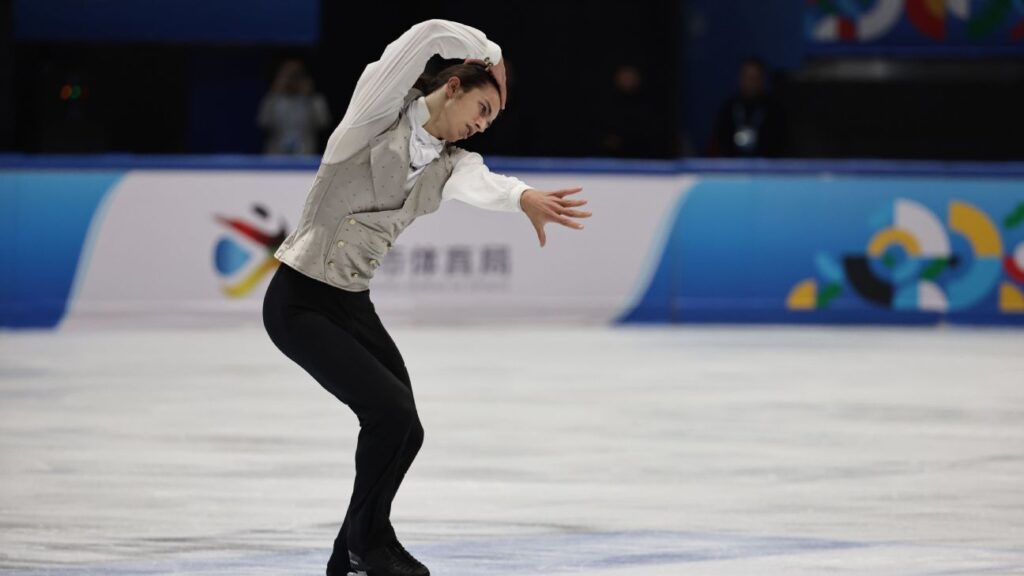
MILAN — Russian figure skater Petr Gumennik has had to change his short program music just two days before the men’s competition at the Milan Cortina Olympics, joining a rising number of skaters facing copyright challenges.
Competing as a neutral athlete at the Winter Games, Gumennik had prepared all season using music from “Perfume: The Story of a Murderer,” a psychological thriller. but, the 23-year-old Russian national champion discovered recently that he lacked the necessary permission to perform to this music, leaving him in a precarious situation as the competition approached.
With such a tight deadline, Gumennik was unable to secure clearance for his music from the previous season, taken from the space opera “Dune.” Instead, he opted for “Waltz 1805” by Edgar Hakobyan, for which he managed to obtain permission.
The men’s competition kicks off Tuesday night with the short program.
Last week, Spanish skater Tomas-Llorenc Guarino Sabate rushed to secure approval for his short program music, which featured a medley from the animated film “Minions.” even with performing it all season, he learned that Universal Studios was likely to deny permission for the Winter Games.
As he sought approval on two music cuts, Sabate simultaneously worked on a backup program. He achieved success by contacting a fellow Spanish artist for a third piece and received permission on Friday for the last track, “Freedom” by Pharrell Williams.
“It hasn’t been an easy process,” Sabate remarked, “but the support from everyone following my case has been crucial in keeping me motivated and optimistic in recent days.”
Loena Hendrickx from Belgium also faced copyright concerns after skating to “Ashes” by Celine Dion from “Deadpool 2.” She ultimately switched to “I Surrender,” another Dion song that was easier to clear.
Copyright issues have become increasingly problematic in figure skating. For many years, athletes could use mostly instrumental music, often deemed public domain. but, the International Skating Union relaxed its rules in 2014, leading to more modern music selections, which some artists began to contest when used without permission.
The ISU has attempted to put systems in place to mitigate copyright issues, but they continue to emerge with alarming regularity.
“It is a very, very, very serious problem,” stated ISU president Jae Youl Kim. “We don’t want athletes to be anxious about their music.”
Compounding Gumennik’s situation is the fact that Russian athletes have been barred from international competitions since their nation’s invasion of Ukraine, resulting in fewer opportunities for audiences outside Russia to hear his music.
In May, the ISU confirmed that Gumennik was assessed for any connections to the Kremlin and cleared to compete as a neutral athlete if he qualified for the Winter Games. Gumennik secured his Olympic spot by winning Skate to Milan, an event held in late September designed as a last-chance qualifier.
His free skate music is from “Onegin,” a Russian historical romance film, for which he has received approval.
Adeliia Petrosian, another Russian competing as a neutral athlete, will take part in the women’s event in Milan. She has reported no issues with her music, which includes a Michael Jackson medley for her short program and classical music for her free skate.