








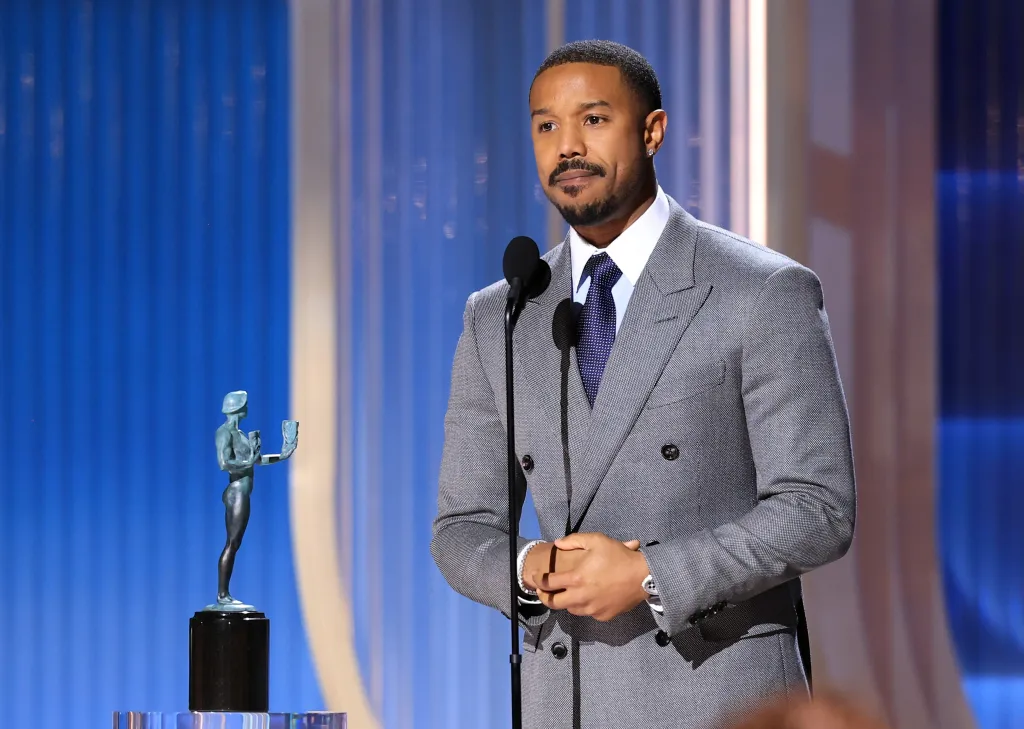
With clear eyes and a full heart, Michael B. Jordan took home two Actor Awards (one for Smoke and one for Stack).
There are moments — not very often — at an awards ceremony where you feel the entire DNA of the Oscar season shift beneath your feet, and in the room itself. At the Actor Awards on Sunday night, we experienced one of those moments. When Jordan and the cast of the Warner Bros. vampire drama “Sinners” took home best actor and the top ensemble prize, the room roared.
This past weekend shook up the race in ways many observers were either unable or unwilling to acknowledge. On Saturday, Paul Thomas Anderson’s political epic “One Battle After Another” claimed the top prize at the Producers Guild of America Awards, all but confirming its path to Oscar glory — at least by historical precedent. Then, less than 24 hours later, Ryan Coogler’s box office sensation threw a wrench into that trajectory, with Jordan claiming best actor over a field of presumed frontrunners and the cast walking away with the ensemble prize.
It is easy to tally the statistics and call the race for “One Battle After Another.” That argument is entirely plausible. But reporting from the ground and speaking with multiple Oscar voters over the last week suggests a race unfolding in real time. As it stands, the only genuine certainty heading into Academy Awards night is best actress, where Jessie Buckley — the season’s lone sweeper for “Hamnet” — remains the surest thing on the board.
This is what the Oscar race should be. And that’s exciting.
The last time we walked into a ceremony where the top six categories — best picture, director and four acting races — felt this genuinely unsettled was the 2003 ceremony. That night produced shocking wins for Adrien Brody and director Roman Polanski for “The Pianist,” over SAG and BAFTA winner Daniel Day-Lewis (“Gangs of New York”) and DGA winner Rob Marshall (“Chicago”). Nicole Kidman’s work in “The Hours” overtook Globe and SAG winner Renée Zellweger from best picture winner “Chicago,” and Chris Cooper’s Globe and Critics Choice Association-winning turn in “Adaptation” triumphed over SAG and BAFTA winner Christopher Walken from “Catch Me If You Can.” Coincidentally, no one has ever won the supporting actor Oscar with both the SAG and BAFTA awards, which is precisely the position Sean Penn now finds himself in.
And then there’s the coveted 2000 ceremony, which I’ve been referencing for the past few weeks as the gold standard of volatility. Ang Lee walked in with DGA, Golden Globes and BAFTA wins for “Crouching Tiger, Hidden Dragon.” Steven Soderbergh — armed with only a combined Critics Choice win for “Erin Brockovich” and “Traffic” — won his Academy Award for the latter, even with double bids. “Gladiator” won best picture with three technical Oscars and a surprise best actor winner in Russell Crowe, who had only the BAFTA. That same night, Marcia Gay Harden stunned in supporting actress for “Pollock,” without a single other precursor nomination to her name, and a different winner had emerged at each individual ceremony leading up to Oscar night.
Hello, Delroy Lindo?
We may be living inside that kind of year right now.
“Sinners” becomes only the fifth film to win both best cast ensemble and best actor at the SAG/Actor Awards, following “American Beauty” (1999) and Kevin Spacey; “Traffic” (2000) and Benicio Del Toro (won supporting Oscar, despite winning lead at SAG); “The King’s Speech” (2010) and Colin Firth; and “Oppenheimer” (2023) and Cillian Murphy.
“Traffic” is the only title among those four to subsequently lose best picture. The implication for “Sinners” is obvious.
And yet the statistics are not simply stacked in one direction. Consider the following scenarios, assuming the WGA wins go to the respective films.
In “One Battle After Another’s” corner: No film in history with wins at the Critics Choice Association, Golden Globes, BAFTA, ACE Eddie Awards, DGA, PGA and WGA — along with at least one SAG prize — has ever lost best picture.
In “Sinners’” corner: No film with ACE, SAG and WGA wins has ever lost best picture.
One of those streaks will end on Oscar night.
Michael B. Jordan accepts best actor at The Actor Awards for “Sinners”
Getty Images
plus worth noting: No film since 2000 has lost best picture while winning director, screenplay and editing — a trio “One Battle After Another” is positioned to sweep. And no film since 1993 has lost best picture while winning two acting awards and screenplay, which is where “Sinners” finds itself.
The math doesn’t disappear just because “One Battle After Another” has stacked more trophies. It only gets more interesting.
Triple nominee Coogler, meanwhile, made history at the Actor Awards as the first director to helm two cast ensemble winners, for “Sinners” and “Black Panther.” That’s just on top of all the history his vampire drama has made until now.
Jordan’s win was critical, not only for his personal campaign (though presenter Viola Davis’ reaction may go down as one of the great awards show moments of recent memory), but also for his film’s path to best picture.
Timothée Chalamet’s prospects for “Marty Supreme” have all but evaporated. For weeks, his campaign style drew significant criticism from industry professionals and voters, and he may have to wait a little longer for his first Oscar. I’ve long believed this season might ultimately belong to four-time nominee Ethan Hawke for “Blue Moon” — and that’s still theoretically possible. But what I’ve grown increasingly confident in is that Chalamet would not emerge victorious. We just needed to figure out who would. Sunday at the Actor Awards may have answered that.
With only Golden Globe and Critics Choice wins to his name, Chalamet now occupies the same precarious territory as early frontrunners who came up short — among them Angela Bassett for “Black Panther: Wakanda Forever” and Jack Nicholson for “About Schmidt.”
At this stage, only Hawke and Globe winner Wagner Moura from “The Secret Agent” carry enough juice to topple Jordan. But that path is steep. The parallels to Russell Crowe’s run in “Gladiator” — claiming a key acting win to complete his package at the finish line — are unmistakable. And “Sinners” is also positioned for original screenplay, which the Roman empire epic did not have. That makes Coogler’s film an even stronger cumulative case.
There is, however, a significant statistical caveat. No performer has ever won the Oscar for best actor with only a SAG win as their lone televised precursor — with one notable asterisk. Roberto Benigni accomplished it for “Life Is Beautiful” (1998), though it should be noted that BAFTA voting took place after the Oscars in that era, making the comparison less clean. That asterisk has historically swallowed actors like Denzel Washington for “Fences” (2016) and, most recently, Chalamet for “A Complete Unknown” last year.

Sean Penn in “One Battle After Another”
©Warner Bros/Courtesy Everett C
If Chalamet’s approach has been polarizing, Sean Penn’s has been virtually nonexistent. Penn mirrored his BAFTA win for “One Battle After Another,” but attended neither ceremony. He has never been an avid campaigner, and with two Oscars already on his shelf — for “Mystic River” and “Milk” — that absence could prove decisive. He also once said publicly he would “smelt” his Academy Awards. The Academy does not hand out third Oscars to just anyone. And wouldn’t it feel better to hand it to someone who would appreciate it?
Which brings us to Lindo. The 73-year-old veteran landed a surprise Oscar nomination for his scene-stealing turn in “Sinners,” despite being shut out by every major precursor. Only three performers in modern history — Marcia Gay Harden (“Pollock”), Regina King (“If Beale Street Could Talk”) and Christoph Waltz (“Django Unchained”) — have won an Oscar without a SAG nomination. Harden is the only one who, like Lindo, missed every major precursor entirely. No one has ever won best supporting actor on the strength of only a SAG nomination and BAFTA wins — a combination that hurts Penn. And the last supporting actor to win with only a Golden Globe was George Clooney for “Syriana,” which hurts Stellan Skarsgård. There could be a surprise on Oscar night, however you slice it.
Consider the possibility now very much on the table: “Sinners” could emerge from Oscar night with three acting winners, a screenplay win for Coogler and at least one near-certain technical prize in original score. If that scenario plays out, the conversation around best picture resolves itself rather quickly. Overwhelming support across categories has a way of pulling the top prize along — see “Everything Everywhere All at Once” (2022), which ran the table in acting and walked away with everything that mattered.
But that outcome immediately raises an uncomfortable question: Why is Coogler’s directorial achievement being left behind?
If the prevailing argument is that Paul Thomas Anderson needs an Oscar — and it is a legitimate one — he gets it in adapted screenplay. His consolation is not nothing. It is, by any measure, a significant recognition. The question is whether that arithmetic satisfies voters who have watched Coogler build one of the most ambitious and formally daring studio films of the decade.
And here is the part that requires genuine candor, the kind that only comes from knowing Oscar history in full — the good, the bad and the ugly: There is no guarantee Coogler ever arrives at this table again as a nominee, regardless of how deep and undeniable his talent is or becomes. Hollywood has an unfortunate habit of making that promise to filmmakers and breaking it quietly over time.
“Shakespeare in Love” (1998) is the last best picture winner to claim two acting prizes, a screenplay win and the top prize while losing the directing award. John Madden took that loss gracefully and largely receded from the awards conversation that followed. But let’s be fully honest — the gap between how much the industry knew Madden then and how much the industry knows Coogler right now is not a gap; it is a canyon. The moral weight of that distinction will not be lost on Academy voters when they sit down to make their final choices.
Amy Madigan in “Weapons”
Amy Madigan doing the “Weapons” run on the Actor Awards stage when she won best supporting actress for her work in the horror film had the kinetic energy of Jamie Lee Curtis’ SAG win for “Everything Everywhere All at Once” in 2022. Emotion in that room can carry real weight in the days that follow.
BAFTA winner Wunmi Mosaku from “Sinners” remains formidable. My read is that the race will ultimately come down to her and Madigan, since Teyana Taylor’s work in “One Battle After Another” has not been awarded since the Golden Globes, and the “Sentimental Value” duo of Elle Fanning and Inga Ibsdotter Lilleaas missed out on SAG bids entirely.
My hesitation in fully committing to Madigan for the Oscar stems from two things: she is not attached to a best picture contender — or any film with another nomination — and she could not crack the top six at BAFTA for a nomination. Being the sole nod for your film is historically difficult to overcome when your closest competitors come from the two presumed best picture frontrunners: Mosaku from “Sinners” and Taylor from “One Battle After Another.”
History offers some perspective. Over the decades, several performers have won acting Oscars as the sole nomination for their respective films. In most of those cases — Forest Whitaker for “The Last King of Scotland,” Charlize Theron for “Monster,” Angelina Jolie for “Girl, Interrupted” and Kathy Bates for “Misery,” among others — the best picture winner did not field a nominee in the same acting category, clearing the path. In fact, it has happened only eight times in Oscar history, and the last was Goldie Hawn for “Cactus Flower” (1969) over Sylvia Miles in “Midnight Cowboy.” That is not the terrain Madigan is navigating.
Based on conversations with multiple Academy voters over the past several days, many have not yet cast their ballots. That could be meaningful for “Sinners.”
The Actor Awards draws from a membership of roughly 160,000 actors, the vast majority of whom are U.S.-based. The Academy, by contrast, has approximately 10,000 active voting members spread across every sector of the film industry. And while the guild and the Academy are distinct bodies, their overlap is significant. The Actors branch is the single largest in the Academy, with more than 1,300 members — more than any other branch, including directors, producers or writers. When actors vote as a bloc, they move numbers. Sunday night’s result should be understood in that context: the most powerful constituency in the Academy just sent a message.
I keep coming back to the single, fundamental question of this phase two voting period: what does a historic 16 nominations mean?
Are we supposed to believe it really means nothing? Nothing at all?
The probability math for “Sinners” does not dissolve simply because “One Battle After Another” has accumulated more individual trophies. A friendly reminder for best picture: “Moonlight” lost the PGA, DGA and SAG Awards. “Parasite” lost the PGA and DGA. “Spotlight” lost the PGA and DGA. “The Departed” lost the PGA and SAG. “Million Dollar Baby” lost the PGA and SAG.
The precedents for an upset are there. The question is whether they matter or not. Something unprecedented is about to happen on Oscar night.
Final Oscar voting will take place from Feb. 26 to March 5. The 98th Oscars will be held March 15 and will air on ABC, hosted by Conan O’Brien. This week’s updated Oscar predictions are below.
Warner Bros.
Best Picture: “Sinners” (Warner Bros.) — Zinzi Coogler, Sev Ohanian and Ryan Coogler
Director: Ryan Coogler, “Sinners” (Warner Bros.)
Actor: Michael B. Jordan, “Sinners” (Warner Bros.)
Actress: Jessie Buckley, “Hamnet” (Focus Features)
Supporting Actor: Delroy Lindo, “Sinners” (Warner Bros.)
Supporting Actress: Amy Madigan, “Weapons” (Warner Bros.)
Original Screenplay: “Sinners” (Warner Bros.) — Ryan Coogler
Adapted Screenplay: “One Battle After Another” (Warner Bros.) — Paul Thomas Anderson
Casting: “Sinners” (Warner Bros.) — Francine Maisler
Animated Feature: “KPop Demon Hunters” (Netflix) — Maggie Kang, Chris Appelhans and Michelle L.M. Wong
Production Design: “Frankenstein” (Netflix) — Tamara Deverell; Shane Vieau
Cinematography: “Sinners” (Warner Bros.) — Autumn Durald Arkapaw
Costume Design: “Frankenstein” (Netflix) — Kate Hawley
Film Editing: “One Battle After Another” (Warner Bros.) — Andy Jurgensen
Makeup and Hairstyling: “Frankenstein” (Netflix) — Mike Hill, Jordan Samuel and Cliona Furey
Sound: “F1” (Apple Original Films/Warner Bros.) — Gareth John, Al Nelson, Gwendolyn Yates Whittle, Gary A. Rizzo and Juan Peralta
Visual Effects: “Avatar: Fire and Ash” (20th Century Studios) — Joe Letteri, Richard Baneham, Eric Saindon and Daniel Barrett
Original Score: “Sinners” (Warner Bros.) — Ludwig Göransson
Original Song: “Golden” from “KPop Demon Hunters” (Netflix) — EJAE, Mark Sonnenblick, Joong Gyu Kwak, Yu Han Lee, Hee Dong Nam, Jeong Hoon Seon and Teddy Park
Documentary Feature: “The Perfect Neighbor” (Netflix) — Geeta Gandbhir, Alisa Payne, Nikon Kwantu and Sam Bisbee
International Feature: “The Secret Agent” (Neon) — dir. Kleber Mendonça Filho
Animated Short: “The Girl Who Cried Pearls” (National Film Board of Canada) — Chris Lavis and Maciek Szczerbowski
Documentary Short: “All the Empty Rooms” (Netflix) — Joshua Seftel and Conall Jones
Live Action Short: “Two People Exchanging Saliva” (Canal+/The New Yorker) — Alexandre Singh and Natalie Musteata
Projected winner leaders (films): “Sinners” (8), “Frankenstein” (3); “KPop Demon Hunters” and “One Battle After Another” (2)
Projected winner leaders (studios): Warner Bros. (12); Netflix (7); Apple Original Films, Neon and 20th Century Studios (1)
Source: variety.com