








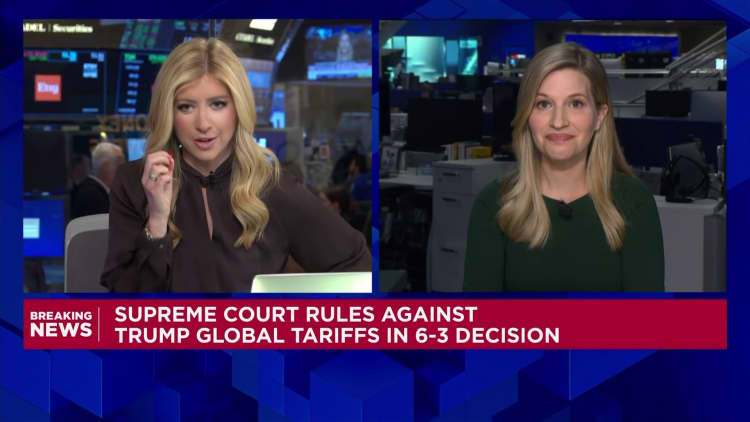
The retail industry on Friday said the Supreme Court’s ruling that struck down some of President Donald Trump’s global tariffs would usher in more predictability and free up businesses from the burden of higher import costs.
“The Supreme Court’s announcement today regarding tariffs provides much-needed certainty for U.S. businesses and manufacturers, enabling global supply chains to operate without ambiguity,” the National Retail Federation said in a statement following the ruling. “Clear and consistent trade policy is essential for economic growth, creating jobs and opportunities for American families.”
The nation’s highest court determined that Trump’s broad tariff rates on U.S. trade partners enacted under the International Emergency Economic Powers Act, or IEEPA, overstepped the president’s authority. The Supreme Court is sending the case back to the lower court with instructions to dismiss it for lack of jurisdiction.
Yet the reversal has raised fresh questions about whether retailers and U.S. consumers will meaningfully feel a financial impact and if the decision means more uncertainty or less.
Just hours after the ruling, Trump condemned the ruling and said his administration has “alternatives,” referencing sector-specific tariffs and announcing a new, global tariff rate of 10%.
It’s also unclear if, when and how the government may refund tariffs that have already been paid and were deemed unconstitutional.
“We urge the lower court to ensure a seamless process to refund the tariffs to U.S. importers,” the NRF said in its statement. “The refunds will serve as an economic boost and allow companies to reinvest in their operations, their employees and their customers.”
The NRF represents a number of U.S. retailers, from big-box retailers such as Walmart to smaller brands and manufacturers.
In an interview with CNBC on Friday afternoon, David French, executive vice president of government relations for NRF, acknowledged that retailers continue to face other tariffs and may face new ones, based on Trump’s remarks.
“The president has lots of other tariff tools in the toolbox ,and we certainly expect he will use these tools to advance his tariff agenda and maintain leverage in negotiations with other countries,” he said. “The good thing about the ruling today is it takes one of the tools away from him and will build a little bit more of certainty into the tariff process.”
Compared to Trump’s broad use of IEEPA, French said alternative duties that the president invoked on Friday “have inherit limitations.” Some of those tariffs would come with time limits or require the administration to clear additional hurdles.
And, he said, if companies get a refund of tariffs they paid, they could put it toward investing in their businesses, hiring more or lowering prices.
He said the trade group is “hopeful the president comes to the conclusion that getting the refunds out as quickly and as simply as possible would be in everybody’s best interest” — noting it could also help Trump ahead of the midterm elections.
As Costco awaited the Supreme Court decision, the warehouse club sued the Trump administration in December to get a full refund of the tariffs it had paid and to block import duties from continuing.
In the lawsuit, filed in the U.S. Court of International Trade, Costco said it risked losing money it has already paid even if the Supreme Court ruled against the tariffs.
Costco did not respond to request for comment about the Supreme Court decision and what it means for the retailer’s lawsuit.
While Friday’s ruling is largely positive for the retail industry, the idea that it brings more predictability and lower costs is likely “a pipe dream,” said Steven Shemesh, a retail analyst for RBC Capital Markets.
“This administration is pretty adamant about tariffs and trade balance, and if it doesn’t come this way, I’m pretty certain it will come in another way,” he said prior to Trump’s announcement of new tariffs. “It may have another look, shape, size, smell, but I think it will end up looking similar.”
Apparel and footwear
Clothing, footwear and discretionary items were among the imports most vulnerable to Trump’s tariffs, which imposed steep rates on countries such as China and Vietnam, where the retail industry maintains large portions of its supply chain.
Footwear has been one the most heavily impacted industries, since nearly 100% of all footwear sold in the U.S. is imported, according to Footwear Distributors and Retailers of America, the industry’s trade group.
Even before Trump’s first term, footwear manufacturers were moving some sourcing out of China as its labor force shrank, Matt Priest, CEO of the FDRA, said. Yet he said it would be unrealistic to return production to the U.S., and moving it to another part of Asia can be difficult.
In an interview with CNBC on Friday, Priest said the decision is a step toward more predictability for the footwear industry because it limits tariffs that Trump can use to ones that “are not as sweeping” and may require Congress’ input.
“whether or not it’s still uncertain to some degree, we are not on that playing field where we have those exorbitant tariffs,” he said.
The trade group, which includes well-known footwear companies and brands including Nike, Crocs and Puma, held an emergency Zoom call with 325 companies on Friday afternoon. Priest said companies were upbeat, but also had a lot of questions. Among them, companies asked about when or if they would get refunds and when the IEEPA tariffs would officially be flipped off, namely whether they would still hit shipments that arrive in the coming days.
Priest said he doesn’t anticipate that refunds will come quickly and that the trade group has coached members against banking on them. He said the group’s work continues, as it tries to work with the Trump administration and Congress to nudge them toward “a more surgical, thoughtful approach” to tariffs.
On the call with trade group members, Priest said, “there was optimism that this part of this journey was at least somewhat being redirected” and described the ruling as “a win” for the industry.
But, he added, without the refund and other details spelled out yet, “it’s a long way to go.”
Source: www.cnbc.com