








“Jean-Michel” is the Jean-Michel Basquiat documentary we’ve been waiting for — the fantastic one he deserves. Over the years, there have been a sprinkling of films built around Basquiat, like the boho vérité snapshot “Downtown 81” (2000) or “Boom for Real: The Late Teenage Years of Jean-Michel Basquiat” (2018), which captured the period in the late ’70s after he’d broken with his family, when he was a scene-maker cultivating the seeds of his art and fame. Both those films are heady time capsules, and so, in a different way, is Julian Schnabel’s “Basquiat” (1996), a biopic — starring the hypnotic Jeffrey Wright — that was way ahead of the curve in recognizing the poetic sway of Basquiat’s art and image.
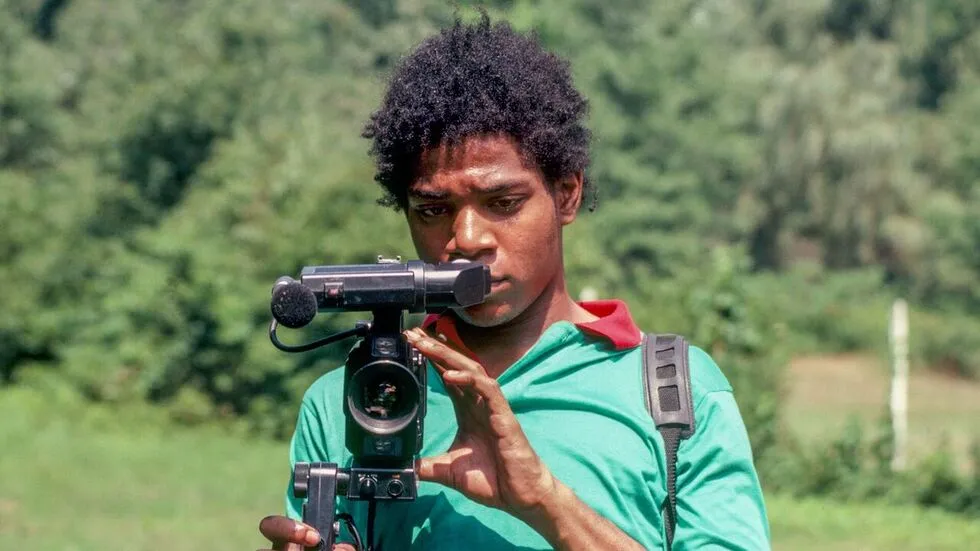
But “Jean-Michel,” directed by Quinn Whitney Wilson and Viridiana Lieberman (it just premiered at the Tribeca Festival and was bought by Netflix), is the first movie to penetrate the Basquiat mystique and give you a full-scale portrait of who he was: New York child of privilege, driven prodigy, bohemian scavenger, downtown rock star, thrill-seeking junkie, media celebrity, meditative soul, spiky and timeless art genius. It’s the first Basquiat film to be made in cooperation with his family, who provided the archive — home movies, photographs, sketches, notebooks — that fills in Basquiat’s life as never before.
When the family estate cooperates in a biography, it can mean the rough edges are sanded off — that you’re getting a burnished, officially approved portrait. But that’s not what happens in “Jean-Michel.” I’m sure there are sordid details that were left on the cutting-room floor (and it’s jarring that the movie leaves out his relationship with the artist Suzanne Mallouk), but the film is bracingly direct about who Basquiat was, his many dimensions and contradictions. He was a singularly charismatic and, by most accounts, ingratiating person, so it’s not like the film has to fudge that, but he could also be moody and jealous and ruthless (at an opening at the Whitney, he used a pen to deface one of Schnabel’s paintings). He was like a planet revolving around himself, and the film does justice to the light and dark sides of that orbit.
The closest thing “Jean-Michel” has to an agenda is to undercut a stubbornly persistent dimension of the Basquiat legend: that he was a “primitive” genius who rose up out of the streets. It’s important to say that we have this image, in part, because it was cultivated by Basquiat himself. But the media dug the myth a little too much; their consuming embrace of it carried a racist undertone, as if Basquiat could only be understood as a derelict version of virtuosity.
It’s true, of course, that he started off as an underground graffiti artist who named himself SAMO (for “same old shit”) and ultimately crossed over to the gallery world. And it’s true that he went through a self-styled homeless period. But “Jean-Michel” fills in the ground floor of his life — that his father, Gerard, a Haitian immigrant who became a New York businessman, and his mother, Matilde, a fourth-generation Puerto Rican, raised him and his two younger sisters in a Brooklyn brownstone that the family owned. They were a close-knit clan, and Jean-Michel was doted on by his mother. He attended private school and wanted to be a cartoonist. But he’s described by his adult sisters, Lisane and Jeanine, as a ball of unruly energy who couldn’t settle down in class; he was too much of a rebel dreamer.
His life took a turn after he was hit by a car (at age 7), and his parents divorced. (In the film, the prospect of losing his family devastated the young Jean-Michel.) Matilde, who had cultivated the love of art in him, declined into mental illness once she was on her own, and his father was basically a 1950s straight-arrow who wanted to shoehorn Jean-Michel into the American Dream. Jean-Michel was having none of that, so in his teens, stoked by the post-punk fervor of the late ’70s, he ran away from home. It’s crucial to note that this was happening at a moment, at least in New York, when squatting had become hip. Madonna did it too, and she and Basquiat had a fling as she was on the verge of fame.
What’s striking about Basquiat’s creativity, which the documentary captures with a seductive, voluminous presentation of the development of his art, is that he was a fountain that never turned off. We see samples of his art as a child, and there’s no question that as he got older he deliberately hung onto and refined elements of that blotchy, scalding style; he saw the expression of his childhood self as the ultimate freedom. Yet by the time he’d reached his teens (he began painting at 15), and was selling postcards on the street for a few dollars, his work had begun to acquire the vibratory quality that made it seem like you were staring at psychological X-rays. “There is no filter,” says one observer. “You’re looking inside his brain.” That’s exactly the talismanic quality of Basquiat’s paintings. He used mixed media (words, collage, geometric piping, icons like the repeated use of a crown, erupting scrawls) to make it feel like you were downloading his soul in its distilled form. The paintings were incantations, shot through with rapture and anxiety, threaded with a secret coded history of the culture. Basquiat looked into himself and saw the world — of Black experience, and of American experience — and then reflected that world back to us.
Growing up, Jean-Michel Basquiat chose to be a drifting bohemian, but the nightclub culture that became his second home was starting to interact with the media in a new way. We see clips of Basquiat on “TV Party,” the New York cable public-access show, where he sat around with people like Christ Stein and Fab 5 Freddy. For a while, his hair is shaved into a widow’s-peak dagger, but what’s disarming about his presence is how gentle and gregarious it is. We see interview segments where he lets his guard down, and also ones where he reveals himself by revealing next to nothing. He’s notably more wary in the interviews he began to give when he was getting famous. One takes place in his loft studio, and as the interviewer nudges him with questions about a painting, all tethered to a kind of racist skepticism (Why did you make that choice? Is it all arbitrary?), Basquiat fends off the cluelessness by creating an aura of invincibility around himself very much like that of Bob Dylan in the mid-’60s.
If you go to see a Jean-Michel Basquiat retrospective (and this movie has the effect of one), it’s astonishing to confront everything he painted, and the maturity of it, all before he died at the age of 27. It’s no hype to say that he can remind one of Picasso. There is only one Picasso, but Basquiat had that kind of fecund imagination, that endlessly varied and prolific joy. He worked fast, and took refuge in his work much as Picasso did. By the time he became buddies with Andy Warhol, Jean-Michel was the one doing the inspiring. The movie colors in their friendship, which we can see was quite close; they each got something out of the other, but it’s also clear that they adored each other. That’s why Warhol, after decades of not painting by hand, was moved to start again, in what became a collaborative project. The critics hated it, and they were too harsh; they couldn’t process the dual authorship, and by then they had turned, almost reflexively, on Warhol. The bad response soured the friendship….and then Warhol died. This left Jean-Michel without the mentor who had been a fulcrum for him.
He returned to his family, showing up in Brooklyn in a limo one day, handing out money, but in a way he was lost. Jennifer Goode, a girlfriend of his from 1984 to 1988, tells the story of his heroin addiction (she was his partner in junk), and how they would go to Hawaii so that he could get clean. They travelled extensively for his art openings around the world, and Jean-Michel would power through when he was someplace where he couldn’t get drugs. He should have gone to rehab, but he was deeply private, like Philip Seymour Hoffman, who also felt himself to be invincible and used heroin to self-medicate his way into an early grave. The film presents some evidence that Basquiat, near the end, was losing interest in art (he talked about wanting to become a writer). But I don’t believe that. He lived and breathed painting; it’s hard to conceive of him abandoning it. The paintings, of course, now sell for so much that they have put him on that rarefied level, along with Van Gogh and Francis Bacon and Picasso. There are still Basquiat doubters who think that’s a travesty. Don’t listen to them. Decide for yourself by seeing “Jean-Michel.”
Source: variety.com