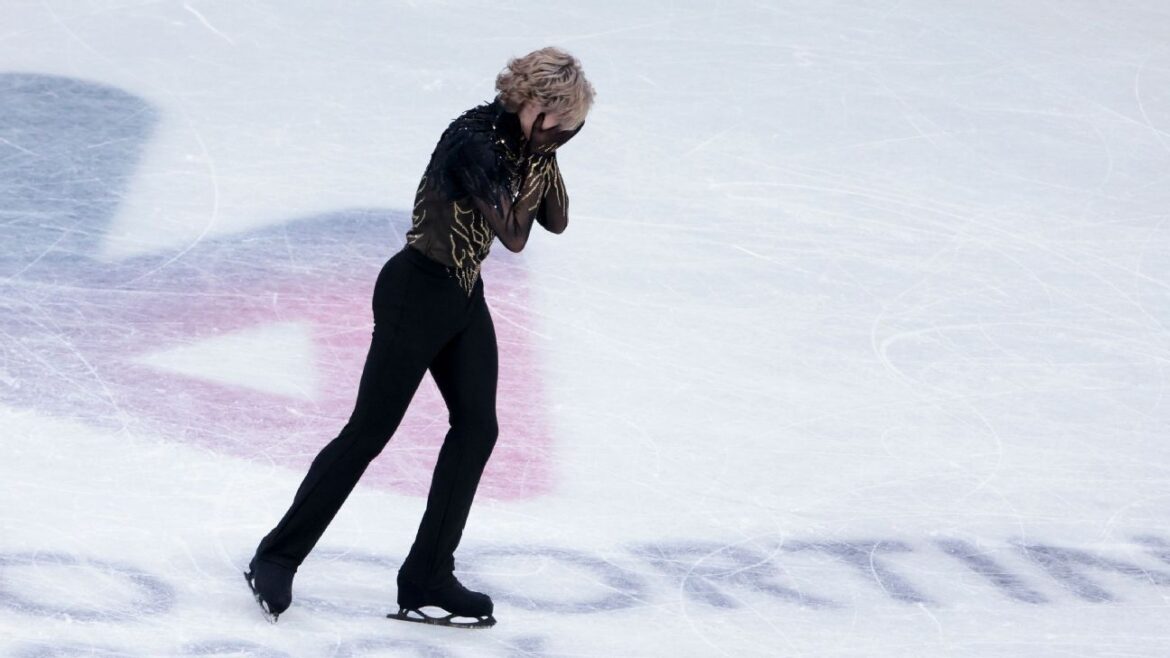









MILAN — Ilia Malinin’s expression conveyed everything.
Standing at the center of the ice after his free skate on Friday, he couldn’t mask his anxiety and confusion, his frustration — and profound heartbreak.
The gold medal that had felt almost guaranteed moments earlier was now entirely beyond his grasp. Everything he had dedicated himself to over the last four years, truly a lifetime, unraveled in just four devastating minutes.
Malinin, the two-time reigning world champion with an unbeaten streak since 2023, ended up in a shocking eighth place. There would be no medal, no place on the podium, only a barrage of questions from reporters about what had gone wrong.
“I thought all I needed to do was go out there and trust the process I’ve followed in every competition,” Malinin, 21, shared. “But this isn’t just any competition. It’s the Olympics. It really overwhelmed me, and I felt completely out of control.”
While it may offer little comfort to Malinin now, he is far from the only elite athlete to struggle under the unique pressures of the Olympic stage, especially when projected to win. Simone Biles, hailed as the greatest gymnast in history, withdrew from most events in 2021 to address “the twisties,” a mental block causing disorientation in the air. Likewise, Mikaela Shiffrin, the most successful Alpine skier in World Cup history, has faced challenges at the Olympics. even if she was a gold medal favorite in multiple events in 2022, she completed six races without a medal. As of 2026, her two races have not yielded podium finishes, with one event still to come. Malinin’s predecessor, Nathan Chen, also had a disheartening Olympic debut in 2018, finishing fifth overall.
Biles and Chen were present on Friday, with Biles expressing her devastation for Malinin on Threads.
“It’s the magic of the Olympics, but for someone like Ilia, the overwhelming favorite, the pressure is unlike any other competitor’s,” Dr. Wilsa Charles Malveaux, a former Division I track athlete and sports psychiatrist, told ESPN. “That pressure creates a competitive disadvantage with all eyes on him, all expecting perfection, even though he doesn’t need it to win. Knowing this expectation amplifies the stress to an entirely different level.”
Since making his senior debut four years ago, Malinin has skated at the biggest figure skating events, ranging from world championships to the Grand Prix Final. yet, the 2026 Olympics marked his debut on this venerable stage.
He was controversially named an alternate in 2022 after finishing second at the national championships and was not granted an official spot due to inexperience.
“I told them they should have sent me to Beijing; I wouldn’t have skated like that,” Malinin was filmed saying in the kiss-and-cry area on Friday while waiting for his score.
It’s uncertain how much his Olympic inclusion might have changed the results this week in Milan — or the implications of performing four programs within six days across both team and individual events — but his sentiment remains valid. The Olympic experience is unlike any other.
The spotlight is intensified. The expectations, demands — from fans, media, and sponsors alike — are unparalleled. Even simply experiencing the Olympic Village and being among athletes from various sports sets it apart from any other competition. Dr. Jessica Bartley, the senior director of psychological services for the United States Olympic and Paralympic Committee (USOPC), noted that the myriad decisions and options in this new environment can be overwhelming.
“Athletes face numerous other events and opportunities,” Bartley told ESPN. “Do you want to watch another sport? Attend the opening ceremony even if you compete the next day? What’s unique is striking a balance between taking advantage of these once-in-a-lifetime opportunities while also performing at their best.”
Jordan Stolz, another 21-year-old American with towering expectations entering the Games, has thrived thus far, clinching two gold medals in the 500 meters and 1,000 meters. It’s worth noting this is his second Olympic appearance; he did not medal or finish in the top 10 in either race in 2022.
The USOPC recognizes the distinct pressure of Olympic competition. Bartley elaborated that her team aims to prepare athletes for what they can expect, emphasizing mental training. Athletes across all sports receive a virtual training guide before arriving at the Games, covering everything from housing to team gear, and all mental health resources.
While she cannot comment on specific athletes, Bartley and her psychological services team strive to connect with many athletes and their teams well in advance of Olympic events. They attend national team camps, practices, and even travel with athletes to Olympic venues to ensure they know help is accessible.
In preparation for the pandemic-delayed 2020 Tokyo Games, the organization rolled out a virtual reality experience designed to simulate the unique atmosphere of competition without spectators. This continues to be utilized now that audiences have returned, allowing athletes to recreate the competition experience, including the arena’s visuals and crowd noise.
As part of the USOPC’s mandatory physical evaluation following Olympic team selection, athletes undergo a mental health assessment.
“It’s us asking, ‘What do you need? Do you have a provider? What’s your mental health strategy? How can we assist your existing plan?'” Bartley stated. “Especially when we’re in places like Italy, which is eight hours ahead of Colorado, where the USOPC and many Winter Olympians are based, we want to figure out how to support them when they can’t reach their providers.” She emphasized the importance of assuring athletes they are not alone and that help is available.
This support includes Bartley and six other professional mental health experts on-site in Italy for personalized, on-demand counseling. As of Saturday, the group had conducted 211 sessions to assist athletes before, during, or after their events. (Bartley estimates the total for the Paris Olympic and Paralympics was around 1,200.) Some athletes seek help to manage negative thoughts; others just need advice on how to reset before their next event. Regardless of prior performance, no one is immune to the pressure.
in the end, it’s individual athletes and their teams who decide how extensively they wish to utilize the resources offered. Some engage more than others, and strategies that work for one athlete may not suit another.
Malinin stated he felt fine leading up to Friday’s free skate, yet emotions overwhelmed him as he took his opening pose.
“It felt as if all the traumatic moments of my life flooded my mind, and overwhelming negative thoughts took over,” he recounted. “I just couldn’t manage it.”
Charles Malveaux described this phenomenon as “automatic thoughts,” and Malinin is far from the first to face such challenges. Having never worked with Malinin, she focuses on helping her athletes understand the root of their feelings and subsequently find pathways to overcome them.
“It’s about saying to oneself in that moment, ‘I didn’t choose this initial thought, but I can choose the next one,'” Charles Malveaux clarified. “It’s identifying an immediate response or comforting phrase to counter those damaging thoughts.”
in the end, negative emotions can arise, sometimes at the most inconvenient times, but it’s essential to have strategies in place to quickly navigate through them. This approach also applies post-error: How can the athlete shift focus to future tasks rather than fixate on past mistakes?
Bartley noted that her team at the USOPC focuses on visualization techniques along with mindfulness and meditation exercises. Often, she or one of the mental health professionals assists the athlete in envisioning the event and competition experience. This can involve something as straightforward as planning what they’ll say to themselves at the start.
“It’s all about equipping athletes with multiple tools,” Bartley stated.
Some athletes manage to filter out external pressures and noise, concentrating solely on their performance. Yet, as Charles Malveaux believes, mental training becomes even more crucial, as anxiety and doubt can approach unexpectedly. It’s better to be prepared for any sudden onslaught of pressure.
Swimmer Michael Phelps, the all-time most decorated Olympian, often spoke about visualizing every possible scenario before a race, allowing him to enter an autopilot state because he had anticipated various challenges.
For some, achieving that mental clarity requires time and is rarely a direct path. Chen redeemed himself with Olympic gold in 2022, while Biles, who dominated her Olympic debut in 2016 with five medals, secured three golds in Paris in 2024, including in the all-around. For others, the journey is more complex.
Shiffrin, who garnered three medals (two gold, one silver) during her first two Olympic runs in 2014 and 2018, has found Olympic success harder to come by in recent years, despite triumphing in virtually every other arena. The past five years have been especially challenging for Shiffrin; her father passed away in 2020, and in 2024, she suffered a severe crash leading to a puncture wound and a subsequent PTSD diagnosis. The 31-year-old appears at peace with her Olympic outcomes.
After finishing 11th in the giant slalom on Sunday, Shiffrin remained positive, praising the competitive atmosphere and her fellow athletes. “It was one of those days you can truly appreciate,” she commented.
Shiffrin reflected on her attempt to channel nervous energy into intensity but did not seem disheartened by her result.
Earlier, she candidly acknowledged the pressures of the Olympics in a social media post but expressed pride in how she had managed the intense experience.
“The Olympics require us to take significant risks on the global stage,” Shiffrin shared. “Such risks call for bravery and vulnerability amidst inaccurate judgments and narratives shaped by a limited understanding of our sport’s demands. All of these experiences contribute to our growth as individuals.”…
“I’m grateful to be here, motivated for what’s next, and proud to be part of this American team. Let’s support one another, approach what we don’t fully understand with care, and possess the strength to keep showing up.”
It remains to be seen how Malinin will navigate his future. With more experience, will he achieve a redemption arc akin to Chen’s by 2030? Or will the Olympics forever represent an overwhelming spotlight?
Malinin has not retreated since the competition; he has been seen around the Olympic Village receiving support from other athletes and was even spotted in the stands during Sunday’s pairs competition, between Mexican singles skater Donovan Carrillo and Canadian bronze medalist Piper Gilles. He is reportedly set to participate in the Gala performance this weekend and, according to NBC, will also compete in next month’s World Championships.
This might be one of the best strategies for his recovery.
“My aim is to assist [an athlete] in preparing to return, because withdrawing will linger in your mind and body, preventing you from moving forward,” Charles Malveaux stated. “If you don’t re-engage after a setback, you’re only creating a greater mental barrier, a deeper cloud of doubt. if not safety is a concern, it’s generally best to try again.”