









-

Dan Wetzel
The snowy conditions significantly impacted the AFC Championship Game, nearly halting both offenses. Together, the teams only managed to produce 48 yards and zero points in the fourth quarter, allowing New England to secure a 10-7 victory over Denver. The Patriots are set to face Seattle in Super Bowl LX on February 8.
For some NFL enthusiasts, accustomed to high-scoring games and dramatic finishes, this result felt lackluster.
This led to much discussion online about the need to shield games of such importance from weather conditions, with suggestions to move championship weekend to neutral sites equipped with domed arenas, and so forth.
While acknowledging that complaints are a common occurrence on social media …
Let’s not.
Can we please keep football authentic and refrain from altering it into a flashy, algorithm-driven product designed to cater to fleeting attention spans?
Can football, despite its inherent brutality, still be appreciated as a game of intellect, where strategy, decisions, and countless subtleties—whether it’s snow, wind, rain, or sunshine—remain significant?
All weather is football weather. The elements, or their absence, always influence the game.
This is one of the sport’s great attractions. if not faced with severe conditions—like lightning, tornadoes, or hurricanes—the game proceeds. The players adapt.
The game is built for whatever conditions exist rather than some ideal scenario. A clear sky with no wind may benefit the offense, but it can put the defense at a disadvantage. Why should one side be prioritized over the other? Why should passing be favored over running, blocking, ball security, or clock management?
It’s all part of the game. It was never intended to fit into a tidy package; its imperfections and unpredictability add to its charm.
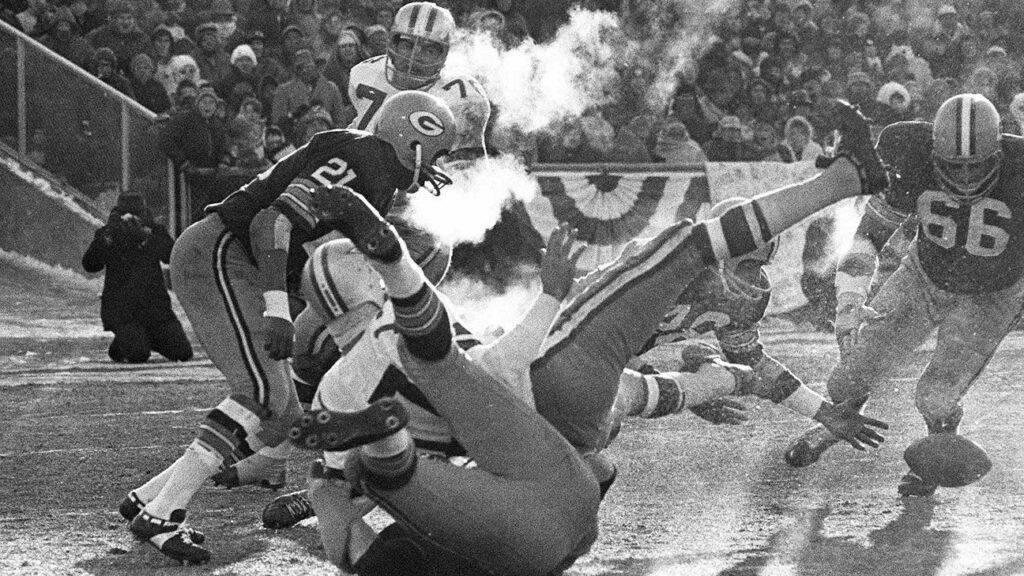
Many unforgettable NFL games have featured harsh weather—like the Ice Bowl, the Fog Bowl in Chicago, or Adam Vinatieri’s playoff game-winning kick in a Foxborough blizzard. There’s a rich history of breath visible in cold air, playful snow angels, and the expressions of determined middle linebackers.
A pivotal moment in this AFC Championship Game occurred in the second quarter when Denver was faced with a fourth-and-1 at the New England 14. Instead of opting for a nearly guaranteed field goal, Broncos coach Sean Payton decided to go for it, resulting in an incomplete pass from Jarret Stidham.
The impending weather factored into his choice. Payton believed his team was gaining momentum and getting ahead early might secure the win under the wind and snowfall. In hindsight, he might have been better off kicking the field goal to bring them to 10 points. Regardless, the weather was a consideration.
One of football’s most captivating aspects is its strategic complexity. What works in one match may not apply in another. That’s why, as the game progressed, New England coach Mike Vrabel played it safe on offense, essentially challenging a backup quarterback (Stidham) to win in the awful weather.
Had it been a clear day, he likely wouldn’t have taken that chance against players like Josh Allen or Patrick Mahomes.
This may not have been a rapid 13-second scoring drive or an exhilarating back-and-forth showdown, but that doesn’t diminish its entertainment value.
Not every movie needs to be a superhero film, and not every NFL matchup should be designed to favor offenses. A 35-31 game isn’t inherently superior to a 10-7 game. Drake Maye’s flawlessly executed 7-yard bootleg on third-and-5 to secure the win for New England is just as exciting and significant as a last-minute Hail Mary.
If you’re a true football fan, you appreciate every aspect of the game.
Relocating conference championship games away from home stadiums is an idea likely to appeal only to venture capitalists. Ensuring home-field advantage, allowing devoted fans to support their teams, and boosting local economies should take precedence.
The Super Bowl has evolved into such a grand event that hosting it in a predetermined, typically neutral location seems reasonable. There’s no way to anticipate all the related business, entertainment, tourism, and security needs.
besides, the NFL is moving increasingly away from outdoor venues. Plans for domed stadiums are underway in cities like Kansas City, Cleveland, Washington, and possibly even Chicago.
Other owners will likely share this vision, driven by the potential for additional revenue streams like conventions, Final Fours, concerts, and more.
Climate control is becoming an increasingly significant factor.
So let’s value what we still have while we have it.
Let football remain true to itself. And let it snow.