








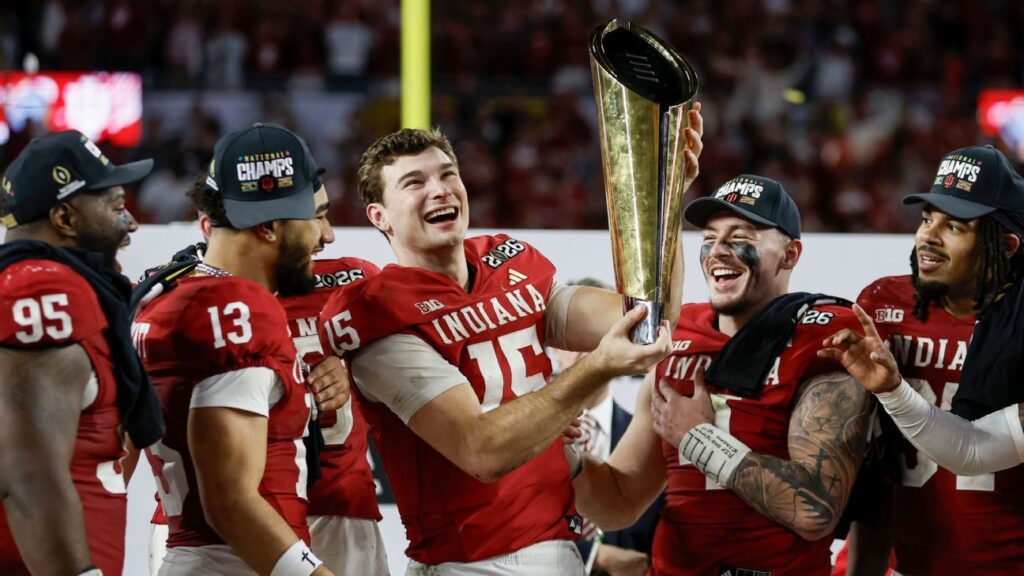
On Monday evening, Indiana triumphed over Miami in the College Football Playoff National Championship, marking a staggering transformation in sports history.
Just a few months ago, during the fall, the Hoosiers were recognized as the all-time losingest program in Division I college football. They had never achieved a double-digit win season—getting close only a handful of times. For the majority of its history, Indiana football was noted as one of the sport’s least successful teams, that is, until the arrival of Curt Cignetti.
Appointed at the end of the 2023 season, Cignetti quickly revamped the Hoosiers. Indiana surged to an 11-2 record in his debut season, and in Year 2, dispelling any notions of it being a one-time fluke, they completed an undefeated national championship campaign—the first team to finish a season 16-0 since Yale in 1894.
The Hoosiers’ success quickly raised a lofty question: Is this the greatest story in sports history?
A definitive response seems elusive. yet, we began to consider which other teams might stand alongside the 2025 Indiana squad in the annals of unlikely champions.
so, we solicited our experts’ opinions on the most Hoosier-like championship teams across major sports, spanning those that overcame enormous preseason odds to those that ended century-long title droughts and more.
Here are some of our experts’ suggestions for Indiana’s companions in the Hall of Fame for all-time sports championship stories (keeping in mind that some sports lack a clear counterpart):


How improbable was Leicester City’s journey to the Premier League title a decade ago? Well, one English bookmaker listed Leicester at 5000-1 odds to win it—comparable to the odds for Elvis Presley being found alive and Barack Obama playing cricket for England.
Fans of college football are likely familiar with the “haves vs. have-nots” dynamic in soccer, where parity is an uncommon term. It’s fair to say that few Premier League teams possessed less talent than Leicester during the 2015-16 season, just two seasons after being in the second tier of English soccer and coming off a 14th-place finish. As former Leicester player Christian Fuchs told ESPN: “Why should freaking Leicester win the Premier League? It doesn’t make sense.”
It helped that some superstars were obscured in plain sight: striker Jamie Vardy, future World Cup-winning French midfielder N’Golo Kanté, and winger Riyad Mahrez. The players also exhibited remarkable health. But perhaps most significantly, all of the Big Six clubs had off-seasons. Everything had to align perfectly, which made it improbable.
A group of underdogs that transformed the game en route to a title no one foresaw? There’s nothing more Hoosier than that. — Nicholas Som

Expansion teams aren’t usually predicted to succeed immediately. Yet, the Vegas Golden Knights proved otherwise by reaching the Stanley Cup Final in 2018 in their inaugural season. Some franchises have labored for decades to reach a Cup Final, while an expansion team in a “nontraditional market” achieved it in its debut year.
The key difference between Indiana football and the Golden Knights lies in their history. At times, Indiana was the third-ranked football program in its state but experienced a remarkable turnaround in two years that reshaped its future. Meanwhile, the Golden Knights, established only five years before claiming the Stanley Cup in 2023, have upheld a win-at-all-costs mentality that has made them a continual championship contender. — Ryan S. Clark


The case for: 1966 Texas Western … or 2021 Baylor
Two notable examples come to mind in men’s college basketball, one with a short timeline and another representing a long-term transformation.
Before Don Haskins took charge at UTEP—then known as Texas Western—in 1961, the men’s basketball team had never reached the NCAA tournament. They had never won more than 15 games in a single season. The Miners improved to 18-6 in Haskins’ first season, then made their NCAA tournament debut in his second (1962-63) and again in his third (1963-64). finally, in his fifth season (1965-66), Texas Western captured the national championship, defeating the No. 1-ranked Kentucky in the championship game.
As the first team to secure the national title with five Black players in the starting lineup, the 1966 Texas Western squad became the inspiration for the book and Disney film, “Glory Road.”
In a longer rebuild, Scott Drew undertook what is arguably the toughest reclamation project in recent college sports history at Baylor. Before Drew’s arrival in 2003, Baylor had been the third least successful power conference program over the past 53 years, making just one NCAA tournament appearance in that duration.
The program was also reeling from a major scandal. Following the murder of Patrick Dennehy by teammate Carlton Dotson during a dispute in June 2003, then-head coach Dave Bliss attempted to frame Dennehy amid an NCAA investigation into player payments, suggesting Dennehy was dealing drugs to fund his tuition. Major violations committed by Bliss were later revealed, resulting in a 10-year show-cause penalty for him, alongside significant sanctions against the program.
After a ban on nonconference play in 2005-06, Drew led Baylor back to the NCAA tournament just two seasons later—its first appearance in two decades. The Bears have since participated in 12 of the last 16 tournaments, culminating in a national championship triumph in 2021. — Jeff Borzello

At that time, it was considered the pinnacle of professional sports: a Chicago Cubs World Series championship. Decades passed without a title, leading to a 108-year championship drought—the longest in American professional sports history—between the team’s 1906 World Series win and their 2016 triumph. Similar to Indiana football’s timeline, the Cubs were a last-place team just two seasons prior to their championship. Yet by the start of 2016, the Cubs emerged as one of the favorites to win the World Series.
Nevertheless, previous Cubs teams had faced immense pressure under high expectations, and this title was not easily won. Trailing 3-1 in the series, the Cubs eventually claimed victory in seven games, albeit after relinquishing a late lead in the final match. A rain delay following nine innings heightened the suspense, which concluded in the Cubs’ favor just one inning later. The most elusive championship in professional sports history ultimately became a reality. — Jesse Rogers


The case for: the 1999 St. Louis Rams … or a New York Jets squad to be named later?
It seems unlikely that any NFL team could mirror the Hoosiers’ turnaround, given that NFL teams generally haven’t had the same extent of a losing history as Indiana football faced prior to 2024. One of the most enduring and unsuccessful NFL franchises prior to 1999 was the Rams, making them a close comparison. The Rams had won titles in 1945 (as the Cleveland Rams) and in 1951 (in Los Angeles against the Cleveland Browns), but they never won a Super Bowl until ’99, when Kurt Warner—akin to Curt Cignetti—transformed the team and became a national sensation. The Rams had a losing record across the nine seasons leading up to Warner’s Super Bowl run, amassing a woeful record of 45-99 (.313). Even among poor football franchises, that statistic stands out.
Interestingly, the league may be witnessing the genesis of the most Indiana-like turnaround in NFL history. The Jets have endured a 15-year playoff drought without any relief in sight. If and when a coach (Aaron Glenn? Or someone else?) successfully rejuvenates the Jets in a single season, there could be an argument made that they represent the NFL’s version of the Indiana football team. Of course, this hinges on that turnaround occurring swiftly. — Ben Solak

The case for: the 2003 Detroit Shock
What do Indiana head football coach Curt Cignetti and former “Bad Boy” Detroit Pistons center Bill Laimbeer share in common? The answer can be found in a 2003 WNBA team: the Detroit Shock. (And no, Cignetti doesn’t harbor a hidden career as a basketball coach.) Just like Cignetti and the Hoosiers, Laimbeer transformed the Shock from a losing team into a championship contender.
The Shock started the 2002 season at 0-10, leading to the dismissal of coach Greg Williams. Laimbeer took the reins and concluded the season with a 9-23 record. Ahead of his second season, Laimbeer confidently predicted that his 2003 squad would “win the championship next season.” Remarkably, he was correct. The Shock finished the 2003 regular season with an impressive 25-9 record and went 6-2 in the playoffs, ultimately overpowering the Los Angeles Sparks to clinch the title. Dare we say, Laimbeer indeed shocked the basketball realm as a head coach? — Charlotte Gibson