










-

Ryan O’Hanlon
Multiple Authors
As the UEFA Champions League playoff round commences this week, only one Premier League club will be in action. Newcastle United heads to Baku on Wednesday to face the reigning Azerbaijani champions, Qarabag FK.
For most, reaching the playoff stage is already an achievement. Both the defending champions from Eredivisie and Serie A failed to qualify for the playoffs, having been eliminated from the league phase, along with two teams from LaLiga, another Dutch club, a German club, and a French club. The finalists of last year’s Champions League, Inter Milan and Paris Saint-Germain, did not perform well enough in the league phase to advance directly to the round of 16, meaning they, along with Real Madrid, Atlético Madrid, Borussia Dortmund, and Juventus, are now in the playoffs.
The main goal of the league phase is to avoid elimination—unless you’re a Premier League team.
Arsenal topped the league phase of the Champions League, winning all eight matches. Liverpool finished in third, Tottenham Hotspur fourth, Chelsea sixth, and Manchester City eighth. to sum up, the origins of the eight clubs that advanced to the round of 16 are as follows:
• Germany: 1
• Spain: 1
• Portugal: 1
• England: 5
Even more noteworthy: four of the five Premier League teams in the top eight averaged more points per game in the Champions League than in their domestic league. Liverpool is sixth in England but third in Europe. Tottenham recently dismissed their manager, sits five points above the relegation zone in England, and managed to finish fourth in a tournament that ostensibly includes the best clubs worldwide.
It almost appears that the Champions League is easier for English teams than for those in the Premier League—and the reasons for this are clear. Here are the five key factors.
– Premier League superlatives: 25 best/worst players at different skills
– Which clubs sign the best players for each position and why?
– Premier League’s 50 worst transfers of all time: Who is No. 1?
1. Premier League teams are wealthier than most Champions League teams
A couple of weeks back, Deloitte published their Money League, ranking the 30 highest-earning soccer clubs globally. Here’s the distribution of clubs by country:
• Portugal: 1
• France: 1
• Turkey: 2
• Spain: 3
• Italy: 4
• Germany: 4
• England: 15
The Premier League boasts the most lucrative broadcasting deals—by a significant margin—and has also distributed those revenues more equitably from top to bottom compared to any other Big Five league in Europe, resulting in the statistics mentioned above.
While revenue doesn’t always correlate to success—West Ham United is ranked 20th in the Money League, for instance—over time, wealthier teams tend to perform better for obvious reasons.
2. Premier League teams possess more talent than most Champions League teams
Though reliable wage data can be elusive, studies indicate that estimated squad transfer values from Transfermarkt serve as a solid measure of how much teams invest in their players. How much a team pays its players is also a reasonable indicator of how talented those players are.
The top 25 teams in estimated market value are distributed across global soccer leagues as follows:
• France: 1
• Portugal: 2
• Italy: 3
• Spain: 3
• Germany: 3
• England: 13
As highlighted in my previous article discussing this season’s Premier League parity:
“According to an analysis by Futi’s John Muller, the Big Six employed 29% of Transfermarkt’s estimated 300 most valuable players globally during the 2014-15 season, with just 7% on other English teams, and 64% elsewhere in Europe. Fast forward a decade, and the Big Six’s share of the world’s elite players remains at 29%, while the rest of the Premier League’s hold on top talent has nearly tripled to 18%.“
The majority of the best soccer players worldwide are currently competing in the Premier League—many of whom are not involved in the Champions League.
3. Premier League teams excel compared to most teams in the Champions League
The Club Elo ratings provide historical data dating back to the 1920s, based on a straightforward record: when two teams compete, rating points are given or taken away based on match location and final result.
Current Elo rankings align closely with Transfermarkt evaluations—even if the rankings focus solely on outcomes and ignore player salaries or perceived talent. The ranking of the top 25 clubs by league is as follows:
• France: 1
• Portugal: 2
• Spain: 3
• Germany: 3
• Italy: 4
• England: 12
While Elo is a retrospective model, we can also consult betting markets to project team performance moving forward. Financially dependent analysts continually assess how a soccer team measures up against others, and the site PitchRank cross-references weekly betting odds to gauge prevailing beliefs about team strength.
Bayer Leverkusen is seeded eighth among the 16 Champions League playoff squads—roughly average. According to PitchRank, 11 Premier League teams are rated higher than Leverkusen. If we take Benfica, the lowest-seeded team left in the Champions League, there are 16 Premier League clubs rated better.
In a hypothetical 36-team competition comprising the best clubs globally—regardless of league affiliation—almost half could originate from the Premier League.
4. Premier League teams have less challenging schedules than others in the Champions League
Using Club Elo ratings as a general measure of strength, here’s how Premier League clubs stack up against other Champions League participants:
• Arsenal: 1st
• Manchester City: 2nd
• Liverpool: 5th
• Chelsea: 8th
• Newcastle: 10th
• Tottenham: 16th
As per UEFA regulations, teams from the same nation cannot face off during the league phase of the Champions League. so, Tottenham cannot face five of the top 10 teams in the tournament. Opta’s strength-of-schedule metrics indicate that Spurs faced the easiest draw of any team, while Liverpool had the fourth easiest, Chelsea the fifth, and Manchester City the seventh.
This doesn’t imply that Premier League teams are immune to tough draws—Arsenal’s schedule was about average in difficulty, whereas Newcastle had one of the five hardest—but it does suggest that, on average, Premier League teams enjoy easier draws than clubs from other top leagues.
Of course, a circular argument exists concerning league-strength discussions: Premier League teams have easier schedules! But they have easier schedules partly because they don’t compete against one another!
This explains why the top-eight stats stand out: Premier League teams are already significantly stronger than teams from any other league, and Premier League clubs in the Champions League generally have easier matches than their counterparts in different leagues.
5. The Premier League is more physically demanding than the Champions League
Before Newcastle’s final league-phase match with PSG, Anthony Gordon discussed the differences between playing in the Premier League and the Champions League.
“In the Champions League, teams tend to be more open,” he mentioned. “They all try to play. It’s less transitional. The Premier League has become more physical than I’ve ever seen it. It resembles a basketball game at times. It is so relentless physically. There’s not much control; it’s a running game. Victory comes down to who wins the duels.”
“The Champions League feels more traditional. It’s a football-centric game. Teams aim to engage in proper football. In the Premier League, you see a surge of throw-ins and set pieces. It’s become slower and increasingly reliant on set pieces.”
Several evidence-based methods support this observation. The first involves examining the number of long throw-ins per game across both the Champions League and the Premier League over the past two seasons.
Last season, the average Premier League match had 1.22 long throw-ins, which aligns closely with the Champions League figures of approximately 1.23 per game. But in the Premier League this season, teams are averaging a remarkable 3.59 long throw-ins per game—a significant year-over-year increase.
likewise, a recent analysis on the set piece revolution in England found that Premier League teams are now launching 45% of their throw-ins from attacking areas into the box, compared to an average of just 17% over the previous four seasons.
A greater emphasis on aerial duels further illustrates this trend—essentially, as Gordon described, the competition for balls in the air. When he mentions teams in Europe “trying to play football,” he refers to their attempts to move the ball upfield through passing sequences. This year in the Premier League, most actions on the field revolve around who wins the aerial challenges—or who capitalizes on another player winning such challenges.
Totaling 110 aerial challenges per game this season, English teams have seen a significant spike from last season’s average of 86.6 and are far ahead of the Champions League average of 77.3 per game.
in fact, four teams in the Champions League league phase recorded a set piece expected goal differential of plus-2 or better, and all were from the Premier League. importantly, all six Premier League teams ranked in the top 10 for set piece effectiveness:
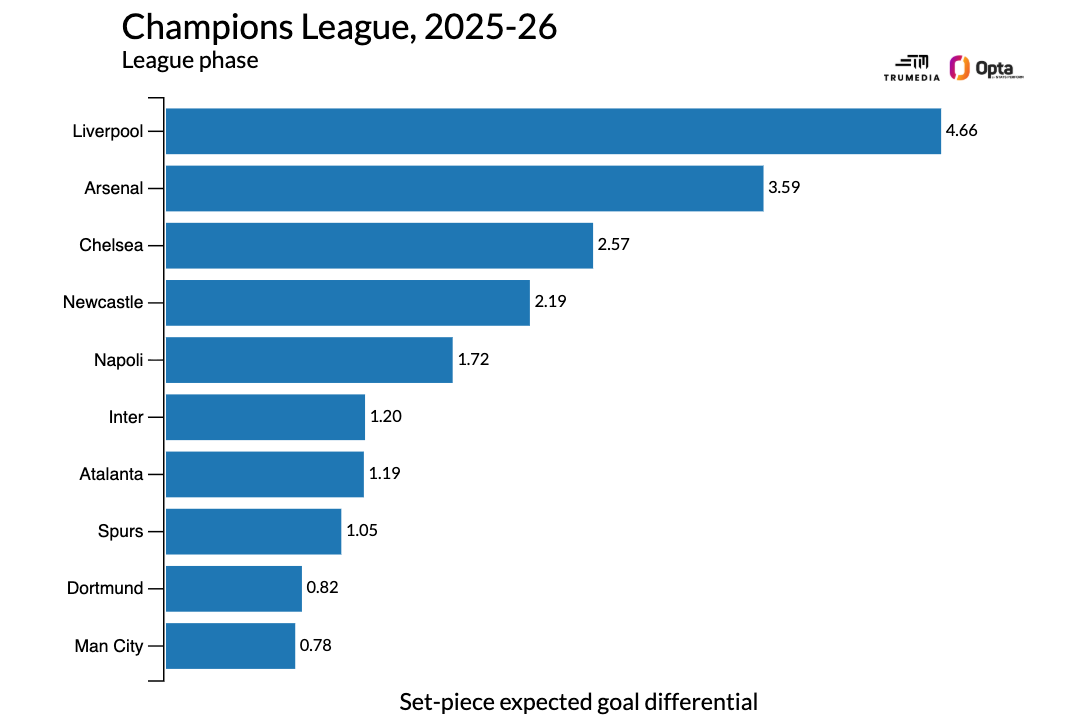
Perhaps no greater illustration exists of the differences between the Premier League and the Champions League than the team that clinched the Premier League title last season.
As displayed above, Liverpool showcased a strong set piece performance in the Champions League league phase. Conversely, their effectiveness in the Premier League was noticeably lacking:
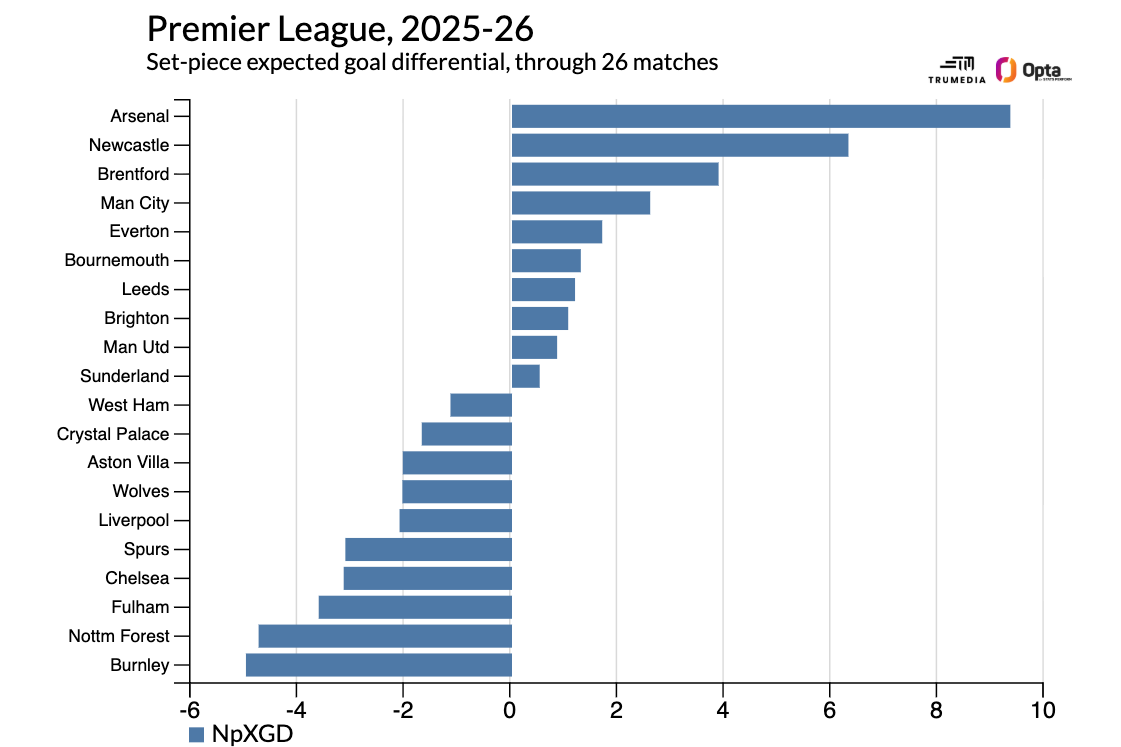
In simpler terms, Liverpool led the Champions League with a plus-8 goal differential from set pieces, whereas they ranked second-to-last in the Premier League with a minus-6 goal differential. This demonstrates their ability to dominate less physical European opponents using set pieces while also executing the style of play referred to by Gordon. In England, they’re hitting 86.3% of their passes outside the attacking third, but in Europe, that number surges to 90%.
The financial and tactical dynamics of global soccer have converged, magnifying the existing gap between the top clubs in Europe’s elite leagues.
While it was once accurate to say that Premier League teams were more physically demanding than those in other leagues, other leagues had their own technical, tactical, and skill-based advantages. Now, however, Premier League teams are leveraging the most valuable strategic advantage (set pieces) far more aggressively than their global counterparts, their players are significantly more physical, and their finances allow them to have players who are equally as skilled, if not more so, than athletes in any other league. Combine this with the league-based rule that restricts them from facing each other, and it’s clear why five Premier League teams can automatically qualify for the Round of 16.
As for the lone team facing playoff challenges? Reflecting on the set piece chart from the Champions League, where Newcastle ranked fourth behind Liverpool, Arsenal, and Chelsea, it’s notable that Qarabag sits at the very bottom.
You can predict what will transpire over their next two matches—it will likely mirror what unfolded during the first eight.