








-

Jake Michaels
Multiple Authors
MELBOURNE, Australia — Carlos Alcaraz. Jannik Sinner. Alexander Zverev. Novak Djokovic. This marks the first time since 2013 that the top four men’s seeds have advanced to the semifinals of the Australian Open.
Historic moments are on the horizon at Melbourne Park. Alcaraz aims to become the youngest male to achieve a career Grand Slam, while Sinner hopes for a rare three-peat in Australia. Zverev is chasing his first major title, and Djokovic is targeting a record-extending 25th Grand Slam victory.
Here’s a breakdown of why each semifinalist has a chance to lift the trophy:
Carlos Alcaraz (No. 1 seed)
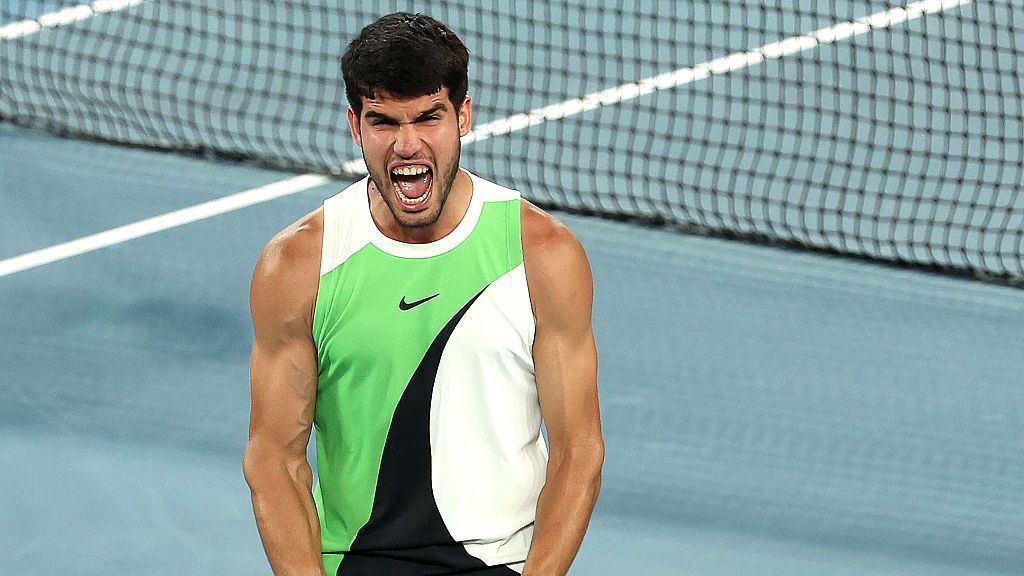
Alcaraz has been on an impressive run in tennis over the past 18 months, claiming Grand Slam titles and reclaiming the esteemed No. 1 rank. His consistent high-level performance has been evident throughout the past 11 days in Melbourne.
This marks Alcaraz’s first appearance in the Australian Open semifinals during his still-nascent career, having smoothly sailed through all 15 sets played. He has delivered strong performances under pressure, winning an outstanding 76% of points when serving at crucial moments (30-30 or 40-40).
What may be most concerning for his opponents is his improved serve, a previously noted weakness. Alcaraz has adopted elements from Djokovic’s serving strategy, focusing more on accuracy than sheer velocity.
“He may not serve the fastest, but his serves are incredibly accurate and very hard to read,” Alcaraz remarked about Djokovic’s serve earlier in the tournament. “It often lands right near the lines, creating a challenging dynamic once the ball hits the court. Sometimes it’s about precision over speed.”
In this year’s Australian Open, Alcaraz has improved his first serve percentage to 66%, up two points from last year. His second serve win rate has also seen a rise from 56% to 60%. though these may seem like minor adjustments, they complicate the game for Sinner, Zverev, and Djokovic, especially given Alcaraz’s already formidable skills.
If he clinches the Australian Open title on Sunday evening, Alcaraz will make history as the youngest player ever to achieve a career Grand Slam—winning at all four major tournaments. His drive to rewrite history shouldn’t be underestimated.
Jannik Sinner (No. 2 seed)
It’s beginning to feel almost assured that Sinner will be competing in Sunday’s final. This isn’t simply due to facing 38-year-old Djokovic in the semifinals, but rather because of his consistent performances in recent Grand Slam matches.
Sinner has participated in the last five Grand Slam finals, emerging victorious in three. He has an impressive record of 32 wins in his last 33 matches on hard courts at Grand Slams, without a loss at Melbourne Park since 2023 when he was defeated in an intense five-set match against then-finalist Stefanos Tsitsipas.
even with a brief scare in the third round against unseeded American Eliot Spizzirri, Sinner has cruised through to the semifinals. His quarterfinal win over eighth-seeded Ben Shelton showcased his dominance, signaling to the others that they must bring extraordinary performances to challenge him.
With efficient serving and a low error rate, Sinner has maintained control during his matches, forcing opponents out of their comfort zones.
“We never underestimate our opponents,” Sinner commented after his win over Shelton. “I like to stay in the moment. I’m thrilled to be back in the semifinals here in Australia. This place holds a special meaning for me.”
As the clear favorite against Djokovic in the semifinals—a player he has bested in their last five encounters—Sinner also remains confident having not dropped a set against Djokovic in their last three matches. A final clash with either Alcaraz or Zverev, two players he recently defeated in the ATP Finals, may be on the horizon.
Alexander Zverev (No. 3 seed)
Zverev has been on the verge of clinching his first Grand Slam title for a significant time; is this the year he finally accomplishes that goal?
The world No. 3 is well-acquainted with the atmosphere of late-stage major matches and won’t feel out of place stepping onto Rod Laver Arena for his 10th Grand Slam semifinal. He has reached the finals on three occasions, including last year in Melbourne.
Continuing to show a strong form, Zverev has progressed through each match with a display of disciplined tennis and minimal unforced errors, particularly evident in his quarterfinal win against rising star Learner Tien.
Much of Zverev’s success relies heavily on his mighty serve. Throughout the tournament, he has registered 80 aces, with only six double faults, and achieved a remarkable 92% success rate in his service games, winning 77% of points on his first serve.
“I’m feeling healthy and pain-free for the first time in ages,” Zverev stated after his quarterfinal match. “While I’m still pursuing that longed-for Slam, my focus is on enjoying playing tennis.”
Zverev faces both good and bad news ahead of his semifinal matchup. Unfortunately, he must go up against the top-seeded Alcaraz. Conversely, he boasts a solid winning record against him, with both players having won six matches each in their previous 12 meetings, and they stand at 1-1 in their last 18 months. This provides Zverev with the confidence to upset Alcaraz and make his way to a second consecutive Australian Open final.
Novak Djokovic (No. 4 seed)
No player in tennis history is more adept at winning Grand Slam titles than Djokovic, particularly at the Australian Open, where he has secured an impressive ten championships.
Within the last 16 years at Melbourne Park, he’s lost just six matches and maintains an astounding 20-2 record in semifinals and finals. even with not having secured a Grand Slam trophy since 2023, Djokovic remains a formidable contender, even at 38 years old. With only two matches separating him from another title, he shouldn’t be underestimated.
This tournament has also seen some fortune favor Djokovic. He didn’t encounter any top-70 ranked players in the initial rounds, benefitting from a walkover in the fourth round when Czech player Jakub Mensik withdrew due to an abdominal injury. At one point, Djokovic was facing a potential exit while trailing Lorenzo Musetti by two sets, but Musetti’s injury retirement allowed Djokovic to advance to the semifinals for the 13th time.
This fortunate twist might be what he needs to secure his 25th major title, intending to surpass Margaret Court’s record for most singles Grand Slam championships.
“When I’m healthy and all the elements align, I feel I can compete with anyone,” Djokovic noted before the tournament commenced. “My main focus is on taking care of my body, building momentum, and conserving energy. Last year, I ran low on energy during crucial points of the tournament.”
Djokovic has spent the least amount of time on court among the semifinalists, totaling just nine hours and seven minutes, while Alcaraz, Sinner, and Zverev have each accumulated over eleven hours playing time to reach this stage.
Interestingly, there seems to be minimal pressure on Djokovic. Sinner stands as a strong favorite for their semifinal, expected to win with ease. but, facing Djokovic in Australia is never straightforward. He remains a threat, even when underestimated.