









-
Tim Bontemps
Close
Tim Bontemps
ESPN Senior Writer
-
Tim Bontemps serves as a senior NBA writer for ESPN.com, analyzing both the on-court action and off-court developments affecting the league, including trade insights, expansion discussions, and his MVP Straw Polls. Tim appears on The Hoop Collective podcast alongside Brian Windhorst and Tim MacMahon.
-
Brian Windhorst
Close
Brian Windhorst
ESPN Senior Writer
- ESPN.com NBA writer since 2010
- Covered the Cleveland Cavs for seven years
- Author of two books
While the Trae Young trade from last week marked the initial transaction of this NBA season, Thursday was a key date on the league’s timeline. On this day, most players became eligible for trades, with notable exceptions like Bradley Beal and LeBron James, who possess no-trade clauses.
The NBA’s frantic three-week countdown to the Feb. 5 trade deadline has commenced, with team executives busy making calls, exploring trade scenarios, and calculating salary cap implications. but, many contenders are still weighing their options.
This week’s exploration across The Association highlights teams looking to enhance their rosters, those opting to offload players, and the most crucial of all — those still contemplating their next moves.
Jump to a team:
Bucks | Warriors | Raptors
Wolves | Grizzlies | Mavericks
Nets | Hawks | Lakers | Celtics

Which teams will look to add at the deadline?
What we’re monitoring: Their aggressive pursuit of support for Giannis
According to NBA executives polled by ESPN, the Bucks are widely anticipated to be significant players at the trade deadline. General manager Jon Horst and his team are known for their innovative asset management and ongoing pursuit of talent to enhance the roster around two-time MVP Giannis Antetokounmpo.
“Milwaukee still has a first-round pick to trade, and they’re currently $14 million under the luxury tax,” an Eastern Conference executive noted. “I’ve seen teams work wonders with less.”
The Bucks exhibit a remarkable gap of 21 points per 100 possessions when Antetokounmpo is on the floor — an advantage comparable to that between the Oklahoma City Thunder and the Sacramento Kings. That’s why the Bucks are optimistic about a strong playoff showing in a competitive Eastern Conference.
although the team’s recent challenges, including a lopsided loss to a short-handed Timberwolves squad, during which even the home crowd booed, the consensus remains that Milwaukee is more inclined to add talent rather than consider trading away their franchise’s finest player.
What we’re watching: The conclusion of the Jonathan Kuminga situation
The ongoing saga surrounding Kuminga appears to be reaching a resolution after lasting almost as long as his four-season career. His $22.5 million contract this season, featuring a $24 million team option for 2026-27, was designed to facilitate a trade, yet the front office faces hurdles: Being just $264,000 under the second apron means they cannot absorb further salary in a Kuminga deal.
“At one point, it was uncertain what it would take to secure [Kuminga], and now there’s clarity for the next season,” a Western Conference executive mentioned. “The downside is that neither the team nor the player has effectively increased his value.” The Warriors also possess four tradable first-round picks.
“It’s no secret they plan to be aggressive with the picks while maximizing the Steph [Curry] window,” another executive commented, “but they need a target worthy of those assets.”
With potential contracts exceeding $100 million expiring this summer, involving Jimmy Butler III, Draymond Green, and Kuminga, the Warriors’ eight-game homestand may serve as a crucial indicator of their approach as the deadline approaches.
What we’re watching: Their pursuit of a star player
Post three consecutive missed playoffs, a sense of urgency looms in Toronto with new governor Edward Rogers poised to assume full control of the franchise later this year. The Raptors have been actively contacting other teams to assess the trade value of players like RJ Barrett and Immanuel Quickley, multiple sources revealed to ESPN.
According to ESPN’s Shams Charania, Toronto is interested in the Mavericks’ Anthony Davis and the Grizzlies’ Ja Morant. While other teams may hesitate to absorb long-term contracts, the Raptors could swap their own contracts for those players, facilitating a deal.
Toronto commands all of its first- and second-round picks for the next seven years. Notable factors include the franchise being a rare taxpayer and currently sitting about $1 million into the tax, and possessing long-term financial commitments that could deter trade partners.
“Toronto will need to incentivize meaningful offers with draft capital,” one Eastern executive stated. “They must be cautious to avoid crossing the second apron next year with their current roster.”
What we’re watching: Their ongoing search for a point guard
For months, rival teams have suspected the Wolves are interested in acquiring a point guard. Coach Chris Finch has frequently opted not to utilize a traditional point guard, relying instead on off guards Donte DiVincenzo and Anthony Edwards for playmaking duties.
This strategy has resulted in the league’s No. 6 offense, primarily due to strong health among Minnesota’s core players and remarkable offensive seasons from Edwards and Julius Randle. but, trading into the lottery for point guard Rob Dillingham suggested expectations for him to mature into a key player alongside Edwards in their backcourt.
Instead, Bones Hyland — another former draft selection of Timberwolves president of basketball operations Tim Connelly from his Nuggets tenure — has been getting more playing time.
Still, it’s understood that the front office is eager to acquire guard talent while simultaneously cutting costs, as multiple league executives indicate. (The Wolves face a looming $24 million luxury tax bill after ownership spent over $90 million in tax last year.)
but, with no first-round picks available for trade, making significant roster changes would necessitate moving on from a pivotal rotation player — a challenge shared by many teams, leading several executives to predict that minor trades will dominate this deadline.
Which teams will look to subtract?
What we’re watching: The Anthony Davis saga and its implications for the summer
though several rival executives cite the appeal of acquiring Davis for playoff eligibility, numerous sources believe that Dallas would be better off waiting until summer.
“This should allow them to take a step back and see how things unfold,” commented an Eastern Conference executive.
Part of the trade discussions surrounding Davis stems from the Mavericks’ projected payroll and luxury tax figure of nearly $400 million for the 2026-27 season, a total that no one expects them to fulfill.
Yet Dallas has indicated it will entertain calls leading up to the deadline and might find alternative ways to reduce future expenses beyond a potential Davis trade.
This would enable the Mavericks to finalize their front office structure before determining their direction regarding both Davis and Kyrie Irving as they build around Cooper Flagg.
What we’re watching: The trade market surrounding Ja Morant
Last week, reports of Memphis entertaining a Morant trade created buzz similar to the early discussions concerning Trae Young trades.
As with Young, interest in Morant appears tepid.
The Miami Heat, in particular, have been overstated as a possible landing spot, sources indicate. The Heat are focused on avoiding additional salary commitments for the 2027-28 offseason, a year during which superstars like Antetokounmpo, Nikola Jokic, and Donovan Mitchell may become unrestricted free agents.
It’s unlikely the Heat would deviate from this plan to pursue Morant, according to various sources.
After the Hawks initiated potential Young trade talks, only the Wizards exhibited sincere interest, insiders revealed.
Will Morant attract more interest, given his availability concerns and his contract obligations exceeding $80 million over the next two years? A few sources foresee limited market activity, with Milwaukee surfacing as a potential player.
What we’re watching: Decisions regarding Michael Porter Jr.
The primary trade asset among tanking teams this year appears to be in Brooklyn. At 6-foot-10, Porter has enjoyed an impressive season since his acquisition from the Nuggets this summer, alongside an unprotected first-round pick from Denver, in exchange for Cameron Johnson.
Porter’s contract stands at $38.3 million this season and $40.8 million next season, representing a significant figure to match in any potential deal. although his successful stint in Brooklyn, his injury history—including three back surgeries—has diminished his trade value since moving from Denver, and his role won’t match this season’s usage if he transitions to a contender. because of this, Brooklyn may struggle to garner substantial returns in a trade.
The Nets do have $15 million in cap space, the most in the league. This space could be utilized as a resource for teams needing to offload a contract while facilitating another deal. also, they hold a strong portfolio of draft assets, including 13 first-round picks and 19 second-round picks over the next seven years, and are active in seeking to accumulate more through trades ahead of Feb. 5.
Which teams are still contemplating?
What we’re watching: Following up on the Trae Young deal?
The Hawks achieved a key objective by trading Young and his $50 million player option for next season. Nevertheless, team insiders suggest they still aspire for a successful season.
Atlanta holds $42 million in expiring contracts with Kristaps Porzingis and Luke Kennard, alongside a $13 million trade exception and four tradable first-round picks — though interested teams should not count on securing the unprotected swap rights the Hawks possess with the Pelicans or Bucks in the upcoming draft. Their financial situation is also relatively uncluttered, with only Jalen Johnson projected to earn over $25 million next season.
This is why Atlanta has been linked to discussions involving Davis, but the front office places significant value on its young core, likely aiming to draft another high-impact player with their upcoming pick swap.
What we’re watching: A trade deadline conundrum in L.A.
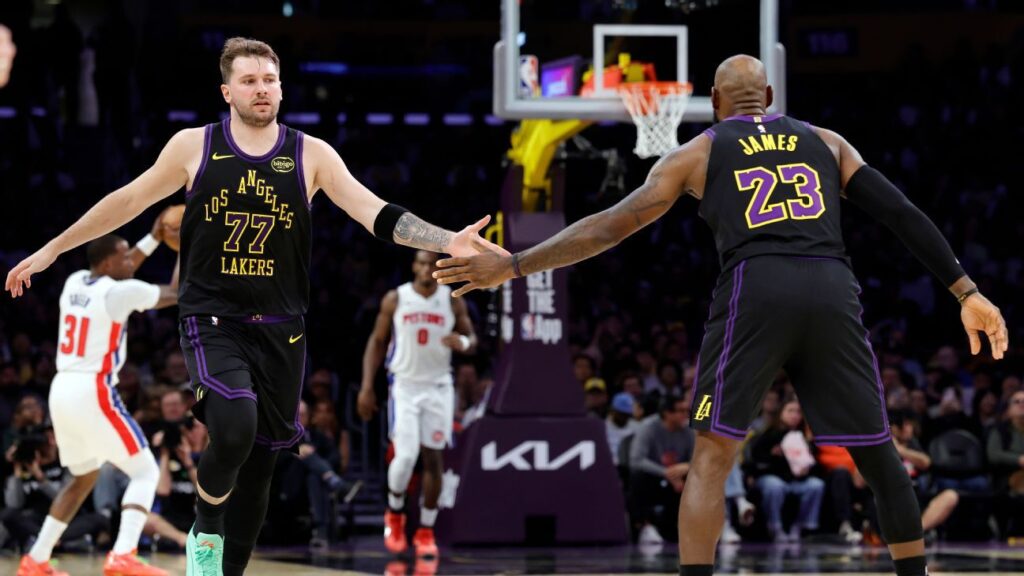
The Lakers have initiated conversations to obtain perimeter support and rim protection, as reported by league sources. With expiring contracts from Rui Hachimura, Gabe Vincent, and Maxi Kleber totaling approximately $40 million, the front office possesses assets for trades.
but, the Lakers are navigating across two timelines. They aim to maximize LeBron James’ final years, but trading expiring contracts for short-term enhancements could hinder their plans for reshaping the roster around Luka Doncic. Should James depart or retire post-season, the Lakers could retain Austin Reaves and possess up to $50 million in cap space.
Currently, the Lakers have one tradable first-round pick and can swap up to five additional picks, but they are just $1.1 million beneath the first apron and cannot exceed that threshold, limiting their ability to take on short-term salary. If they delay until July, they will have three tradable first-round picks, cap space, and salary flexibility.
“They’ll likely pursue budget-friendly opportunities and may discover a good fit if they’re open to acquiring long-term contracts,” remarked a general manager from the West. “but, they must ensure the player suits Luka’s style to rationalize the move.”
What we’re watching: Two paths for the surprising contender
When last season concluded, the Celtics faced the prospect of becoming a $500 million team. although some decisions, like not retaining Luke Kornet and Al Horford and trading away Jrue Holiday and Porzingis, they find themselves roughly $12 million over the luxury tax.
Initially, opposing teams speculated that the Celtics would aim to shed some salary and reset their repeater clock while Jayson Tatum recuperates from an Achilles injury. but, their current standing—tied for second place in the East—has complicated that outlook.
This brings about a pivotal question for the Celtics: Should they focus on escaping the luxury tax, or could they utilize Anfernee Simons’ $27 million expiring contract to add a player with long-term potential?
The solution likely lies somewhere between the two extremes. Celtics president of basketball operations Brad Stevens has a history of making deadline trades aimed at enhancing the roster—whether incrementally or as insurance for depth, such as last year’s acquisition of Mike Muscala and this year’s addition of Xavier Tillman.