









-

Kevin Seifert
When a single NFL playoff game commands widespread attention, officiating decisions become highly scrutinized. Add the intensity of overtime to the mix, and you have the heated discussions that arose after the Denver Broncos’ 33-30 victory over the Buffalo Bills in Saturday’s divisional round.
The game’s outcome hinged on three critical calls in overtime: one was an unusual interception that halted a Bills possession, another involved a pass interference penalty against Bills cornerback Tre’Davious White, and the last was on Taron Johnson. These two penalties accounted for 47 yards on the Broncos’ game-winning drive. Longtime observers of Broncos coach Sean Payton noted the coincidental nature of the two pass interference flags, especially since he missed a chance to advance to Super Bowl LIII in 2019 due to a missed pass interference call while coaching the New Orleans Saints in the NFC Championship Game.
Let’s delve deeper into the specific situations from Saturday night’s game.

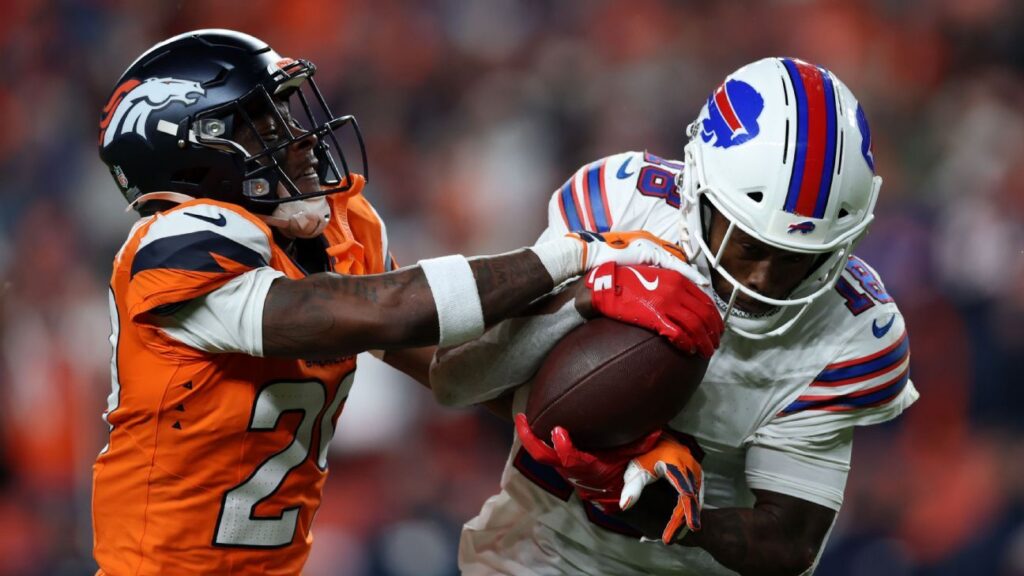
The situation: The Bills were positioned at their 36-yard line, facing third down, needing 11 yards. Quarterback Josh Allen launched a deep pass towards receiver Brandin Cooks, with Broncos cornerback Ja’Quan McMillian covering. Cooks made a leaping catch, but the ball quickly shifted from his grip to McMillian’s just after Cooks landed.
The call: Referee Carl Cheffers’ crew ruled it an interception.
Analysis: mainly, Cheffers’ crew concluded that Cooks failed to maintain possession of the ball before it was taken by McMillian. Since the ball did not touch the ground, it remained live at that moment.
According to the NFL rulebook, Cooks needed to fulfill three criteria to establish possession for a catch. First, he had to exhibit complete control of the ball through his hands or arms, which he did. Next, he had to be in bounds, which he clearly was. Lastly, he needed to execute an additional act common to the game or maintain control of the ball sufficiently to perform one.
also, the rulebook states: “If a player meets the first two criteria but fails to satisfy the third for possession, and then loses control of the ball after contacting the ground, possession is deemed not achieved.”
Video footage reveals that indeed, the ball switched from Cooks to McMillian when Cooks hit the ground. for that reason, Cooks did not satisfy the NFL’s definition of possession. McMillian did; he had control of the ball, was in bounds, and maintained control as he rolled over Cooks.
The quote: “I struggle to understand why the call was made the way it was,” said Bills coach Sean McDermott.
The situation: The Broncos had possession at their 47-yard line, needing 10 yards on second down. Quarterback Bo Nix threw a 17-yard pass toward receiver Courtland Sutton at the sideline, with Johnson providing coverage. The ball fell incomplete.
The call: Johnson was flagged for pass interference.
Analysis: The NFL rulebook defines pass interference as “any action by a player more than one yard beyond the line of scrimmage that significantly impedes an eligible player’s opportunity to catch the ball.” Specific actions that qualify are also outlined, one of which seems applicable to Johnson in this instance.
Players cannot “grab an opponent’s arms in a manner that restricts his chance to catch a pass.” Slow-motion replays indicate that Johnson briefly grabbed Sutton’s right arm, a point Cheffers acknowledged in a subsequent pool report.
but, despite the instances highlighted in the rulebook, pass interference is often subjective. When does contact genuinely impede an opportunity?
The Bills typically excel in refraining from penalties, having tied for the fewest defensive pass interference penalties in the NFL this season (only four). In this particular case, one might argue that Johnson’s interaction did not seem substantial. While these calls can be tough to discern in real time, a reasonable observer watching a replay might conclude that Johnson’s contact was not a factor in the incompletion.
The situation: The Broncos were on the Bills’ 38-yard line, facing second-and-12. Nix sent a pass downfield to receiver Marvin Mims Jr., who was covered by White. The ball was incomplete.
The call: Cheffers’ crew flagged White for defensive pass interference, resulting in a 30-yard spot foul that positioned the Broncos for a short, game-winning field goal.
Analysis: Following the previous call, Nix sought another penalty just two plays later. This time, White’s contact seemed more pronounced. He grabbed Mims around the waist and started to pull him down before the ball arrived. It is irrelevant whether Mims would have caught the pass without the contact; White’s actions prevented Mims from having the opportunity defined by the rules to make the catch.