








-

Dan Graziano
Multiple Authors
As we enter NFL contract extension season, it’s time to anticipate where significant deals might land.
Will wide receivers Puka Nacua and Jaxon Smith-Njigba surpass Ja’Marr Chase’s number? Can running backs Bijan Robinson and Jahmyr Gibbs breach the $20 million-per-year threshold? What steps should the Texans and Panthers take regarding quarterbacks C.J. Stroud and Bryce Young? And will Jerry Jones consider paying Brandon Aubrey a kicker’s top dollar? Market dynamics—team budgets and an ever-growing salary cap—play a role, but we can also make educated guesses about player demands and team responses.
Many of these cases are interrelated, so we’re highlighting a few teams facing interesting extension decisions. While there are numerous situations not discussed here, we chose five teams whose upcoming extension challenges and potential effects merit further exploration.
Jump to:
ATL | DAL | DET | HOU | LAR


The key extension candidates: RB Jahmyr Gibbs, LB Jack Campbell, TE Sam LaPorta, S Brian Branch
One issue with the Lions’ recent drafting success is the impending decisions on which players to retain. In the last year, the Lions struck extensions with Aidan Hutchinson, Jameson Williams, and Kerby Joseph—three stars from the 2022 draft class. This year, they face similar decisions with four stars from their 2023 class.
Is it feasible to extend them all? Absolutely, but contract structuring will be crucial. Hutchinson’s deal includes year-to-year option bonuses that keep his cap hits manageable, anticipating these other deals. For example, Hutchinson’s extension averages $45 million annually, yet his 2026 cap hit is just $10.15 million, rising to $21.74 million in 2027.
To keep these players, the Lions have the flexibility to incorporate void years into contracts and spread out cap hits for future years. Gibbs and Campbell, both first-round picks, come with fifth-year options for 2027, implying that LaPorta and Branch may take precedence this offseason since the Lions can prolong Gibbs’ and Campbell’s free agency longer.
A beneficial aspect for the Lions is that none of the four players occupy high-value positions like quarterback, wide receiver, or edge rusher, which command exorbitant salaries. Running back, tight end, and safety tend to have lower franchise and transition tag values—only kickers and punters rank lower. While the linebacker tag is relatively high, this is due to other positions being included. The upper echelon for Campbell’s middle linebacker role resembles Fred Warner’s $21 million per year.
Campbell likely holds some leverage as the Lions would want to avoid a franchise tag exceeding $28 million next year. It seems plausible they’ll manage his extension prior to Gibbs, but after assessing LaPorta and Branch, who lack those fifth-year options. Campbell had an impressive 89 tackles and 5 sacks last season, suggesting a settlement near similar deals for players like Nick Bolton and Jamien Sherwood, each earning about $15 million yearly. He may aim for Zack Baun’s average of $17 million per year.
LaPorta, despite facing a season-ending back injury, has recorded 20 TDs over 42 games. It’s improbable he reaches the tight end market’s summit, sitting around $19 million per year with names like George Kittle and Trey McBride. He’s more likely to align with T.J. Hockenson’s $17.5 million per year.
Branch, also recovering from a torn Achilles, is a crucial, versatile defensive component with 29 pass breakups in three seasons. His target is likely around $20 million annually, especially since fellow safety Kerby Joseph’s recent extension averages $21.25 million. Joseph’s deal is heavily backloaded, allowing the Lions to exit after 2026 after two years totaling about $24 million. Branch will undoubtedly desire a robust upfront structure.
The Lions wield significant leverage over LaPorta and Branch with the possibility of franchise tagging one (likely at a manageable cost) in 2027. They can leverage negotiations differently based on who signs first, giving them strategic options.
Then there’s Gibbs, the dynamic running back taken 12th overall in 2023. He’s averaged 5.3 yards per carry with 13 touchdowns annually. Saquon Barkley’s post-Super Bowl extension with the Eagles landed him at $20.6 million per year, setting a benchmark for top-tier running backs. Gibbs will aim to exceed Barkley’s number, while the Lions may seek to keep his figure below $20 million. The outcome could hinge on which party holds out longer in negotiations.
Again, the Lions have been creative with contract structures in the past, so it may depend on Gibbs’ openness to novel arrangements. Spirits are high in Detroit, so it seems likely they will finalize all these agreements with low signing guarantees and structures enhancing future-year guarantees. This aligns with their recent strategies.
Predictions
-
Gibbs: Four years, $80 million with $30 million guaranteed at signing
-
Campbell: Three years, $51 million with $22 million guaranteed at signing
-
LaPorta: Four years, $68 million with $24 million guaranteed at signing
-
Branch: Three years, $66 million with $28 million guaranteed at signing

The key extension candidates: QB C.J. Stroud, OLB Will Anderson Jr.
Stroud, selected second overall in the 2023 draft and named Offensive Rookie of the Year, is eligible for an extension for the first time, as is Anderson, the third pick and Defensive Rookie of the Year. The Texans had a successful draft in 2023; now it’s time to pay up.
Anderson has consistently excelled, culminating in a notable performance during the Texans’ playoff loss to the Patriots, where he notched three sacks and forced two fumbles. Currently, the highest-paid edge rusher is Micah Parsons at $46.5 million per year, followed by Hutchinson at $45 million. Next are T.J. Watt at $41 million and Myles Garrett at $40 million.
Anderson will undoubtedly aim to exceed $40 million after an outstanding season with 12 sacks. Houston might hold firm here, noting that Garrett just set the single-season sack record. yet, under GM Nick Caserio, the Texans haven’t been overly aggressive with high-priced players, making a deal with Anderson quite plausible.
2:25
Warner to Eisen: C.J. Stroud has regressed since his rookie season
Kurt Warner joins Rich Eisen and expresses his concerns regarding Texans quarterback C.J. Stroud’s performance.
Stroud faces a unique situation. His subsequent seasons haven’t matched his rookie performance, and a playoff collapse has complicated his standing. Coupled with three missed games in 2025, he’s unlikely to command top quarterback money. Currently, the highest salary is Dak Prescott’s $60 million per year. If Stroud attempts to surpass that, the Texans may opt to trigger his 2027 fifth-year option and hold off on a new deal for now.
So where’s the compromise? Can Stroud hit over $50 million per year, which 11 quarterbacks currently receive? Can he achieve more than $55 million per year, currently shared by Joe Burrow, Josh Allen, Jordan Love, and Trevor Lawrence?
Stroud is slated for a $5.697 million payout in 2026, and his fifth-year option for 2027 is $26.53 million. This means the Texans have him under contract for two more years at just over $32 million (with franchising possible later). They could restructure his final years into a five-year, $250 million deal averaging $50 million, but financially, that equates to around $43.6 million in new money after considering his existing contract. This mirrors the Texans’ recent approach with cornerback Derek Stingley Jr., who signed an extension ahead of the fifth-year option deadline.
Stroud’s situation calls for close monitoring. Historically, the Texans have been generous with extensions, leading to expectations of securing a long-term agreement this offseason. yet, if this season raises any hesitations, or if Stroud’s requests are deemed too high, the situation could prolong.
It’s also essential to mention Carolina’s Bryce Young, the top overall pick in the 2023 draft. Young faced a rocky rookie campaign but has improved, potentially positioning himself as the more favorable candidate than Stroud right now. Both quarterbacks will closely observe each other’s extension discussions. plus, next year’s crop of eligible quarterbacks—Caleb Williams, Jayden Daniels, Drake Maye, and Bo Nix—will be watching, too.
Predictions
-
Stroud: Four years, $224 million with $110 million guaranteed at signing
-
Anderson: Four years, $176 million with $121 million guaranteed at signing

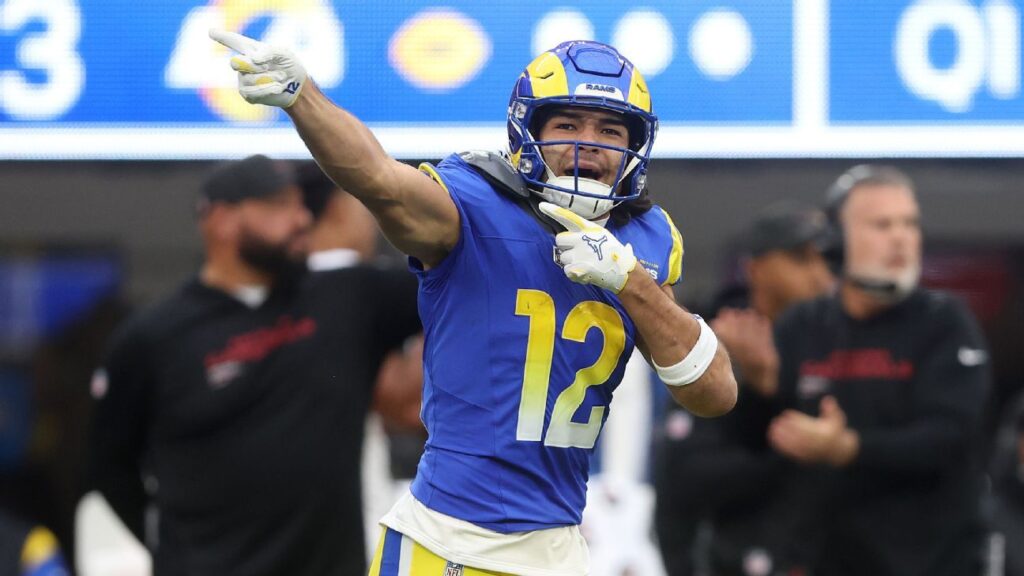
The key extension candidates: WR Puka Nacua, OLB Byron Young
Nacua and Young are both 2023 Rams draft picks, although neither was a first-round selection. because of this, the Rams lack fifth-year options for either player, making them both free agent eligible after the 2026 season.
Nacua and Seattle’s Jaxon Smith-Njigba each enjoyed breakout seasons, positioning them as potential market trendsetters. Ja’Marr Chase currently holds the title for the highest-paid wide receiver at $40.25 million per year, while Justin Jefferson follows at $35 million. This gives rise to two potential scenarios for Nacua and Smith-Njigba:
-
One or both could surpass Chase’s earnings, driving the market higher.
-
They might land somewhere between Jefferson and Chase, helping stabilize the market.
Nacua (129 catches, 1,715 yards, 10 TDs) and Smith-Njigba (119 catches, 1,793 yards, 10 TDs) are both exceptional players. yet, the influx of impactful wide receivers each draft cycle might compel teams to reconsider spending top-tier quarterback-level salaries on a wide receiver.
The Rams have other notable extension-eligible players this offseason beyond Nacua and Young, such as defensive tackle Kobie Turner and guard Steve Avila. Their situations may influence negotiations with Nacua and Young. and, the looming prospect of a franchise tag could be a critical factor here, as using it on either player will depend on the timing of their respective deals.
Young’s case might be further complicated due to the impending extensions of defensive talents Jared Verse and Braden Fiske from the 2024 draft. The Rams may need to make tough decisions about how to manage their emerging defensive cornerstones. Young, coming off a 12-sack season, has potential for an extension, but there’s a chance he might find himself on a different roster in the future. The Rams’ front office is highly competent and can retain their core players if they so choose, but salary cap limitations create a balancing act of resource distribution amongst various position groups.
Lastly, the Rams face another pressing matter with Matthew Stafford’s contract, considering his approaching 38th birthday means a quarterback transition is imminent.
1:19
Schefter expects Matthew Stafford will play next year
Adam Schefter discusses the future of Rams QB Matthew Stafford following their NFC Championship loss.
Predictions
-
Nacua: Four years, $156 million with $90 million guaranteed at signing
-
Young: Four years, $145 million with $72 million guaranteed at signing

The key extension candidates: RB Bijan Robinson, WR Drake London
If Gibbs aims to breach the $20 million-per-year threshold as a running back, Robinson has an equally compelling case. He boasts superior rushing yards, attempts, receiving yards, and receptions since their respective entries into the league. Both players are outstanding, and while preferences may differ, Robinson’s argument is particularly strong for a higher payday.
Will the Falcons allocate top-tier RB funds to Robinson? Not all teams wish to commit that level. As the eighth overall pick in the 2023 draft and the team’s best offensive player, Robinson may compel the Falcons to make an exception. yet, they must also consider extending London, who approaches his fifth-year option, alongside other key players like safety Jessie Bates III and offensive lineman Matthew Bergeron. Plus, tight end Kyle Pitts is also nearing free agency.
The Falcons’ organization now features a new head coach (Kevin Stefanski), a new president of football operations (Matt Ryan), and a new GM (Ian Cunningham), which could shift previous decision-making paradigms. even if Pitts, London, and Robinson were all high picks, their futures in Atlanta aren’t guaranteed. Pitts could face a franchise tag (likely near $16 million), delaying a long-term decision entirely. Quarterback Michael Penix Jr. will also be eligible for an extension soon, adding uncertainty.
Predicting extensions for Robinson and London is complex. Should the Falcons activate the fifth-year option, they will control Robinson for two more years at approximately $18 million, providing them the time to wait if he demands too much. instead, Robinson could pursue a shorter deal, allowing him to hit the open market again while still young (his 24th birthday is Friday).
London occasionally shines like a No. 1 wide receiver and, at 24 years old, has tremendous potential. yet, his performances have only led to over 72 catches once in four seasons, and the same applies for crossing the 1,000-yard threshold. These factors will weigh heavily in negotiations.
Predictions
-
Robinson: Three years, $60 million with $25 million guaranteed at signing
-
London: Four years, $120 million with $35 million guaranteed at signing

The key extension candidate: K Brandon Aubrey
To be transparent, players like linebacker DeMarvion Overshown are extension-eligible in Dallas, but the focus here is primarily on Aubrey’s intriguing case. He has emerged as a significant player in a position increasingly valued due to long-range kicks and crucial kickoff accuracy. plus, as a restricted free agent, the Cowboys possess substantial negotiation leverage.
If the Cowboys prefer not to extend Aubrey, a year-long restricted free agent tender is an option. Choices include a first-round tender (around $7.8 million), a second-round tender (around $5.7 million), or a right of first refusal tender (roughly $3.5 million). With a first-round tender, should another team sign Aubrey and the Cowboys choose not to match, that team would owe a first-round pick. in the same way, a second-round tender would result in a second-round pick owed if Aubrey is signed elsewhere. The least costly option wouldn’t require compensation at all.
Interestingly, the kicker franchise tag is projected around $6.7 million, potentially providing a less expensive option than a first-round tender. yet, Dallas may opt to reserve the franchise tag for wide receiver George Pickens if no extension is reached with him. This uncertainty presents the Cowboys with multiple avenues regarding Aubrey’s compensation.
It remains feasible that they might choose to make him the highest-paid kicker in the NFL. still, contract negotiations with the Cowboys often become intricate, and assuming a straightforward resolution would be unwise. I will provide a prediction, albeit tempered by the Cowboys’ significant leverage and their previous approach of utilizing it.
Prediction