








although my initial skepticism, I’m now sold on wireless Qi chargers that add integrated fans to keep your phone cool while charging. I figured they’d be too loud, or too weak, or too gimmicky, but I’m a convert after spending a week with the new $59.99 Kuxiu D5 Qi2.2 charging dock. Its active cooling system has kept my phone from heating up, unlike every other Qi charger I’ve tried. Good thing, given my own history with an overheating phone.
Last year I fried the logic board on my titanium iPhone 15 Pro. I was on a sweltering train and trying to edit a 4K video on my phone, which was charging from a magnetically attached Qi power bank. Oof, my iPhone is getting really hot, I thought, just as the screen went forever blank. The repair bill was €660.33 (over $750), for which I paid nothing because it was just inside the two-year warranty. Apple’s “genius” wouldn’t say if the phone overheated, but I’m not keen to tempt fate twice.
Heat is the enemy of batteries
Heat is the enemy of batteries. High temperatures accelerate the chemical degradation of lithium-ion cells, permanently reducing how much charge they can hold over time. The electromagnetic induction employed by Qi chargers is inherently inefficient, producing far more heat than transferring electricity through a cable plugged into your phone. That heat can cause phones to throttle the wireless charging speed in order to protect the battery.
although knowing this, I keep coming back to Qi charging docks and power banks because they’re so damn convenient. I’m also addicted to Apple’s StandBy feature that turns my phone into a desk or bedside clock and widget machine when docked and charging in landscape orientation.
Fortunately, companies like Anker, Aukey, ESR, and Kuxiu have started building active cooling systems directly into their Qi chargers. They feature tiny heat sinks and ultra-quiet internal fans that actively blow the heat away from the back of your phone while it charges. This keeps the battery significantly cooler and allows for faster charging speeds. Powerful magnets ensure perfect alignment between the phone’s receiver coil and the charger’s transmitter coil to maximize efficiency and minimize heat waste.


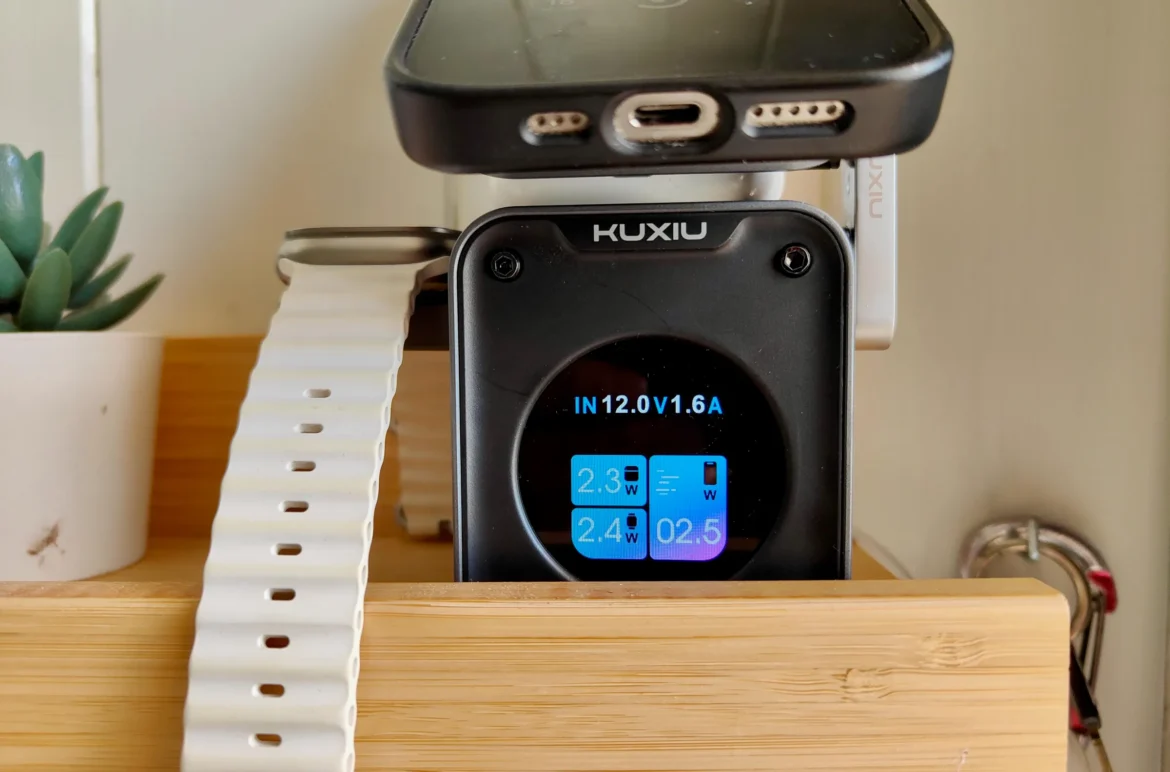
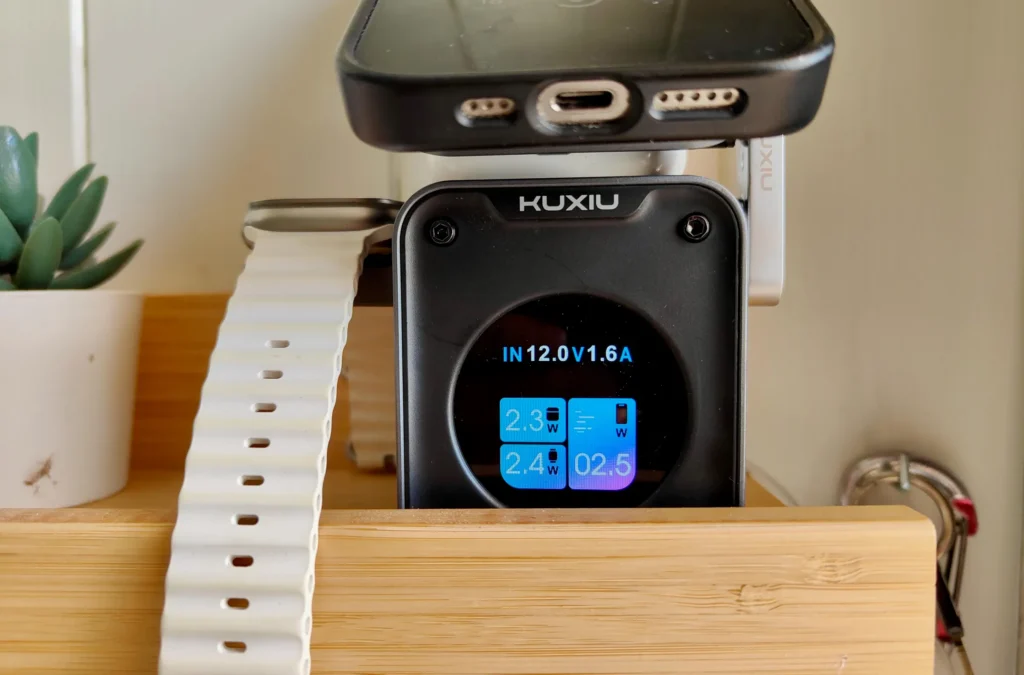
The fan inside the Kuxiu D5 operates silently, but it can still be turned off if you want. The display is useful, but the little winky-faced screensaver is not. I do like knowing the time and how much charge each device is pulling, in addition to the total power draw, but the animated movement is distracting when caught out of the corner of my eye. Fortunately, I can turn the display off with a tap of a button.
I like that the Kuxiu D5 ships with a 45W USB-C PD charger in the box. Otherwise, you’d have to guess if whatever charger you have lying around will support the dock’s max total output, which can deliver up to 25W to Qi2.2-compatible phones, 2.5W to Qi-compatible watches, and 5W to Qi-compatible earbuds. It’s compatible with several generations of phones, watches, and earbuds sold by Apple, Samsung, and others.
Kuxiu calls the D5 a “5-in-1” charger, which I find misleading since it’ll only charge up to three devices simultaneously. It seems to include the display and fan in its total. By that count, I’d be happier if this was a 4-in-1 device, since the added cost for the display won’t add much value for most people, and it can only cause issues down the road.
The watch charger is also a little silly in its over-engineering. A long-press on the dock’s sole button kicks off a tiny motor to slowly push the watch dock out the side. I guess it adds to the blocky dock’s durability when traveling, but not by much, and it can only be retracted when the dock is plugged into the wall.
1/7
Overall the Kuxiu D5 is a fine Qi2.2 charging dock made better by active cooling. It’s equally at home on a desktop or nightstand, and priced below similar docks from Anker, ESR, and others.
Active cooling on Qi chargers is a good idea whose time has come. Phones sold by Huawei, Xiaomi, and Oppo have supported wireless charging speeds of 50W and above for years. But that’s only possible when placed on proprietary charging docks capable of whisking away all the extra waste heat. Now the body responsible for Qi is working on a global 50W standard for release by 2028. Manufacturers will likely need to adopt active cooling to reliably sustain those higher charging rates.
Fine by me. Whatever it takes to keep that vital Qi life force flowing.
All photography by Thomas Ricker / The Verge
Source: www.theverge.com